

1.11 - Defining Continuity at a Point
Introduction
Earlier we used an informal definition of continuity (the pencil test). Now we’ll build a formal mathematical definition of what it means for a function to be continuous at a specific point.
Formal Definition of Continuity
A function is continuous at if and only if all three of these conditions hold:
Condition 1: is defined.
The function has to have a value at . In other words, has to be in the domain of .
Condition 2: exists.
The limit as approaches has to exist, which means both one-sided limits exist and are equal:
Condition 3: .
The limit value has to equal the function value. The function has to approach the same value it’s actually defined to be.
Important Note
If any one of these three conditions fails, the function is not continuous at .
Testing Continuity: Step by Step
When checking if a function is continuous at a point, go through each condition systematically.
Example 1: Piecewise Function, Not Continuous
Determine whether this function is continuous at :
Step 1: Find the left-hand limit.
(Use the first piece, since we’re approaching from the left where .)
Step 2: Find the right-hand limit.
(Use the second piece, since we’re approaching from the right where .)
Step 3: Compare the one-sided limits.
Since the one-sided limits aren’t equal, the limit does not exist.
Conclusion: The function is not continuous at .
Justification: Not continuous because . This violates Condition 2 (the limit must exist).
Example 2: Piecewise Function, Continuous
Determine whether this function is continuous at :
Step 1: Find the left-hand limit.
Step 2: Find the right-hand limit.
Step 3: Check that the limit exists.
So . Condition 2 is satisfied.
Step 4: Find .
Since satisfies , use the second piece:
So is defined. Condition 1 is satisfied.
Step 5: Compare the limit and the function value.
Condition 3 is satisfied.
Conclusion: The function is continuous at .
Justification: Continuous because and . All three conditions hold.
Jump Discontinuities Revisited
A jump discontinuity happens when both one-sided limits exist but aren’t equal.
Example 3: Identifying a Jump Discontinuity
Determine the type of discontinuity at :
Left piece:
Right piece:
The left-hand limit is and the right-hand limit is . Since , the function jumps from one value to the other.
Answer: Jump discontinuity at . The function jumps from to .
Example 4: Hole, Not a Jump
Determine the type of discontinuity at :
Left-hand limit:
Right-hand limit:
Function value:
Analysis:
Both one-sided limits equal , so exists.
But . The limit exists, but the function value doesn’t match it.
Answer: Hole (removable discontinuity) at .
Even though the limits from both sides agree, the function is defined at a different value, which creates a hole at the point with a separate point sitting at .
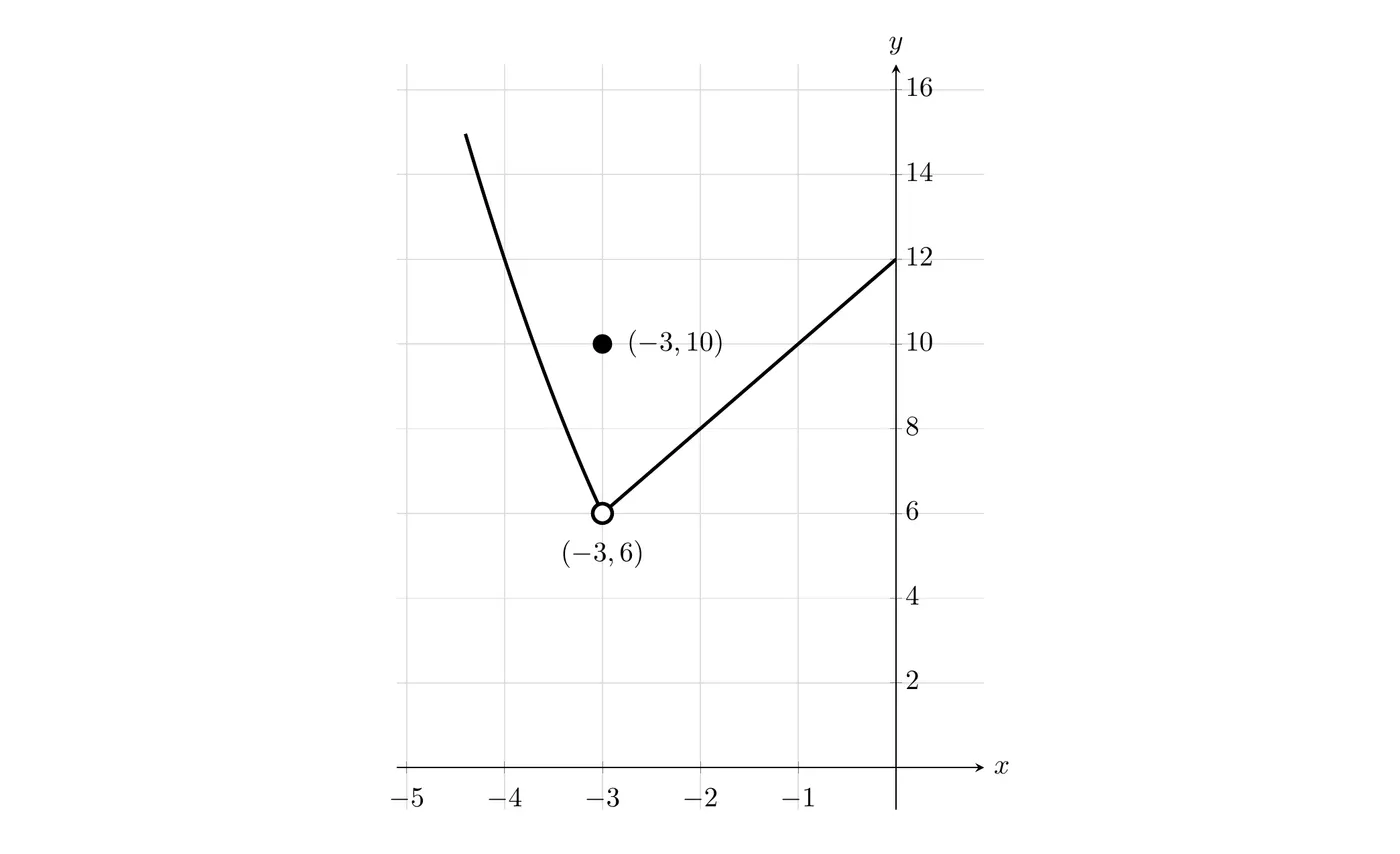
Important: Just because the two pieces agree with each other doesn’t automatically mean the function is continuous. You also have to check that the function is actually defined at that value, not just approaching it.
Finding Constants for Continuity
Sometimes you need to find an unknown constant that makes a function continuous.
Strategy
For a piecewise function to be continuous at the boundary point, the two pieces have to have the same value at that point.
Example 5: Finding an Unknown Constant
Find the value of that makes this function continuous at :
For continuity at , the two pieces have to be equal at .
Step 1: Set up the equation.
Step 2: Substitute .
Step 3: Solve for .
Answer:
Verification: When , the left side at gives , and the right side gives . They match.
Example 6: Two Unknown Constants
Find values of and that make this function continuous everywhere:
For continuity at , both pieces have to approach the value .
From the left:
For continuity, , so .
From the right:
For continuity, , so .
Answer: and
Practice Problems
Problem 1
Is continuous at ?
Answer:
Left:
Right:
Since , yes, it’s continuous at .
Problem 2
What type of discontinuity exists at ?
Answer:
Left:
Right:
Jump discontinuity (the function jumps from to ).
Problem 3
Find so that is continuous at .
Answer:
At :
Key Takeaways
- Three conditions all have to hold for continuity at a point
- Condition 1: is defined
- Condition 2: exists
- Condition 3:
- If any one condition fails, the function isn’t continuous
- Jump discontinuities happen when one-sided limits exist but don’t match
- A hole can exist even when both one-sided limits are equal, if the function value differs
- To find constants for continuity, set the two pieces equal at the boundary point
- Always justify your answer by saying which conditions are satisfied or violated
- Read the inequality symbols carefully () so you use the right piece