

1.8 - Determining Limits Using the Squeeze Theorem
Introduction
The Squeeze Theorem (also called the Sandwich Theorem or Pinching Theorem) is a tool for finding limits of functions that are hard to evaluate directly. The idea is intuitive: if a function is squeezed between two other functions that approach the same limit, the middle function has to approach that limit too.
The Statement
Suppose for all in some interval around (except possibly at itself).
If:
Then:
In words: if is trapped between and , and both of them approach the same limit as approaches , then has to approach as well.
Visual Understanding
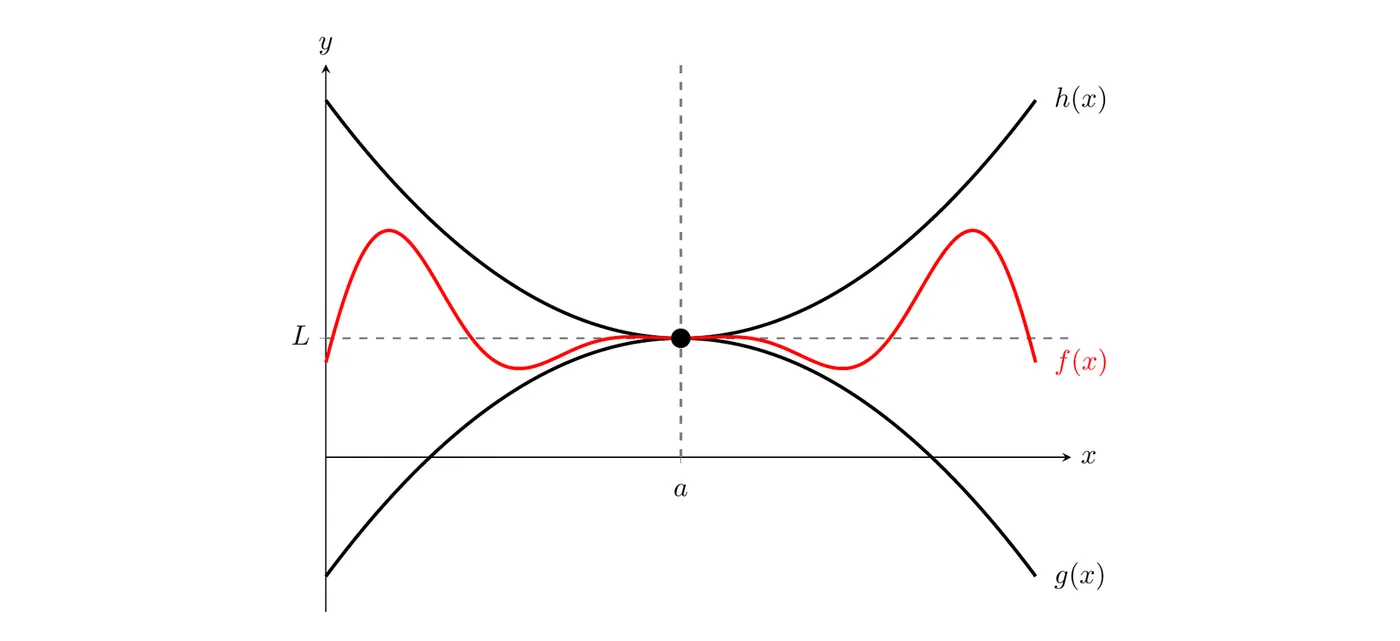
The function (middle curve) is squeezed between (bottom) and (top). Since both boundary functions approach the same value, has nowhere else to go.
Example 1: Using Trigonometric Bounds
Find .
Why is this hard? Direct substitution gives , which means dividing by zero inside the sine. Undefined.
Step 1: bound the sine function
For any input, sine is bounded:
This is true because sine always oscillates between and no matter what its argument is.
Step 2: multiply all parts by
Since for all , multiplying preserves the inequality:
Step 3: take limits of all three parts
Step 4: evaluate the boundary limits
Step 5: apply the Squeeze Theorem
Since both boundary limits equal :
Answer:
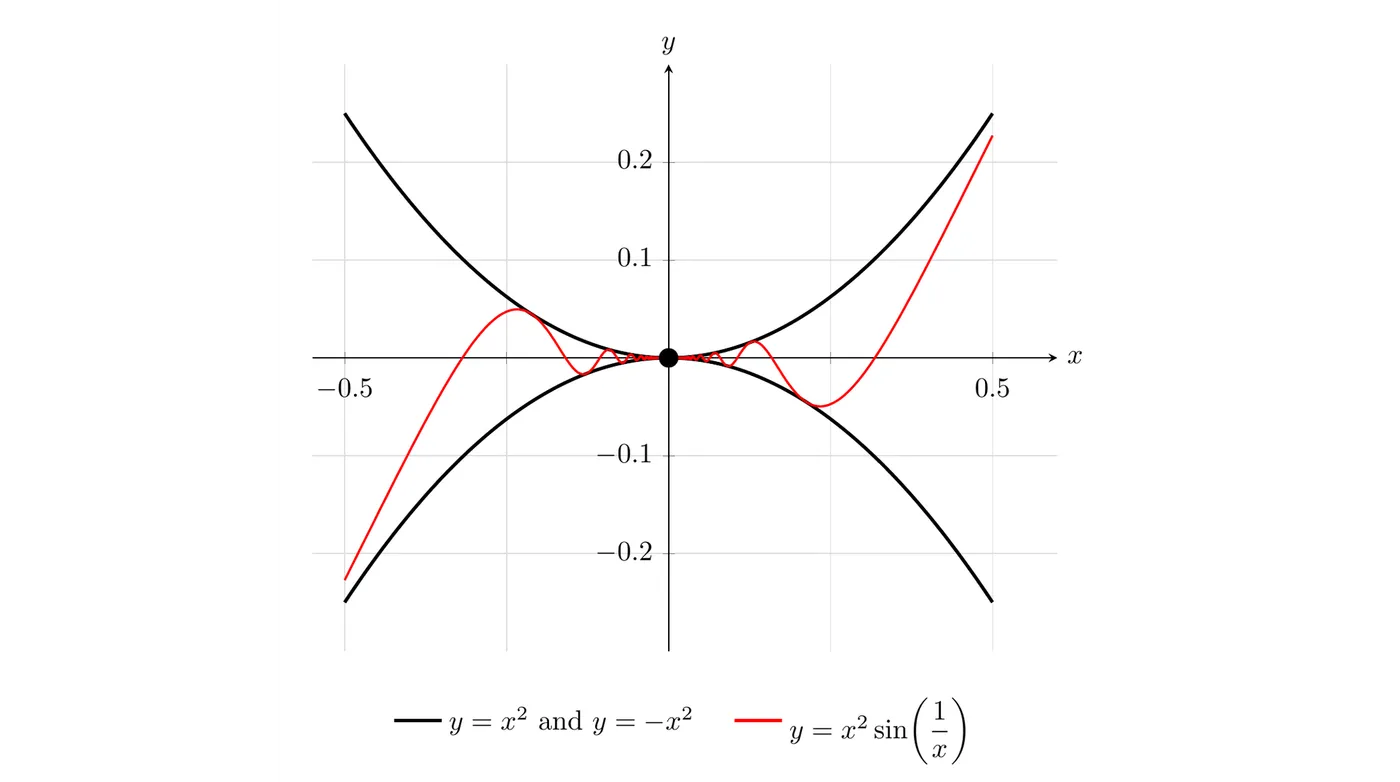
The function oscillates wildly near , but it’s trapped between and , both of which approach .
Example 2: When Limits Don’t Match
Given:
-
-
- for all
Find .
Step 1:
Step 2:
Step 3: since , the boundary functions approach different values.
The limit cannot be determined with the Squeeze Theorem. All we know is:
could approach any value in that range. Without more info about , we can’t pin it down.
Answer: cannot be determined
Example 3: When the Squeeze Theorem Works
Given:
-
-
- for in
Find .
Step 1:
Step 2:
Step 3: both boundary limits equal , so:
Justification: is squeezed between two functions that both approach as , so by the Squeeze Theorem, must also approach .
Answer:
Checklist for Using the Squeeze Theorem
To use it, you have to verify:
- Condition 1: on some interval containing
- Condition 2: (this limit exists)
- Condition 3: (the same value)
- Condition 4: both boundary functions are bounded near
If all four hold, then .
Practice: Can the Squeeze Theorem Be Applied?
Problem 1
Can we use the Squeeze Theorem to find ?
Since , the boundary functions approach different values.
No. The Squeeze Theorem doesn’t apply. The limit of could be anything between and .
Problem 2
Can we find ?
Both boundary limits equal .
Yes. The Squeeze Theorem applies, so .
Justification: since and both approach as , and is squeezed between them, must also approach .
Problem 3
Can we find ?
Both boundary limits equal .
Yes. The Squeeze Theorem applies, so .
Justification: is squeezed between two functions that both approach , so must approach too.
Important: Unbounded Functions
The Squeeze Theorem cannot be applied if either boundary function is unbounded near the point of interest.
Example of unbounded behavior
Consider .
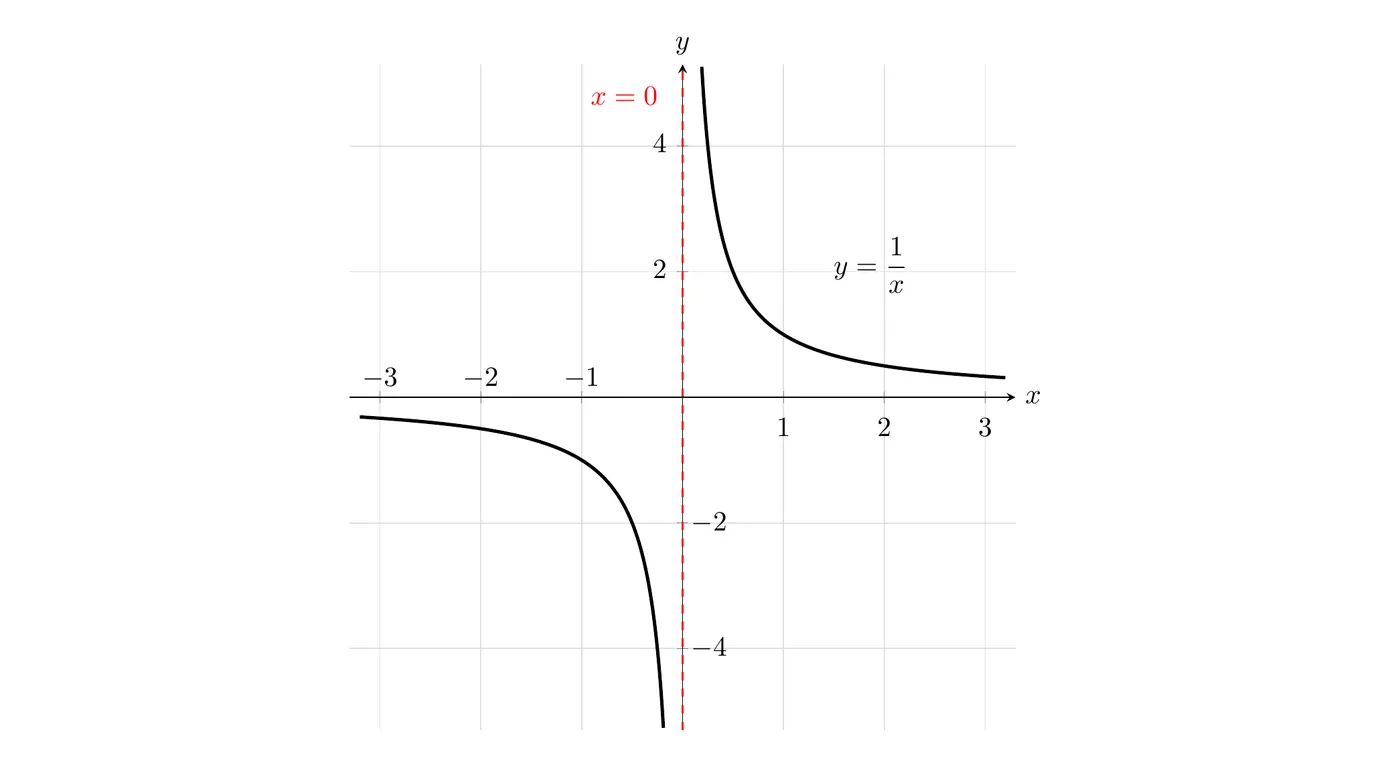
As :
- From the right,
- From the left,
That’s unbounded behavior, the function grows without bound.
Why it matters: if one of your boundary functions is unbounded (heads toward ), the Squeeze Theorem doesn’t apply, because there’s no finite value to squeeze toward.
Example: disqualified by unbounded behavior
Can we find ?
No. The Squeeze Theorem cannot be applied, because both boundary functions are unbounded. Even though they both “approach” the same thing (infinity), infinity is not a real number, and the theorem requires finite limits.
Common Applications
The Squeeze Theorem is especially useful for:
- Products of bounded and vanishing functions, like as
- Oscillating functions multiplied by functions approaching zero, like as
- Functions with irregular behavior near a point, when direct evaluation is impossible
- Proving the special trig limit from 1.6: for close to (but not equal to ), a geometry argument shows . Both bounds approach as , so the Squeeze Theorem gives .
Summary: When to Use It
Use the Squeeze Theorem when:
- You can’t evaluate the limit directly
- The function is bounded between two simpler functions
- Both boundary functions approach the same finite limit
- Neither boundary function is unbounded
Steps to apply:
1. Identify bounds: find and such that
2. Evaluate boundary limits: find and
3. Check if they’re equal: if both equal , then
4. State the conclusion by citing the Squeeze Theorem
Key Takeaways
- The Squeeze Theorem is your move when direct evaluation fails
- The middle function has to be trapped between two boundary functions
- Both boundary functions must approach the same limit
- If the boundary limits differ, you cannot determine the middle limit
- Unbounded behavior disqualifies the Squeeze Theorem
- It shows up a lot with trig functions that oscillate rapidly
- For sine and cosine, always remember
- Multiply inequalities by the same function to create your bounds
- Always justify by showing both boundary limits equal the same value