

1.10 - Rational Functions and Holes
Overview
A hole is a single missing point on a graph. It happens when a factor cancels out of a rational function: the function is undefined at that input, but the graph on both sides heads toward the same height. In this topic you'll use multiplicity to tell a hole from a vertical asymptote, and find the hole's exact location with a limit.
What a hole looks like
Take and factor the numerator:
For every input except 3, equals , so the graph is the line . But is undefined, so the point at is missing. We draw it as an open circle.
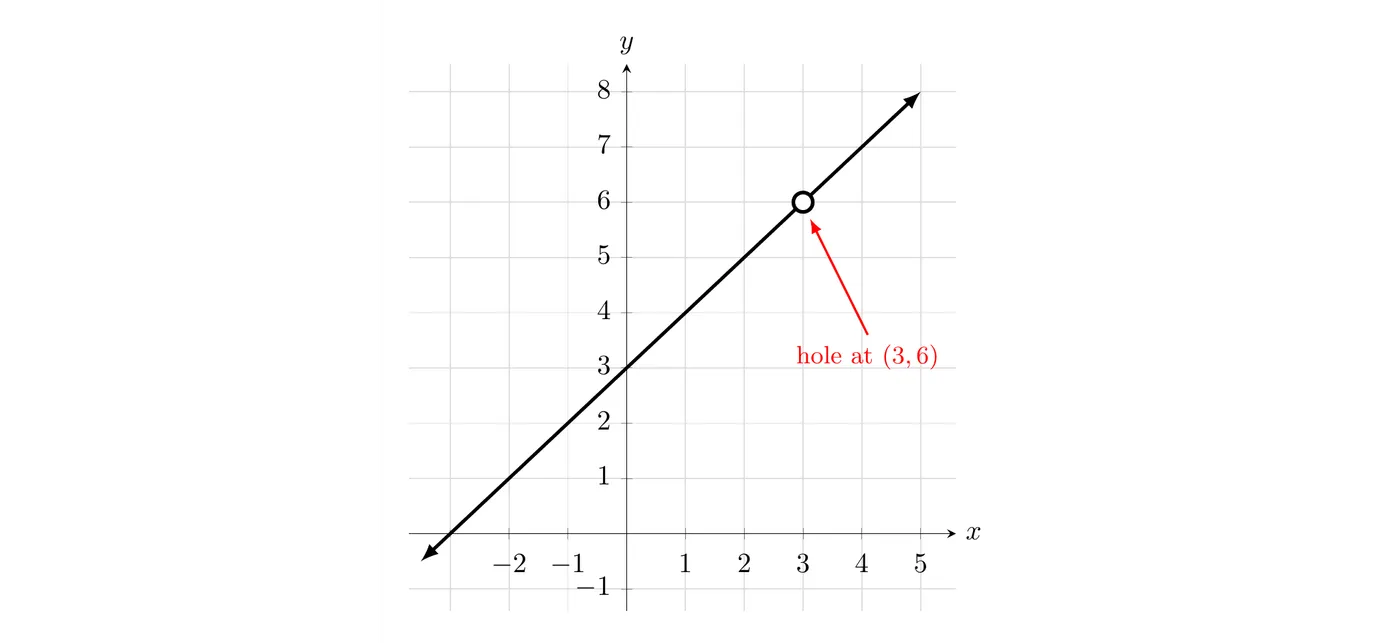
To find exactly where the hole is, look at the outputs near :
From both sides, the outputs get arbitrarily close to 6. So the hole is at .
When does a rational function have a hole?
Suppose is a real zero of both the numerator and the denominator. Compare its multiplicities:
Multiplicities at | Result | Example |
Numerator denominator | Hole at | has a hole at |
Denominator numerator | Vertical asymptote at (Topic 1.9) | has an asymptote at |
Here's why. When you cancel the common factors, the side with more copies of keeps the leftovers. If the numerator has at least as many copies, every copy cancels out of the denominator, and nothing is left there to make it 0. If the denominator has more, some copies are left over, and you get an asymptote.
Finding the location of a hole
If the graph of has a hole at , its -coordinate is the value the outputs approach as gets close to :
and the hole is at the point . The graph heads to the same height from both sides, so the one-sided limits agree:
In practice, find by canceling the common factors and plugging into what's left. That works because the simplified expression equals at every input near , and it's defined at . You can also estimate from a table or a graph, like the table above.
Holes on the x-axis
If the numerator has more copies of than the denominator, at least one is still in the numerator after canceling, so . The hole sits right on the -axis. Even so, is not a zero of , because is undefined (Topic 1.8).
Examples
Example 1: Full analysis
Find all holes, vertical asymptotes, zeros, and horizontal asymptotes of the graph of .
Step 1: Factor.
Step 2: Look at the zeros of the denominator. At , the factor appears once on top and once on the bottom, so the numerator's multiplicity is at least the denominator's: hole. At , the factor is only in the denominator: vertical asymptote.
Step 3: Locate the hole. Cancel and plug in 2.
Step 4: Find the zeros. The numerator is 0 at and , but 2 isn't in the domain. The only zero is .
Step 5: Find the horizontal asymptote. The degrees are equal (2 and 2), so (Topic 1.7).
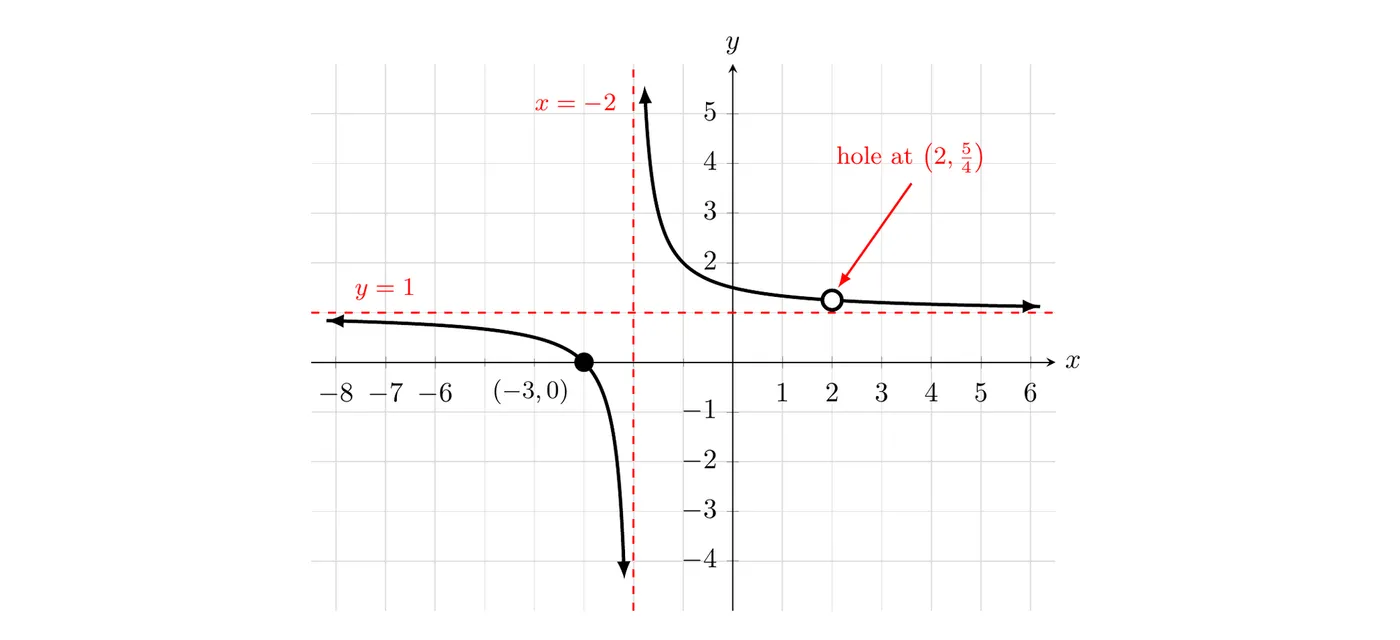
Answer:
- Hole at
- Vertical asymptote , with and
- Zero at
- Horizontal asymptote
Example 2: A hole on the x-axis
Find the hole in the graph of . Is a zero of ?
Step 1: Factor.
Step 2: At , the numerator has multiplicity 2 and the denominator has multiplicity 1. Since , there's a hole at .
Step 3: Cancel one factor of and plug in 1.
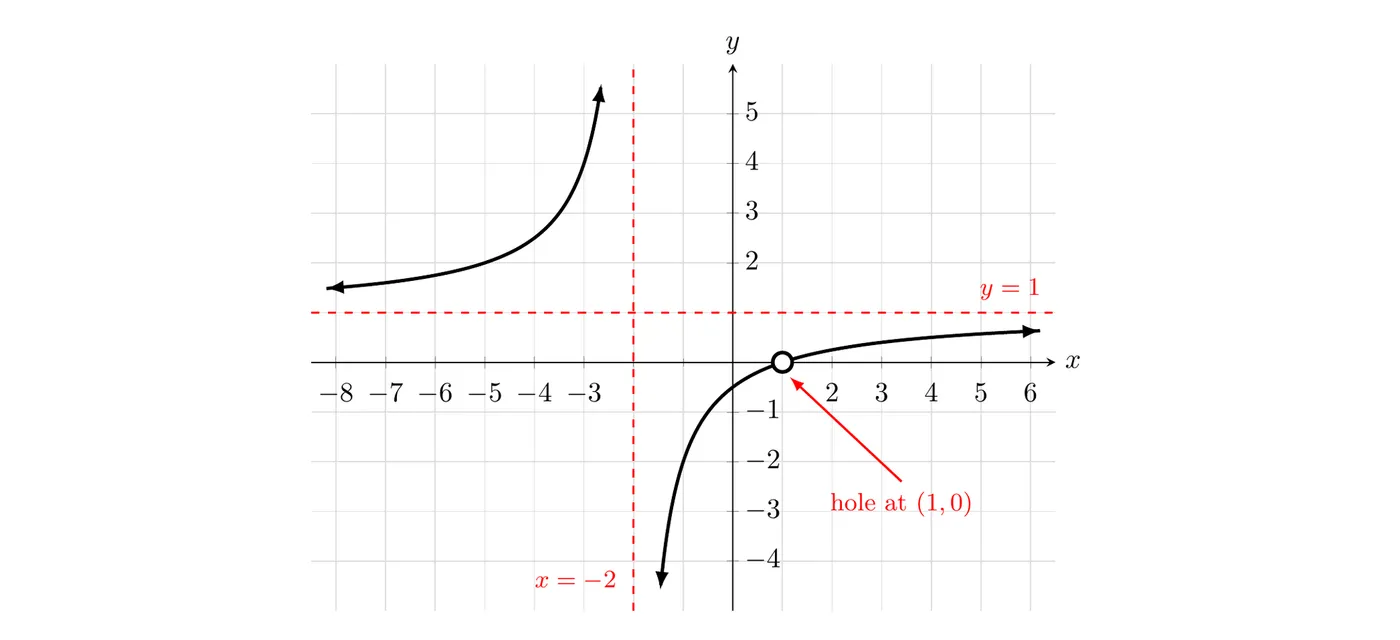
Answer: The hole is at , right on the -axis. But is not a zero, because is undefined. In fact has no real zeros at all: the numerator's only zero is 1, and 1 isn't in the domain. The graph also has a vertical asymptote at and a horizontal asymptote at .
Example 3: Find the error (AP-style)
A student says has zeros at and , because both make the numerator 0. Explain the student's error, and describe the graph of near .
Step 1: Factor: .
Step 2: also makes the denominator 0, so it isn't in the domain. It can't be a zero.
Step 3: The factor appears once on top and once on the bottom, so there's a hole at . Canceling gives for .
Answer: The student forgot to check the domain. Since is undefined, 2 is not a zero. Instead, the graph of is the line with a hole at . The only real zero is , because .
Example 4: Build a function (AP-style)
Write a rational function whose graph has a hole at , a vertical asymptote at , and a horizontal asymptote at .
Step 1: Turn each feature into a factor or a degree condition.
- Hole at : put in both the numerator and the denominator, the same number of times.
- Vertical asymptote at : put in the denominator only.
- Horizontal asymptote : make the denominator's degree greater than the numerator's.
Step 2: Try , where is a constant to be chosen. The numerator has degree 1 and the denominator has degree 2, so the horizontal asymptote is .
Step 3: Choose so the hole is at height 3.
Answer:
Other answers are possible, as long as they keep all three features.
Common mistakes
- Calling a hole a zero, even when the hole is on the -axis (Example 2).
- Giving only one coordinate of the hole. AP questions usually want the point , not just .
- Plugging the excluded input into the original function. You'll get . Cancel first, then plug in.
- Forgetting the excluded value after simplifying. and are not the same function: one is undefined at .
- Assuming every common factor gives a hole. If the denominator has more copies, it's a vertical asymptote.