

1.9 - Rational Functions and Vertical Asymptotes
Overview
A vertical asymptote is a vertical line that a graph shoots up or down along, because the denominator is getting close to 0 there. In this topic you'll find vertical asymptotes, use multiplicity to tell an asymptote from a hole, and describe what happens on each side with one-sided limits. On the AP exam you'll do this from equations, graphs, and tables.
Where vertical asymptotes come from
Dividing by a number close to 0 gives a huge result: and . So when the denominator of a rational function gets close to 0 and the numerator doesn't, the outputs blow up.
Rule: if is a real zero of the denominator but not a real zero of the numerator, the graph has a vertical asymptote at .
Look at near :
undefined |
The closer gets to 3, the bigger the outputs get in size. From the left they're hugely negative, and from the right they're hugely positive.
When the numerator and denominator share a zero
If makes both the numerator and the denominator 0, compare multiplicities, meaning how many times the factor appears in each:
- More copies in the denominator: vertical asymptote at . After canceling, a factor of is still left in the denominator.
- At least as many copies in the numerator: a hole at , not an asymptote (Topic 1.10).
For example, has one copy of on top and two on the bottom. Canceling leaves , so there's a vertical asymptote at .
One-sided limits
Near a vertical asymptote , the outputs increase or decrease without bound, and the direction can be different on each side. We describe each side with a one-sided limit:
Notation | Meaning |
the limit as approaches from the left (inputs less than ) | |
the limit as approaches from the right (inputs greater than ) |
At a vertical asymptote, each one-sided limit is or . For :
Finding the sign on each side
You don't need a calculator. Picture an input just to one side of and track only the sign of each factor. The factor that's going to 0 is tiny, and its sign depends on which side you're on. Every other factor is close to its value at , so its sign is easy to read.
Multiplicity tells you the pattern
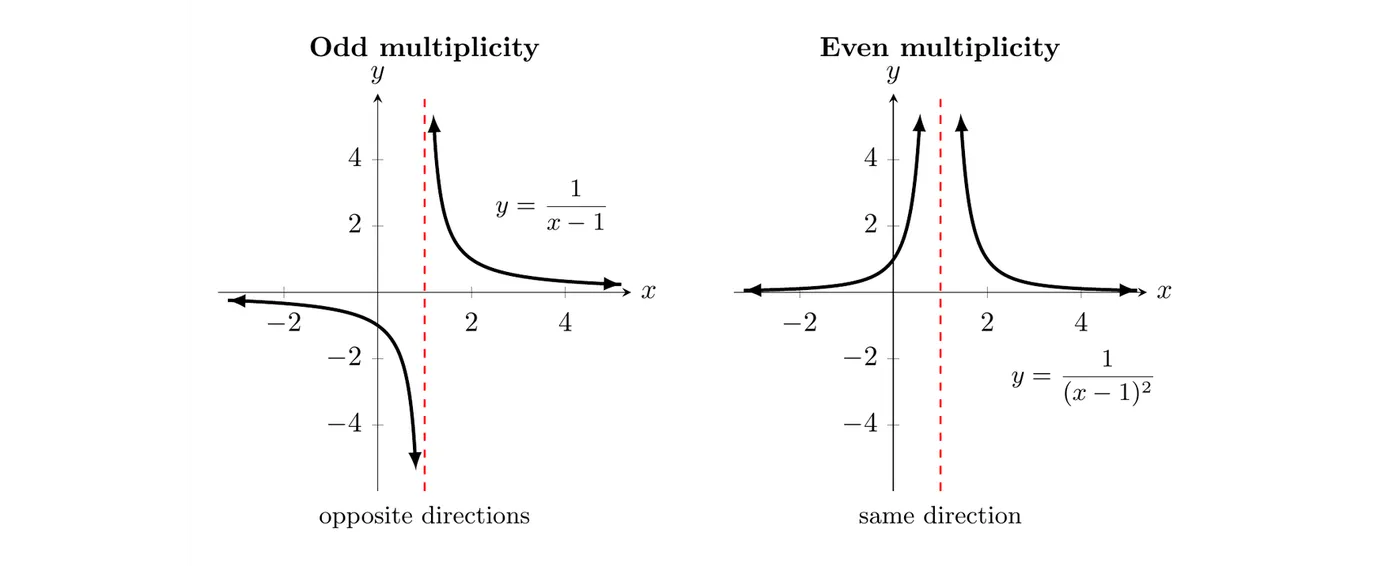
- Odd multiplicity in the denominator, like or : the factor changes sign at , so the two sides go in opposite directions.
- Even multiplicity, like : the factor is positive on both sides, so both sides go in the same direction.
Use the multiplicity that's left after canceling any common factors. Also, a graph never crosses a vertical asymptote, since isn't in the domain. (A horizontal asymptote is different: a graph can cross it.)
Examples
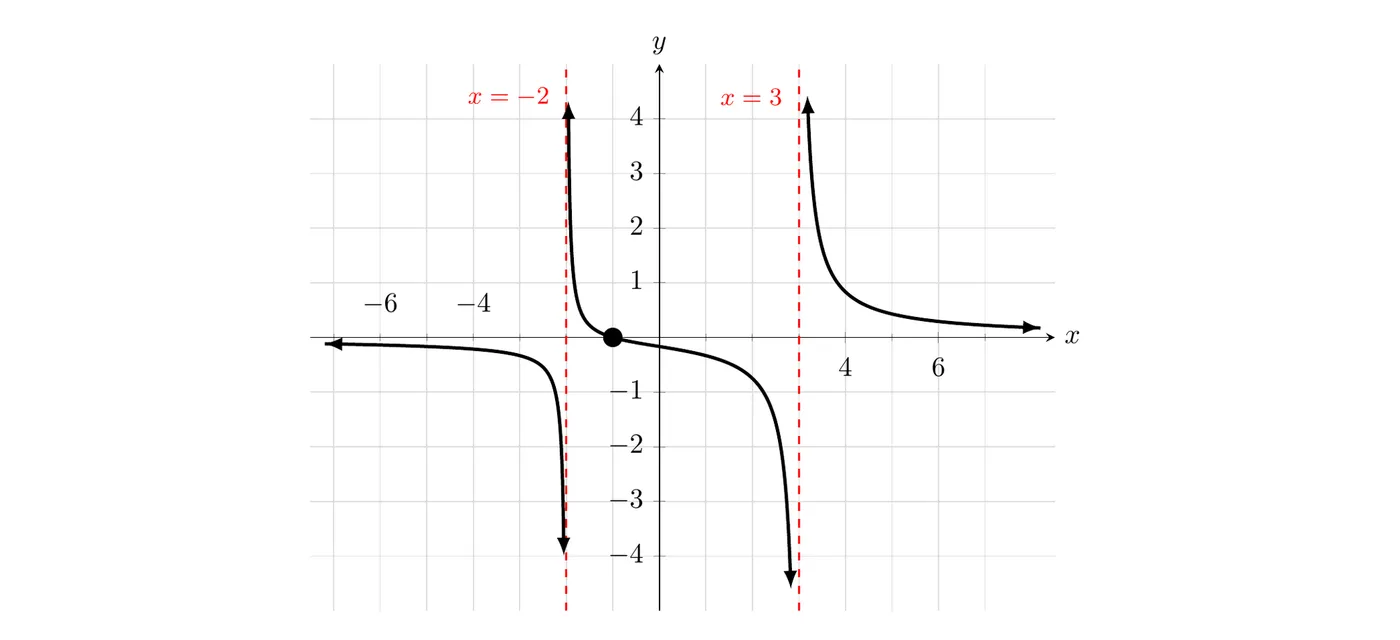
Example 1: Two vertical asymptotes
Find the vertical asymptotes of , and describe the behavior on each side with one-sided limits.
Step 1: Factor.
Step 2: The denominator is 0 at and . The numerator is 0 only at , so there are no shared zeros. Vertical asymptotes: and .
Step 3: Check signs near . The factor is about (negative) and is about (negative).
- Just right of , is tiny and positive: is positive, so .
- Just left of , is tiny and negative: is negative, so .
Step 4: Check signs near . The factor is about 4 and is about 5 (both positive).
- Just right of 3, is tiny and positive: is positive, so .
- Just left of 3, is tiny and negative: is negative, so .
Answer:
Both asymptotes come from factors with multiplicity 1, so each one has opposite directions on its two sides, just as the graph shows. The graph also crosses the -axis at its zero, , and since the denominator has the greater degree, is a horizontal asymptote (Topic 1.7).
Example 2: Factor first (AP-style)
Let . Find all vertical asymptotes of the graph of , and write one-sided limits for each.
Step 1: Factor the numerator: .
Step 2: Factor the denominator. Testing gives , so is a factor. Dividing it out:
Step 3: Compare multiplicities at each zero of the denominator.
- : once in the numerator, twice in the denominator. The denominator has more, so it's a vertical asymptote.
- : once in each. Not more in the denominator, so it's a hole, not an asymptote.
Step 4: Cancel to see the behavior near . For and , . Just left of 2 that's negative, and just right of 2 it's positive.
Answer: The only vertical asymptote is . Even though the original denominator has , only one factor of is left after canceling, so the sides go in opposite directions. And even though makes the denominator 0, it's a hole at , which you'll learn to locate in Topic 1.10.
Example 3: Reading a table
The table shows values of a rational function near , where is undefined. What do the values suggest about the graph near ?
Step 1: As gets closer to 4 from either side, the outputs get larger and larger with no sign of stopping. That points to a vertical asymptote at .
Step 2: The outputs are positive on both sides.
Answer: The graph likely has a vertical asymptote at , rising on both sides. The same direction on both sides suggests an even multiplicity, like in the denominator. (These values come from .) If the outputs had settled toward one number from both sides instead, that would point to a hole.
Common mistakes
- Calling every zero of the denominator a vertical asymptote. Check the numerator first. In Example 2, is a hole.
- Deciding before factoring. Factor the numerator and denominator completely before you compare anything.
- Using the multiplicity from before canceling. In Example 2, the denominator has , but after canceling only one copy is left, so the sides go opposite ways.
- Writing one two-sided limit when the sides disagree. If one side goes to and the other to , write the two one-sided limits separately.
- Drawing the graph across a vertical asymptote. The function isn't defined at .