

1.11 - Equivalent Representations of Polynomial and Rational Expressions
Overview
The same polynomial or rational function can be written in more than one way, and each form makes different features easy to see. Factored form shows zeros, holes, and vertical asymptotes. Standard form shows end behavior. This topic is about picking the right form for the question, plus two tools for rewriting: polynomial long division (which also finds slant asymptotes) and the binomial theorem.
One function, several forms
Rewriting an expression doesn't change the function. The graph, the zeros, and every output stay the same. What changes is which features you can read off without extra work.
Form | Example | What it shows quickly |
Factored polynomial | Real zeros, -intercepts, multiplicities | |
Standard polynomial | Degree, leading term, end behavior, -intercept | |
Factored rational | Domain, zeros, holes, vertical asymptotes | |
Quotient plus remainder | Slant asymptote, and which side of it the graph is on |
Factored form: Zeros, holes, asymptotes, domain, and range
A product equals zero exactly when one of its factors equals zero, so factored form shows the real zeros right away. For a rational function , factor the numerator and the denominator completely, then read the features from the factors:
- Domain: every real number except the zeros of the original denominator. Find these before you cancel anything.
- Holes: a factor in both the numerator and the denominator (at least as many times on top as on the bottom) cancels and leaves a hole at . Plug into the simplified expression to get the hole's height.
- Vertical asymptotes: zeros of the denominator that are left after canceling.
- Zeros and x-intercepts: zeros of the numerator that are left after canceling and are in the domain.
- Range: look for outputs the function never reaches, such as the height of a hole or a horizontal asymptote the graph never crosses.
Example 1: Reading a rational function from factored form
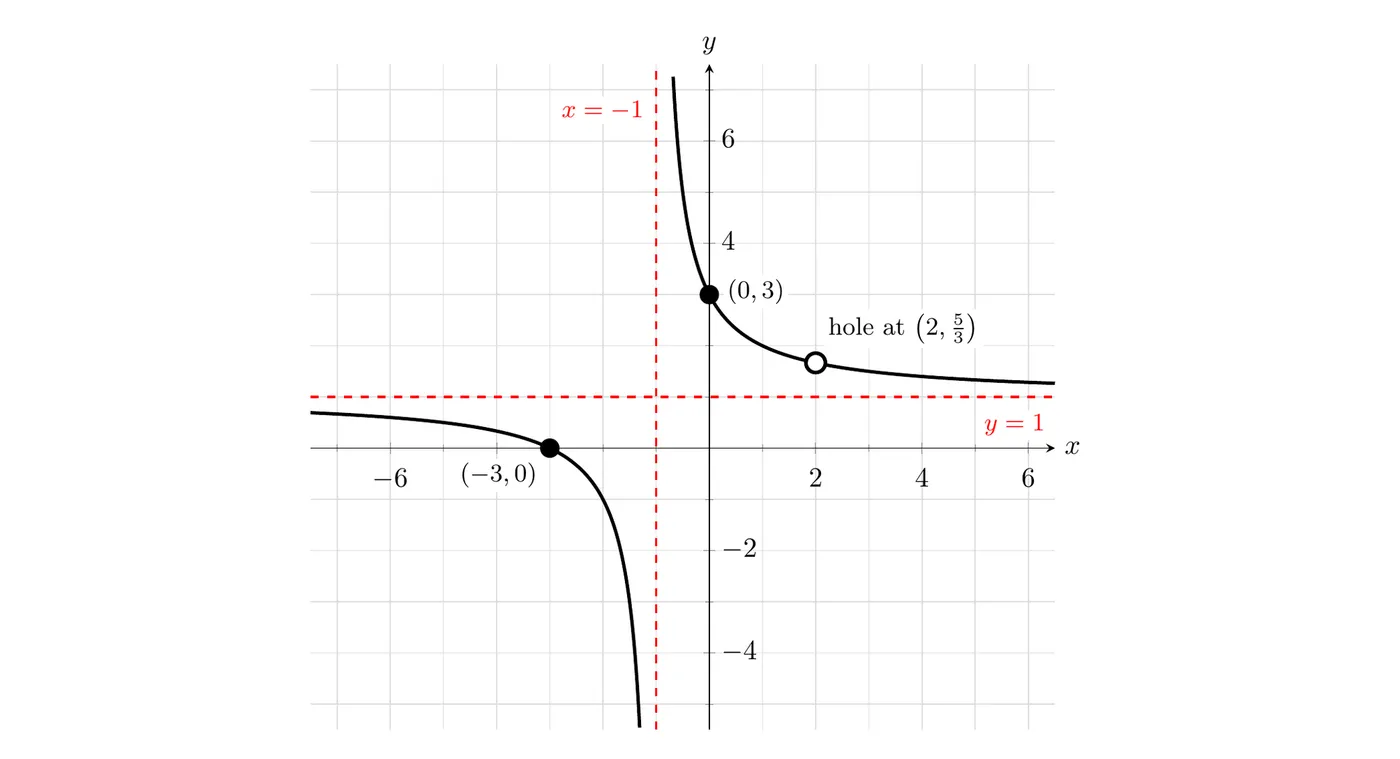
Let . Find the domain, hole, vertical asymptote, zero, -intercept, horizontal asymptote, and range.
Step 1: Factor the numerator and the denominator.
Step 2: Domain. The original denominator is zero at and , so the domain is all real numbers except and .
Step 3: Hole. The factor cancels, so there's a hole at . Its height comes from the simplified expression :
So the hole is at .
Step 4: Vertical asymptote. After canceling, is still in the denominator, so is a vertical asymptote.
Step 5: Zero. After canceling, is still in the numerator, so is a zero and is an -intercept.
Step 6: The -intercept is , so the graph crosses the -axis at .
Step 7: Horizontal asymptote. This one comes from standard form (next section). The numerator and denominator both have degree 2 and leading coefficient 1, so the horizontal asymptote is .
Step 8: Range. Setting gives , or , which is impossible. So the graph never reaches . Setting gives only , which is the hole, so is never an output either.
Answer: The domain is all real numbers except and . There's a hole at , a vertical asymptote at , a zero at , a -intercept of , and a horizontal asymptote at . The range is all real numbers except and .
Standard form: End behavior
Standard form lists the terms from the highest power down. The first term, the leading term, controls the end behavior, because when is large it's much bigger than all the other terms combined.
- Polynomials: as , behaves like its leading term . Whether is even or odd, and the sign of , decide where each end of the graph goes.
- Rational functions: compare the leading terms of the numerator and the denominator. If the denominator has the higher degree, is the horizontal asymptote. If the degrees are equal, the horizontal asymptote is . If the numerator has the higher degree, there's no horizontal asymptote.
Factored form hides the leading term. To find it without expanding everything, multiply only the leading terms of the factors. For , that's .
Example 2: Two forms of the same polynomial
The polynomial expands to . Use whichever form makes each question quick.
- Zeros: use factored form. The zeros are (multiplicity 2, so the graph touches the -axis and turns around) and (multiplicity 1, so the graph crosses the -axis).
- Vertical intercept: use standard form. The constant term is , so the graph passes through .
- End behavior: use standard form. The leading term is , which has odd degree and a negative coefficient, so the left end goes up and the right end goes down:
Using different forms to answer questions in context
In a context problem, different parts of the question often call for different forms of the same function. Rewrite the function into whichever form answers each part fastest.
Example 3: A profit model
A company's profit, in thousands of dollars, from making and selling hundred units is modeled by for .
(a) For what production levels does the company make a profit?
Factor to find where :
The zeros are , , and . The sign of can only change at a zero, so test one value in each interval:
Interval | Test value | Sign of |
Negative (loss) | ||
Positive (profit) | ||
Negative (loss) |
The company makes a profit when , that is, when it makes between 200 and 1,000 units.
(b) What happens to the profit if production keeps increasing?
Use standard form. The leading term is , so . In this model, making more and more units eventually leads to bigger and bigger losses.
Polynomial long division
Polynomial long division works like long division with numbers. Dividing 17 by 5 gives a quotient of 3 and a remainder of 2, so . Polynomials work the same way. If the polynomial is divided by the polynomial , then
where is the quotient, is the remainder, and the degree of is less than the degree of . Dividing both sides by gives the form used for rational functions:
The steps:
- Write both polynomials in standard form. If the dividend skips a power, fill it in with a 0 coefficient, like .
- Divide the leading term of what's left by the leading term of the divisor. Write the result in the quotient.
- Multiply that new quotient term by the whole divisor.
- Subtract the product (change the sign of every term), then bring down the next term.
- Repeat until the degree of what's left is less than the degree of the divisor. What's left is the remainder.
Example 4: Dividing by a linear factor
Divide by .
Step 1: Fill in the missing term: .
Step 2: . Multiply: . Subtract:
Bring down the to get .
Step 3: . Multiply: . Subtract:
Bring down the to get .
Step 4: . Multiply: . Subtract:
The remainder has degree 0, which is less than the degree of , so we stop. Here's the whole division laid out:
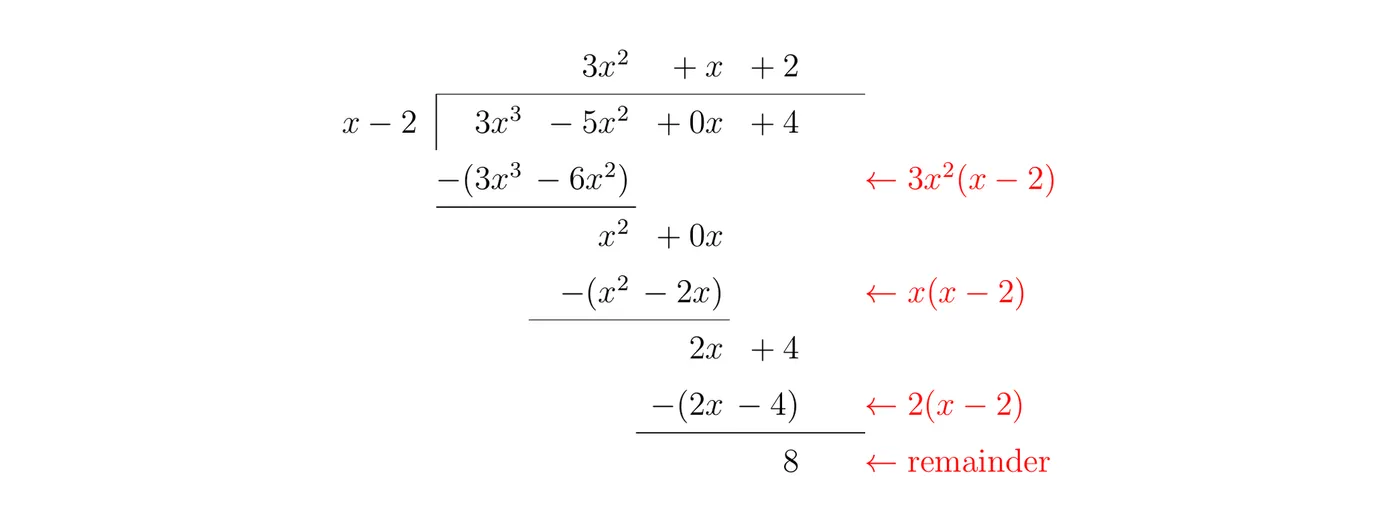
Answer: The quotient is and the remainder is :
Check: Plug in . The left side is , and the right side is . They match. In general, the remainder after dividing by equals .
Example 5: Dividing by a quadratic
Divide by .
Step 1: . Multiply: . Subtract:
Step 2: . Multiply: . Subtract:
Step 3: The remainder has degree 1, which is less than 2, so we stop.
The remainder doesn't have to be a number. It only needs a lower degree than the divisor.
Slant asymptotes
When the numerator of a rational function has degree exactly one more than the denominator, there's no horizontal asymptote. Instead, the graph has a slant asymptote (also called an oblique asymptote): a line that the graph gets closer and closer to as . Long division finds it.
Divide to write as . The remainder has a lower degree than the denominator, so as . That leaves very close to , which is linear. The slant asymptote is .
Example 6: Finding a slant asymptote
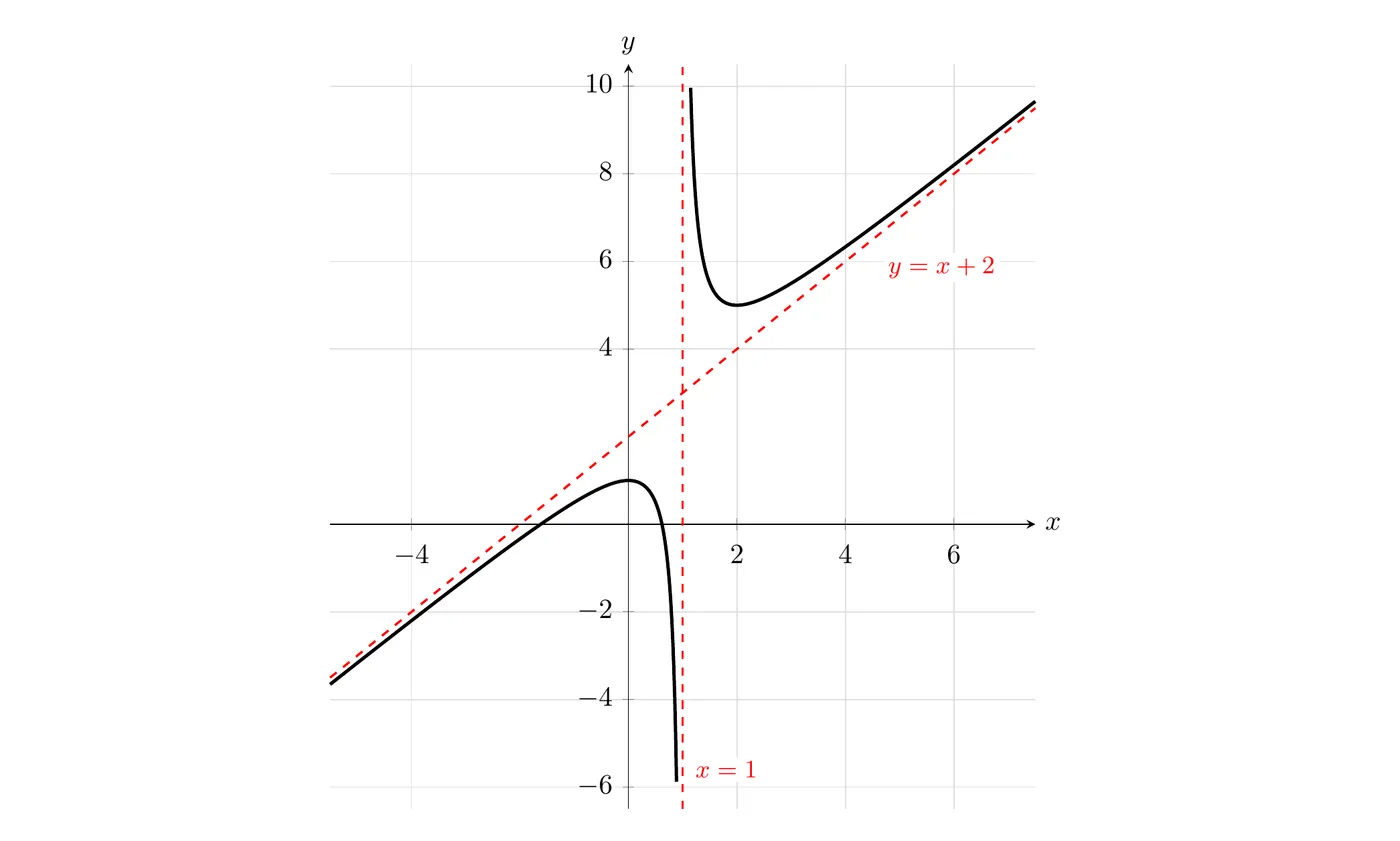
Find the slant asymptote of and describe the graph near it.
Step 1: The numerator has degree 2 and the denominator has degree 1, so there's a slant asymptote.
Step 2: Divide. and . Subtracting leaves . Next, and . Subtracting leaves a remainder of .
Step 3: As , , so the slant asymptote is .
Step 4: The denominator is zero at and the numerator isn't (), so is a vertical asymptote.
The remainder term also tells you which side of the line the graph is on. For large positive , , so the graph sits just above . For large negative , , so it sits just below.
If the numerator's degree is two or more above the denominator's, there's no slant asymptote. The end behavior then follows the quotient, which might be a quadratic or higher.
The binomial theorem and Pascal's triangle
Expanding something like by multiplying it out five times is slow and easy to mess up. The binomial theorem uses one row of Pascal's triangle to expand directly, including polynomials like .
Building Pascal's triangle
Every row starts and ends with 1. Each entry in between is the sum of the two entries just above it, like in red. The rows are numbered starting from row 0.
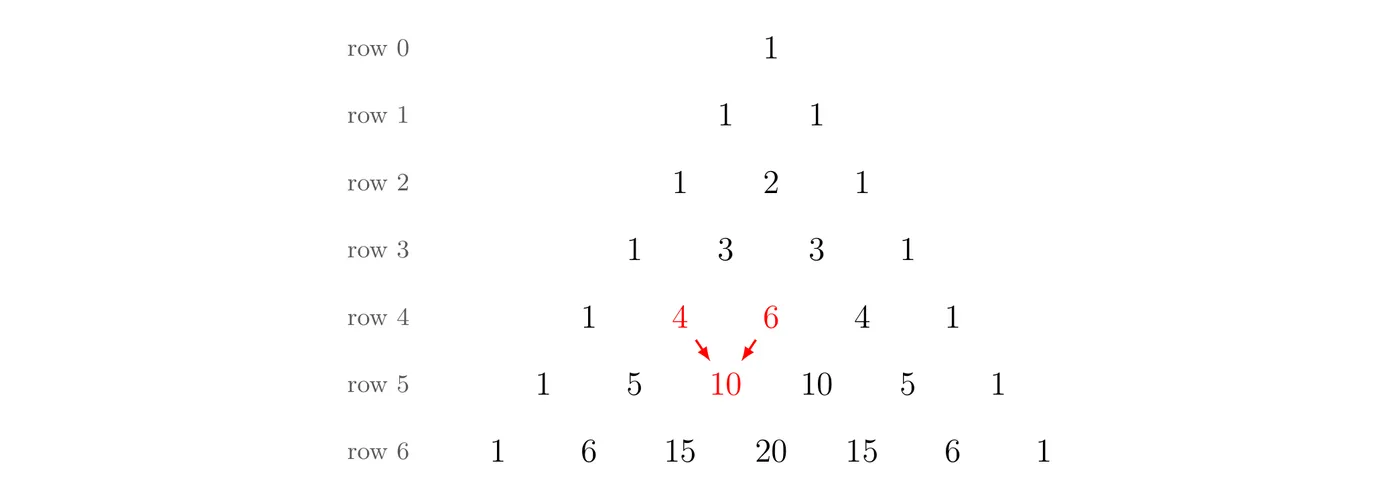
Row gives the coefficients of . Row 4 is 1, 4, 6, 4, 1, so
The pattern
- has terms.
- The powers of count down from to 0, and the powers of count up from 0 to .
- In every term, the exponents add up to .
- The coefficients come from row of Pascal's triangle.
You may also see the entries of row written as , which gives the general formula below. Reading the coefficients from Pascal's triangle is all AP Precalculus needs.
Example 7: Expanding a power of a binomial
Expand .
Here , , and . Row 4 is 1, 4, 6, 4, 1.
Check: Plug in . The left side is , and the right side is .
Example 8: A coefficient and a minus sign
Expand .
Use , , and row 3: 1, 3, 3, 1. Keep the parentheses so the 2 and the negative sign get raised to each power.
The signs alternate because odd powers of are negative.
Example 9: Finding one coefficient (AP-style)
What is the coefficient of in the expansion of ?
Row 5 is 1, 5, 10, 10, 5, 1. The power of counts down from 5, so is in the fourth term, where is raised to the power and the coefficient from row 5 is 10:
Answer: The coefficient is .
Common mistakes
- Canceling before finding the domain. is undefined at , even though the simplified form isn't. That's exactly why there's a hole.
- Calling a canceled factor a vertical asymptote. A factor that cancels completely gives a hole, not an asymptote.
- Skipping the zero placeholders. Without the in , the terms in long division line up in the wrong columns.
- Subtracting only the first term. When you subtract the product, change the sign of every term in it.
- Stopping at the wrong time. Stop exactly when the remainder's degree is less than the divisor's degree.
- Dropping a coefficient or sign in the binomial theorem. In , the second term is , not .
- Looking for a slant asymptote when the degrees differ by more than one. A slant asymptote only happens when the numerator's degree is exactly one more than the denominator's.