

1.5 - Polynomial Functions and Complex Zeros
Overview
The zeros of a polynomial control much of its graph: where it crosses or touches the -axis, and where it is positive or negative. This topic covers real and non-real zeros, multiplicity, polynomial inequalities, finding a polynomial's degree from a table, and recognizing even and odd functions.
Zeros, roots, and linear factors
If , then is a zero of the polynomial function , or a root of the equation . Zeros can be real or complex. A complex number has the form , where , so . Real numbers are the complex numbers with . Complex numbers with , like or , are called non-real.
For a real number , zeros and factors go together:
So if you know a zero, you know a factor, and if you know a factor, you know a zero.
Example 1: Using a zero to factor
Show that is a zero of , then find all of its zeros.
Step 1: Check .
So is a zero, and is a factor.
Step 2: Since is a factor, times a quadratic. Dividing by (polynomial long division, Topic 1.11) gives the quadratic with a remainder of . Check by multiplying: .
Answer: the zeros are , , and .
Multiplicity and counting zeros
If a linear factor appears times, the zero has multiplicity . For example, in , the zero has multiplicity .
A polynomial of degree has exactly complex zeros when you count multiplicities. (This is the Fundamental Theorem of Algebra.) Some of those zeros may be real and some non-real.
Example 2: Counting zeros
List the zeros of with their multiplicities, and check the count against the degree.
- gives the zero with multiplicity .
- gives the zero with multiplicity .
- gives , so and , each with multiplicity .
Answer: the degree is , and the zeros counted with multiplicity add up to . They match, as they must.
Real zeros, x-intercepts, and inequalities
If is a real zero of , the graph of has an -intercept at . Non-real zeros don't appear on the graph at all, since the graph only shows real inputs.
Real zeros are also the boundary points for polynomial inequalities like or . A polynomial's graph can only switch between above and below the -axis at a real zero, so the real zeros split the number line into intervals where the sign of stays the same. Test one value in each interval.
Multiplicity and the shape of the graph
Multiplicity tells you what the graph does at each real zero:
- Odd multiplicity (): the output changes sign, so the graph crosses the -axis. With multiplicity or more, it flattens out as it crosses.
- Even multiplicity (): the output has the same sign on both sides of the zero, so the graph touches the -axis and turns back. The graph is tangent to the -axis there.
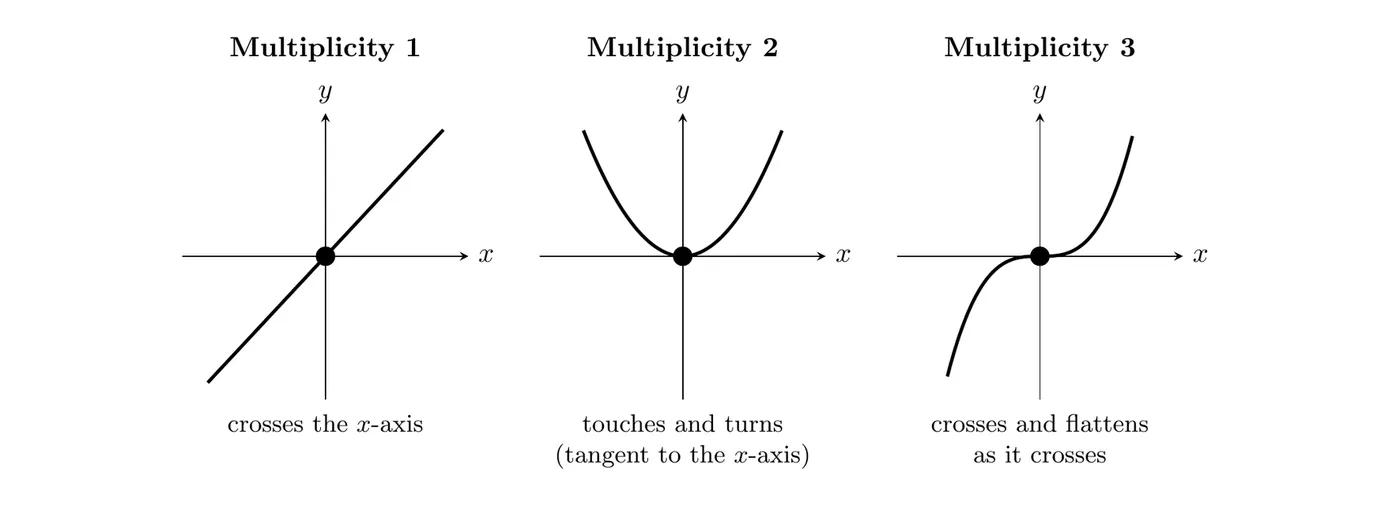
Why does this happen? Near , the factor is the only factor that changes sign. When is even, is positive on both sides of , so the sign of doesn't change.
Example 3: Solving a polynomial inequality (AP-style)
Let . Solve .
Step 1: Find the real zeros and their multiplicities. The zeros are (multiplicity ), (multiplicity ), and (multiplicity ).
Step 2: Test a value in each interval.
Interval | Test value | Sign of |
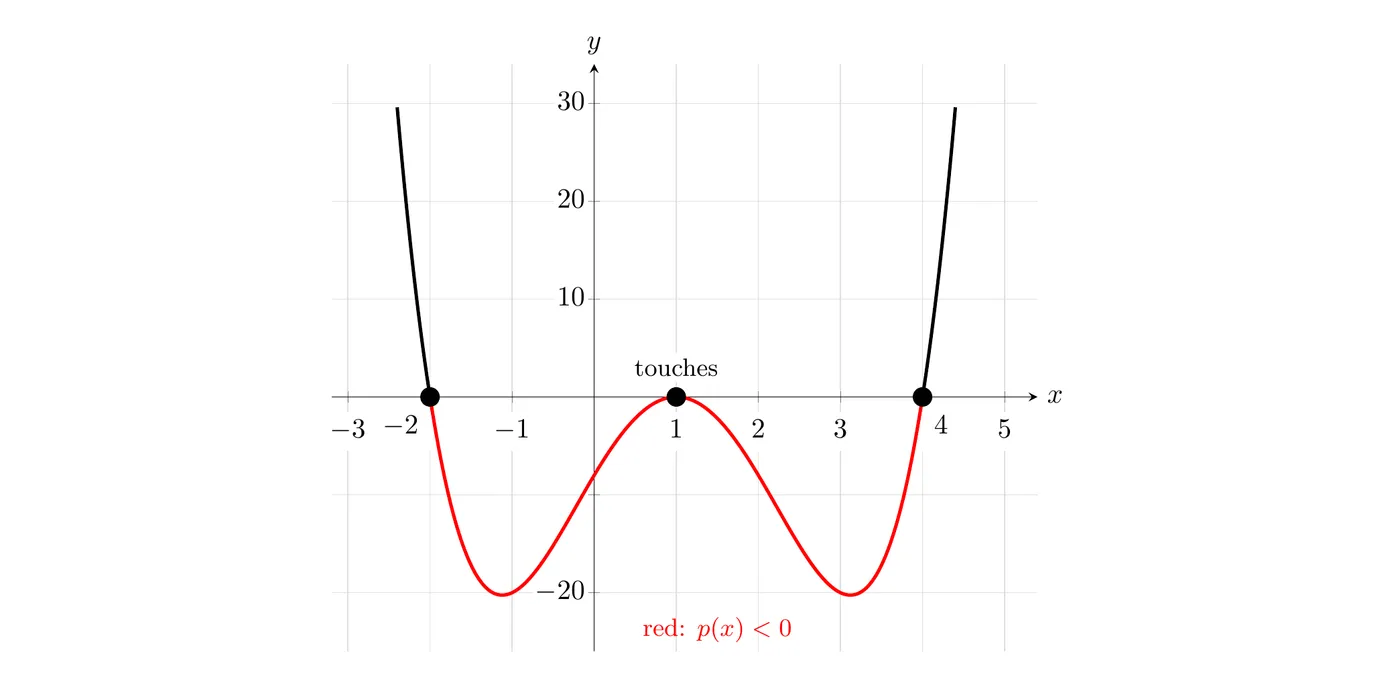
The sign doesn't change at because that zero has even multiplicity: the graph touches the axis and turns back down.
Answer: on . The zeros are left out, since there. If the question asked for instead, the zeros would count too, and the answer would be .
Technology: on calculator-active questions, find real zeros with your calculator's zero feature (on a TI-84: 2nd, TRACE, then 2: zero).
Non-real zeros come in conjugate pairs
If is a non-real zero of a polynomial with real coefficients, then its conjugate is also a zero. So non-real zeros always come in pairs. Two consequences:
- The number of non-real zeros is always even.
- A polynomial of odd degree has at least one real zero, since its zeros can't all pair up.
Example 4: Building a polynomial from its zeros
Write a polynomial of least degree with real coefficients that has zeros and .
Step 1: Since is a zero, its conjugate must be a zero too. So the zeros are , , and .
Step 2: Multiply the factors. Multiply the conjugate pair first, since their product is real:
Answer: , which has degree . Any nonzero constant multiple of it also works.
Example 5: How many real zeros?
A polynomial with real coefficients has degree . Two of its zeros are and , and has multiplicity . How many real zeros does have, counted with multiplicity?
Degree means exactly zeros counted with multiplicity. So far you have , its conjugate , and twice. That's . The fifth zero can't be non-real, because a non-real zero would need a partner, making .
Answer: the fifth zero is real, so has real zeros counted with multiplicity: , , and one more real number.
Finding the degree from a table
If a table gives a polynomial's outputs at equally spaced inputs, you can find its degree with successive differences. Subtract consecutive outputs to get the first differences, subtract consecutive first differences to get the second differences, and keep going. The degree is the smallest for which the th differences are constant.
This extends Topic 1.3: a linear function has constant first differences, and a quadratic function has constant second differences.
Example 6: Successive differences
The table shows values of a polynomial function . Find the degree of .
Differences | Values |
First | |
Second | |
Third |
Answer: the third differences are the first ones that are constant, so has degree . (These values come from .) With real-world data, the differences are rarely exactly constant, so look for the level where they are close to constant.
Even and odd functions
Some functions have a symmetry you can check with algebra:
- An even function is symmetric over the -axis (the line ). Analytically, for every in the domain.
- An odd function is symmetric about the origin . Analytically, for every in the domain.
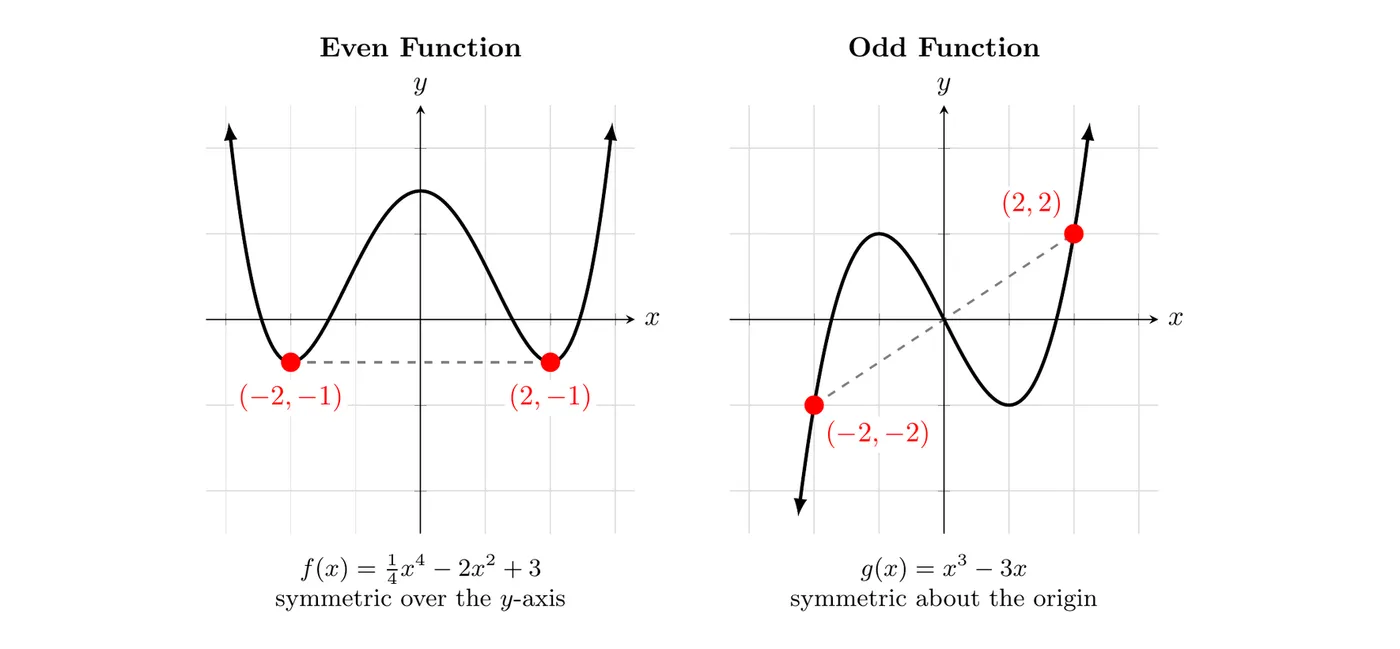
In the figure, the even function has the same output at and . The odd function has opposite outputs there: and .
Power functions: a one-term polynomial , with and , is even when is even and odd when is odd. That's where the names come from. More generally, a polynomial whose terms all have even powers (a constant counts as power ) is even, and one whose terms all have odd powers is odd. A mix of even and odd powers gives a function that is neither.
Example 7: Even, odd, or neither?
Decide whether each function is even, odd, or neither: , , and .
Test by replacing with :
So is even.
Test :
So is odd.
Test :
That's not , and it's not . So is neither. The constant (an even power) mixed with (an odd power) breaks both symmetries.
Common mistakes
- Forgetting the conjugate. If is a zero of a polynomial with real coefficients, so is . Leaving it out gives the wrong degree.
- Counting a repeated zero once. In , the zero counts twice, so there are zeros, not .
- Assuming the sign changes at every zero. It changes only at zeros of odd multiplicity. Test every interval.
- Including the zeros in a strict inequality. For , the zeros are not solutions. For , they are.
- Using successive differences with uneven spacing. The method only works when the inputs are equally spaced.
- Deciding even or odd from the degree alone. has odd degree, but it isn't an odd function. Check .