

1.12 - Transformations of Functions
Overview
A transformation moves, stretches, squeezes, or flips the graph of a function. If you know the graph of a parent function like or , transformations let you sketch and write equations for a whole family of related functions without starting from scratch. They're also one of the main ways to build models in Topic 1.14.
Additive and multiplicative transformations
There are two kinds. Additive transformations add a constant, which slides (translates) the graph. Multiplicative transformations multiply by a constant, which stretches or compresses (dilates) the graph and can also reflect it.
Where the constant goes matters as much as what it is:
- Outside the function, like or , the constant changes the outputs, so the graph changes vertically. These work the way you'd expect.
- Inside the function, like or , the constant changes the inputs, so the graph changes horizontally. These work backwards from what you'd expect.
Function | Transformation of | Point on moves to |
Vertical translation by units | ||
Horizontal translation by units | ||
, | Vertical dilation by a factor of ; also a reflection over the -axis if | |
, | Horizontal dilation by a factor of ; also a reflection over the -axis if |
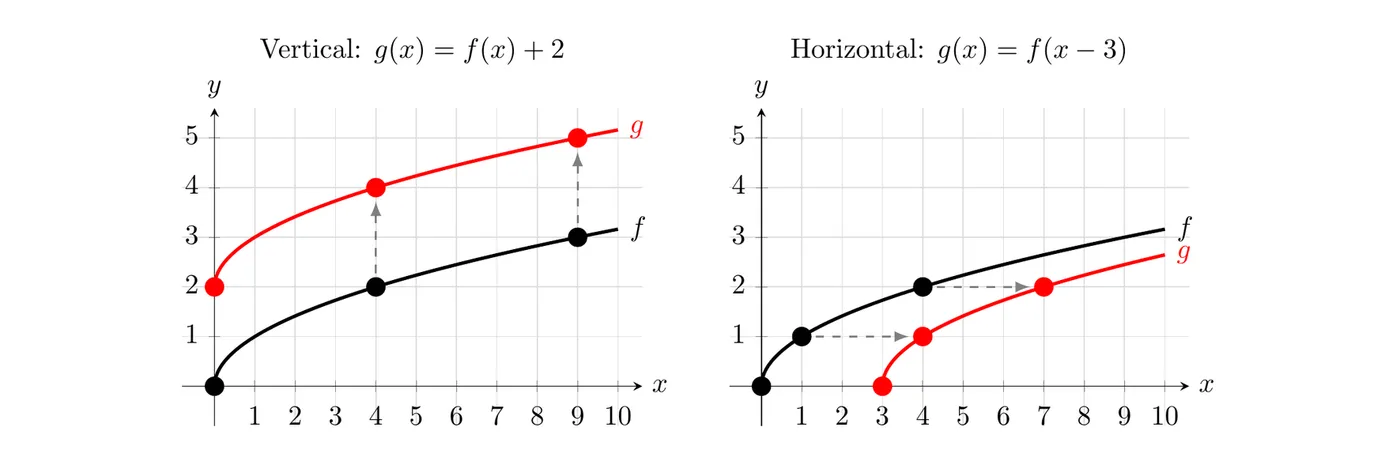
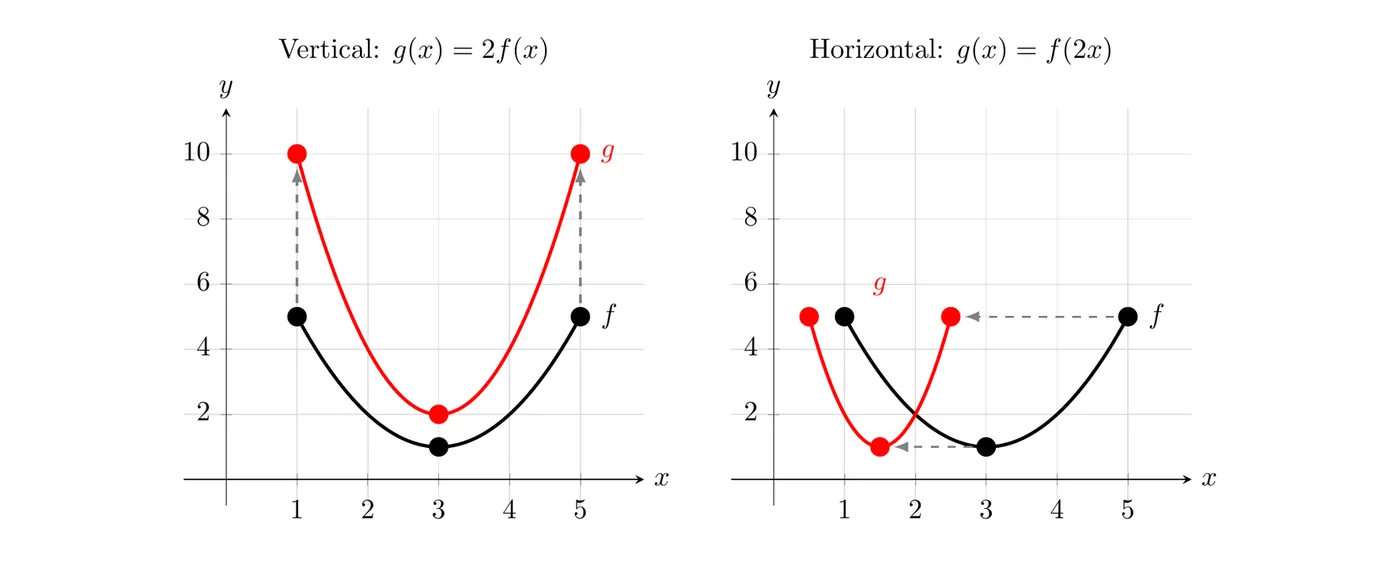
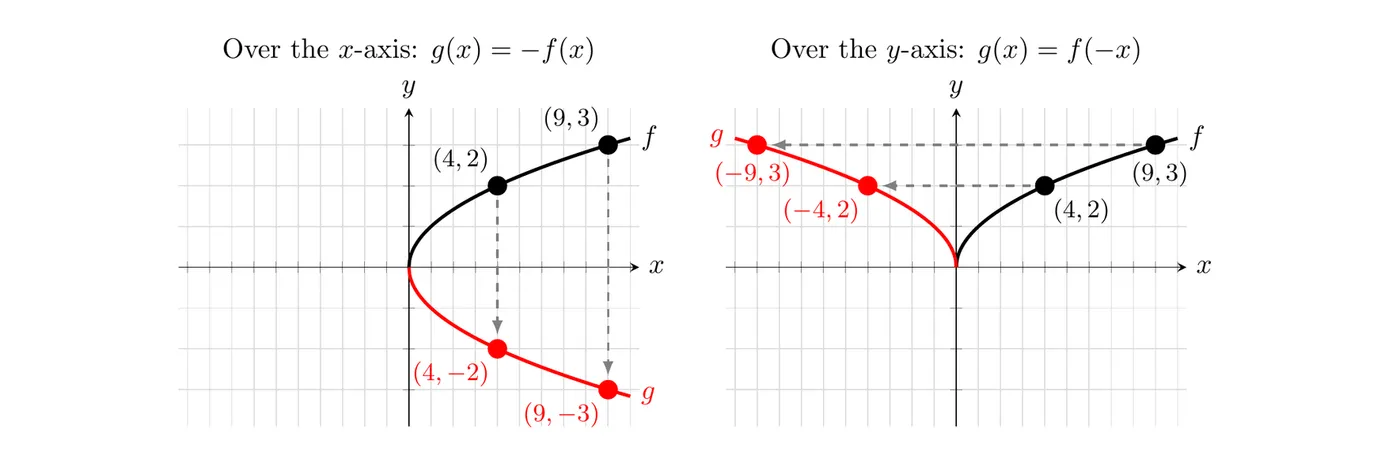
In the figures on this page, the black curve is and the red curve is the transformed function .
Vertical translations
The function is an additive transformation of that translates the graph of vertically by units. Every output gets added to it, so every point moves straight up when and straight down when . The -values don't change.
For example, if , then moves every point up 2 units. The point on becomes on .
Horizontal translations
The function is an additive transformation of that translates the graph of horizontally by units. So shifts the graph 3 units left, and shifts it 3 units right.
Why backwards? Look at . To get the output from , you need , so . Whatever does at , does at , which is 3 units to the right.
For , the graph of starts at instead of , and the point on becomes on .
Vertical dilations and reflections over the x-axis
The function , where , is a multiplicative transformation of that dilates the graph vertically by a factor of . Every output gets multiplied by :
- If , the graph is stretched away from the -axis.
- If , the graph is compressed toward the -axis.
- If , the graph is also reflected over the -axis.
Points on the -axis have , and , so the zeros of don't move.
Horizontal dilations and reflections over the y-axis
The function , where , is a multiplicative transformation of that dilates the graph horizontally by a factor of . Like horizontal translations, this works backwards:
- If , the graph is compressed toward the -axis. For example, is a horizontal dilation by a factor of .
- If , the graph is stretched away from the -axis. For example, is a horizontal dilation by a factor of 3.
- If , the graph is also reflected over the -axis.
Every -coordinate gets divided by , and the -values stay the same. A point on the -axis stays put, because .
The figure compares the two dilations using , drawn for . The vertical dilation doubles every height: the vertex moves from to , and the endpoints rise from height 5 to height 10. The horizontal dilation halves every -coordinate: the vertex moves to , and the endpoints move to and .
Reflections are the cases and . With , the graph of flips over the -axis, and the graph of flips over the -axis.
Combining transformations
Additive and multiplicative transformations can be combined into translations and dilations in both directions at once. The set of points before the transformations is called the preimage, and the set of points after is called the image.
To keep it organized, write the function in the form
Then each point of the preimage moves to
In words: for , divide by , then subtract . For , multiply by , then add . In both directions, do the dilation before the translation.
Example 1: Mapping points and finding the domain and range
Let and . Describe the transformations, map the points , , , and , and find the domain and range of .
Step 1: Match the form. , so , , , and .
Step 2: Describe the transformations.
- Horizontal translation by unit (1 unit left)
- Vertical dilation by a factor of 2, with a reflection over the -axis (from )
- Vertical translation by unit (1 unit down)
Step 3: Map the points using .
Preimage point on | Image point on |
Check: . It matches.
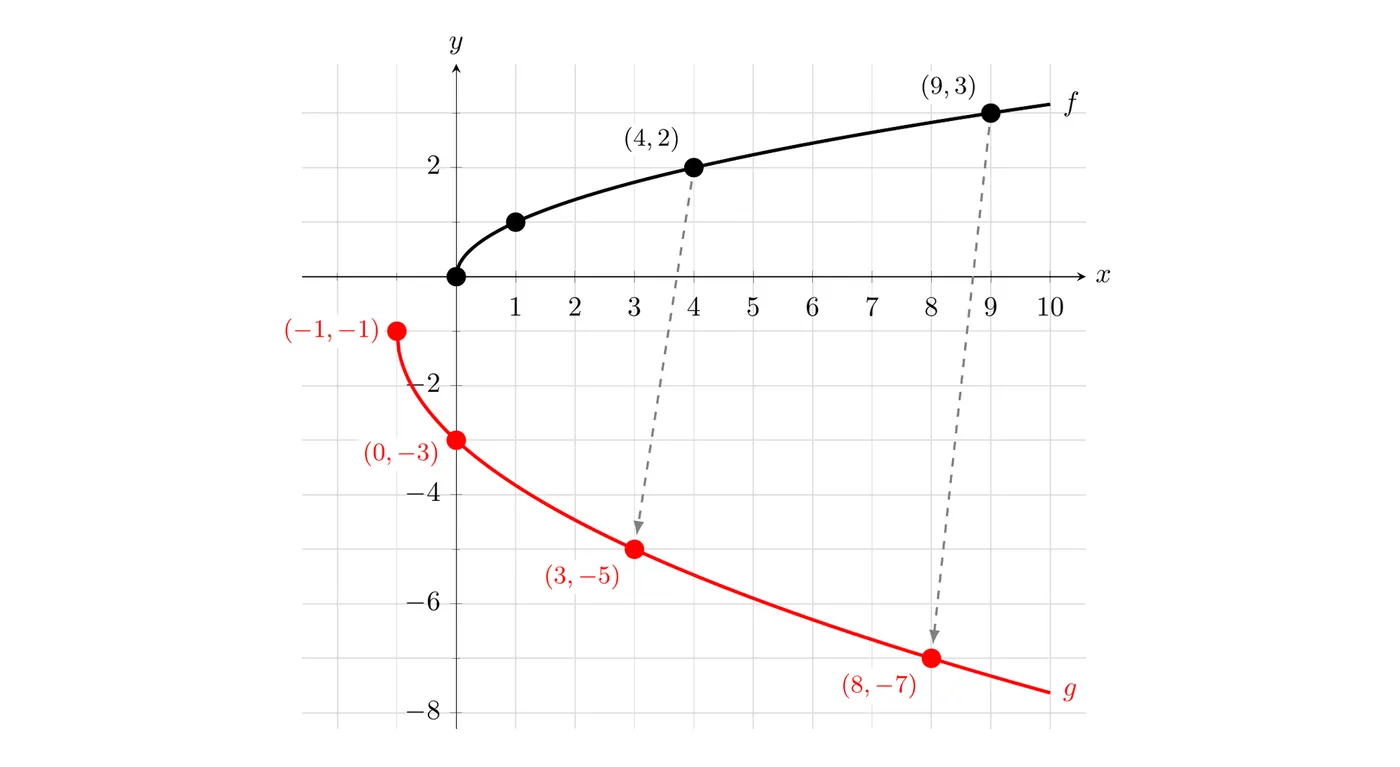
Step 4: Domain and range. The preimage has domain and range . Shifting left 1 moves the domain to . Multiplying the outputs by turns into , and subtracting 1 gives .
Answer: The domain of is and the range is .
Example 2: Factor out the coefficient first
The point is on the graph of . Find the matching point on the graph of .
Step 1: Factor the inside so it matches :
So and . That's a horizontal dilation by a factor of , then a translation 3 units right (not 6).
Step 2: Map the point: .
Check: . It matches.
If you compressed and then shifted right 6, you'd get . But , which is a different point. Always factor out before reading the shift.
Domain and range after a transformation
A transformed function can have a different domain and range than its parent function. Horizontal transformations change the domain because they move the -values. Vertical transformations change the range because they move the -values. Asymptotes move right along with the graph.
Example 3: A transformed rational function
The parent function has domain , range , a vertical asymptote at , and a horizontal asymptote at . Find these for .
Since , the graph shifts 2 units right and 1 unit up, and so do the asymptotes.
- Vertical asymptote , so the domain is all real numbers except 2.
- Horizontal asymptote , so the range is all real numbers except 1.
Writing and using a transformed function
AP questions go both ways: write from a description, or use the formula for to get values from a table or graph of .
Example 4: From a description to a formula
The graph of is the graph of reflected over the -axis, vertically dilated by a factor of , translated 4 units left, and translated 5 units up. Write .
- Reflect and dilate vertically: multiply by .
- Translate 4 units left: replace with .
- Translate 5 units up: add 5.
Check: The point on should move to , and .
Example 5: Using a table (AP-style)
Selected values of are shown in the table. Let .
(a) Find and .
(b) Find a value of for which .
Set , so . The table shows , so and .
(c) Describe how the graph of is related to the graph of .
The graph of is the graph of translated 2 units right, vertically dilated by a factor of 3, and then translated 4 units down.
Common mistakes
- Shifting the wrong way. moves the graph 3 units left, not right.
- Using the wrong horizontal factor. is a horizontal dilation by a factor of , not 2.
- Forgetting to factor. In , the shift is 2 units left, not 6.
- Adding before multiplying. For , double the -value first, then add 1. The point goes to , not .
- Mixing up the reflections. flips over the -axis (outputs change sign). flips over the -axis (inputs change sign).
- Copying the parent's domain and range. Recheck both after transforming, especially for square root and rational functions.