

1.8 - Rational Functions and Zeros
Overview
A fraction equals zero only when its numerator is zero. So the zeros of a rational function come from the numerator, with one catch: the input has to be in the domain. In this topic you'll find zeros, solve rational equations, and solve rational inequalities with a sign chart, a skill the AP exam tests with and without a calculator.
Zeros come from the numerator
For , the quotient is 0 exactly when the numerator is 0 and the denominator isn't.
Key rule: the real zeros of are the real zeros of the numerator that are also in the domain of .
To find them:
- Factor the numerator and denominator completely.
- Find the real zeros of the numerator.
- Throw out any that also make the denominator 0, since those inputs aren't in the domain.
Whatever is left is a real zero of , and each one is an -intercept of the graph.
Why step 3 matters: if an input makes both the numerator and the denominator 0, then there, which is undefined. That input gives a hole or a vertical asymptote (Topics 1.9 and 1.10), not a zero.
Example 1: A zero that isn't in the domain
Find the real zeros of .
Step 1: Factor.
Step 2: The numerator is 0 at and .
Step 3: The denominator is 0 at and , so is not in the domain. Throw it out.
Answer: The only real zero is . Check: .
Solving rational equations
To solve an equation like , turn it into a zero-finding problem. Multiply both sides by the denominator (or move everything to one side and combine into one fraction), solve, and then check every answer against the domain. An answer that makes a denominator 0 is an extraneous solution, and you throw it out.
Example 2: An extraneous solution
Solve .
Step 1: Note the domain: .
Step 2: Multiply both sides by .
Step 3: isn't in the domain, so it's extraneous. Check : the left side is , and the right side is .
Answer: . Notice this is the same as finding the zeros of : the numerator is 0 at , but only is in the domain.
Solving rational inequalities with a sign chart
To solve or , you need to know where is positive and where it's negative. A rational function can only change sign at two kinds of inputs:
- Real zeros of the numerator, where
- Real zeros of the denominator, where is undefined
Between these values, keeps the same sign. So the real zeros of both polynomials are where the solution intervals start and stop: a zero of the numerator can be an endpoint, and a zero of the denominator (usually a vertical asymptote) is a boundary the interval never includes.
Steps:
- Get 0 on one side and write the other side as a single fraction. Factor completely.
- Mark every real zero of the numerator and the denominator on a number line.
- Test one input in each interval to find the sign of there. You only need the sign of each factor, not its value.
- Pick the intervals whose sign matches the inequality.
- Decide the endpoints. Include zeros of the numerator when the inequality is or . Never include zeros of the denominator.
Multiplicity shortcut: a factor with an odd power changes sign as you pass its zero. A factor with an even power, like , does not, since a square is never negative.
Example 3: A rational inequality (AP-style)
Solve .
Step 1: It's already one factored fraction with 0 on the right. Call the left side .
Step 2: The numerator is 0 at (multiplicity 2) and . The denominator is 0 at and .
Step 3: Test each interval.
Interval | Test | Sign of | ||||
Step 4: on and .
Step 5: The numerator zeros and make , so they're included. The denominator zeros and are not.
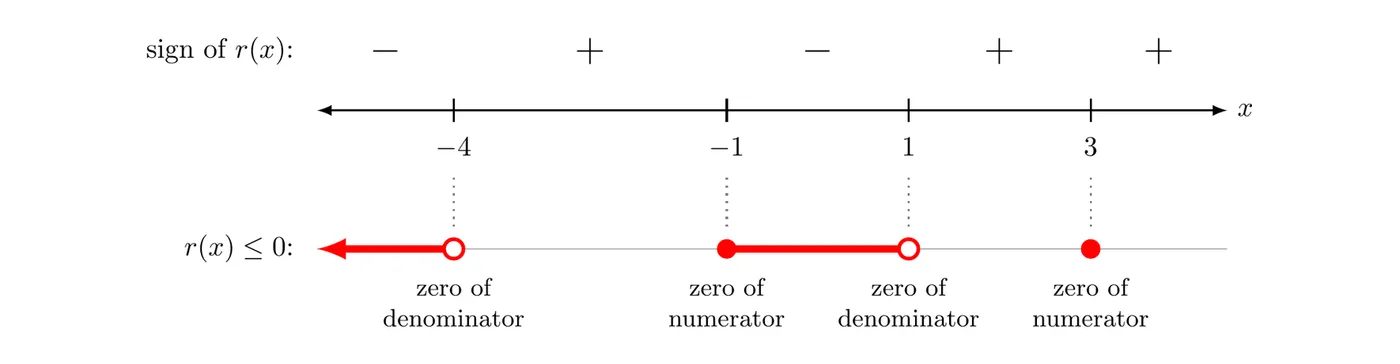
Answer:
The isolated point is the trap. The intervals on both sides of 3 are positive (the squared factor doesn't change sign), so it's easy to skip. But , and is true, so belongs in the answer.
Example 4: Keeping average cost low (AP-style)
A company's average cost per item, in dollars, for making items is , where . For what numbers of items is the average cost at most $5 per item?
Step 1: Set up the inequality and get 0 on one side.
Step 2: The numerator is 0 at , and the denominator is 0 at .
Step 3: In context , so test and . At : . At : .
Step 4: The solution is , including 200 because it makes the expression equal 0. Check: .
Answer: The average cost is at most $5 per item when the company makes 200 or more items.
Since here, you could also multiply both sides by without flipping the inequality. Without that guarantee, multiplying by an expression with in it is risky, because you don't know whether it's negative. The sign chart always works.
Common mistakes
- Calling a value a zero when it also makes the denominator 0, like in Example 1.
- Including a denominator zero in an inequality's answer. Always use a parenthesis (or an open circle) there.
- Multiplying both sides of an inequality by an expression that might be negative. The inequality might need to flip, and you can't tell which way. Use a sign chart.
- Dropping an isolated solution, like in Example 3.
- Skipping the domain check when solving a rational equation.