

1.4 - Polynomial Functions and Rates of Change
Overview
Polynomial functions are the main family of functions in Unit 1. In this topic you'll learn the words for describing a polynomial (degree, leading term, leading coefficient) and the features tied to its rate of change: where it turns around (extrema) and where its concavity changes (points of inflection).
What a polynomial function is
A polynomial function of is any function that can be written in the form
where is a positive integer, every coefficient is a real number, and . Every exponent on is a whole number.
- Degree: the highest power, .
- Leading term: the term with the highest power, .
- Leading coefficient: the number multiplying the leading term, .
Writing a polynomial in standard form means listing its terms from the highest power to the lowest. Do this before you read off the degree or leading coefficient.
Some functions that are not polynomials: (that's , a negative exponent), (that's , a fractional exponent), and (the variable is in the exponent).
Example 1: Degree and leading coefficient
Find the degree, leading term, and leading coefficient of and .
First polynomial. Rewrite in standard form:
The degree is , the leading term is , and the leading coefficient is .
Second polynomial. You don't need to expand all of . The leading term comes from multiplying the leading terms of the factors: . So the degree is , the leading term is , and the leading coefficient is . (Expanding confirms it: .)
Local and global extrema
Where a polynomial switches between increasing and decreasing, it has a local (or relative) extremum:
- Local maximum: the function switches from increasing to decreasing. The output there is greater than or equal to the outputs at all nearby inputs.
- Local minimum: the function switches from decreasing to increasing. The output there is less than or equal to the outputs at all nearby inputs.
If a polynomial's domain is restricted to an interval, each included endpoint is also a local maximum or local minimum, since there's nothing beyond it to compare to.
A local maximum that is greater than every other output of the function is the global (or absolute) maximum. A local minimum that is less than every other output is the global minimum. A function can have many local extrema, but only one global maximum value and one global minimum value (if they exist).
Example 2: Extrema on a restricted domain
The function has domain . Its graph is shown. Identify every local and global extremum.
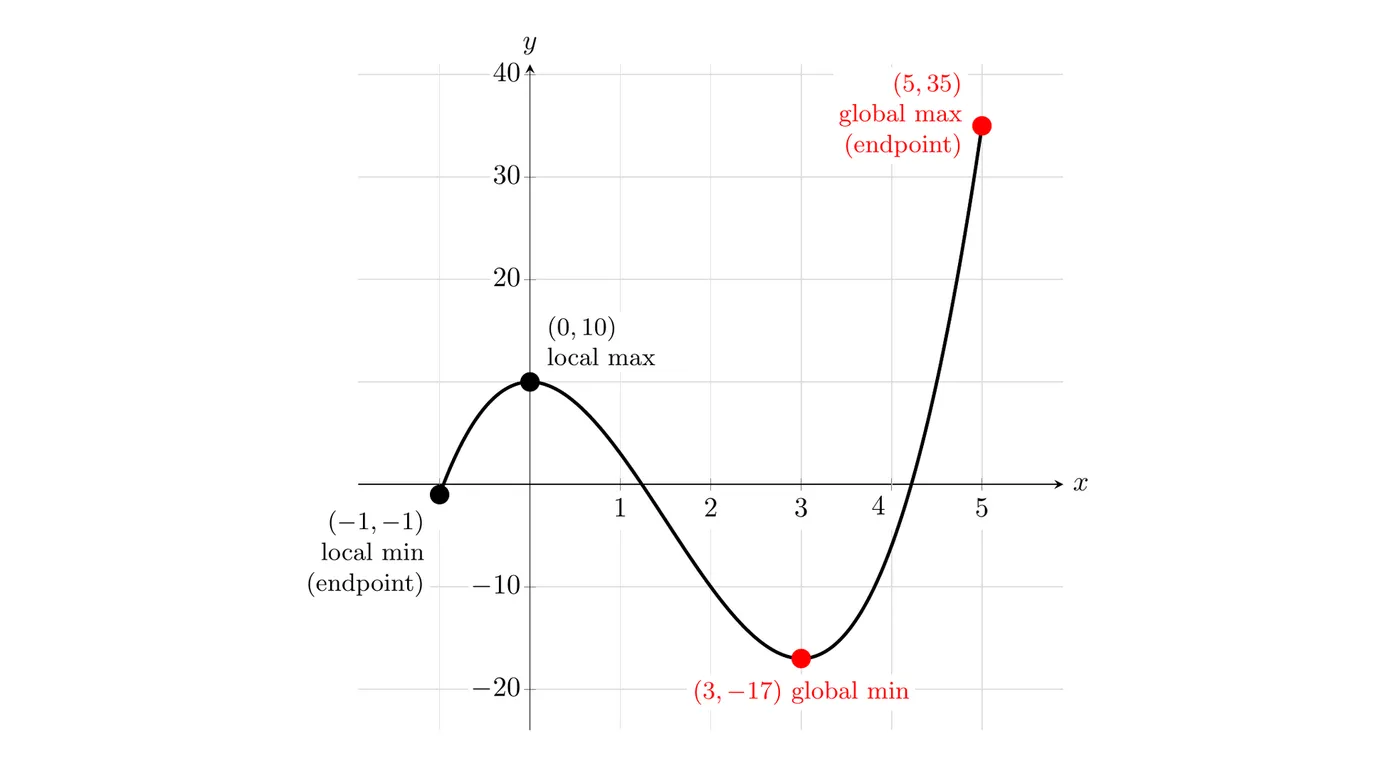
Step 1: Find where the graph turns or ends. Reading left to right, the graph starts at , rises to a peak at , falls to a valley at , and rises to the endpoint at .
Step 2: Compute the outputs at those inputs.
Step 3: Classify each one.
What happens there | Type | ||
Left endpoint, then increasing | Local min | ||
Increasing to decreasing | Local max | ||
Decreasing to increasing | Local min and global min | ||
Right endpoint, after increasing | Local max and global max |
Answer: has local minimums of at and at , and local maximums of at and at . The global maximum is and the global minimum is .
Notice that the global maximum is at an endpoint, not at the turning point , because is bigger than . On a restricted domain, always check the endpoints.
Technology: on calculator-active questions, find local extrema with your graphing calculator's maximum and minimum features (on a TI-84: 2nd, TRACE, then 3: minimum or 4: maximum).
Between two zeros, the graph must turn
Between every two distinct real zeros of a nonconstant polynomial, there is at least one local maximum or local minimum. The reason: the graph leaves the -axis at one zero and has to come back to it at the next. To come back, it has to turn around, and every turnaround is a local extremum.
Example 3: Counting turns from zeros
A polynomial has zeros at , , and , and no others. What is the least number of local extrema must have between and ?
Answer: at least , at least one in and at least one in .
You can see this in Example 2: has zeros near , , and , with the local maximum at between the first two zeros and the local minimum at between the last two.
Even degree means a global maximum or minimum
A polynomial of even degree always has either a global maximum or a global minimum. Both ends of its graph point the same way:
- Positive leading coefficient: both ends go up, so there's a global minimum but no global maximum.
- Negative leading coefficient: both ends go down, so there's a global maximum but no global minimum.
A polynomial of odd degree has ends that go in opposite directions, one up and one down. On its full domain it has no global maximum and no global minimum, though it can still have local ones.
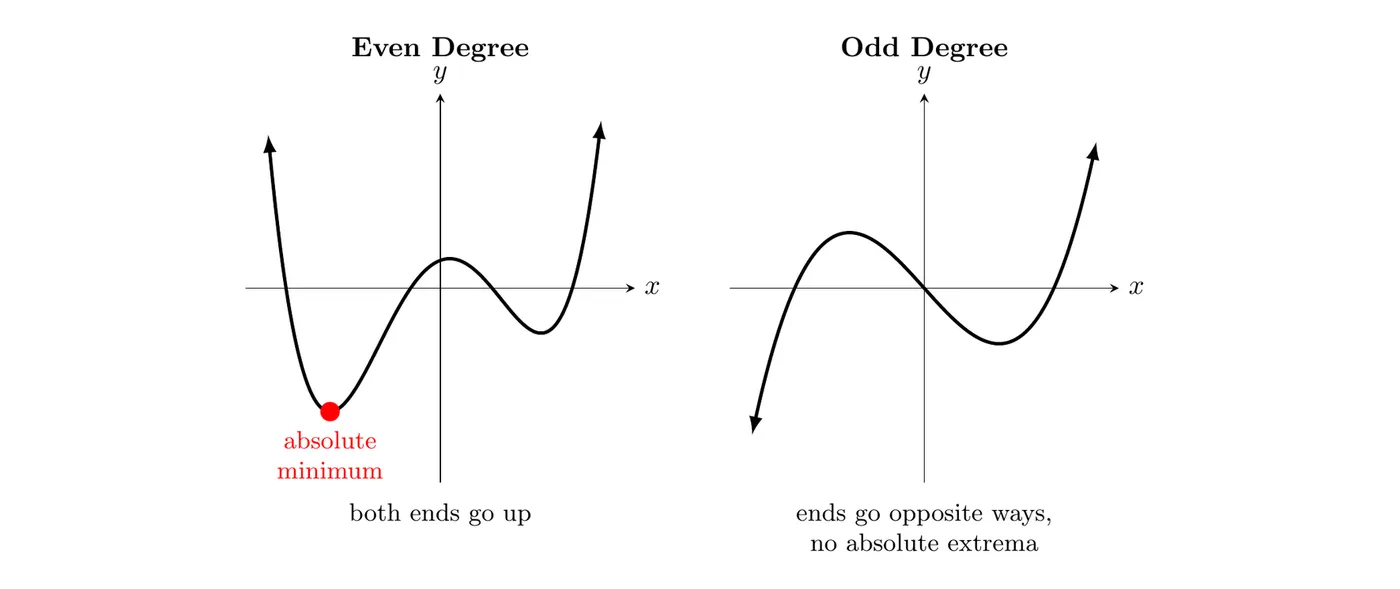
For a quadratic , the global extremum is at the vertex, where . It's a global minimum when and a global maximum when .
Example 4: The highest point of a throw
A ball's height, in feet, seconds after it is thrown is . What is the ball's maximum height?
The leading coefficient, , is negative, so the vertex is a global maximum.
Answer: the ball reaches a maximum height of feet, seconds after it is thrown.
Points of inflection
A point of inflection of a polynomial is a point where the rate of change switches from increasing to decreasing, or from decreasing to increasing. That's exactly where the graph changes from concave up to concave down, or from concave down to concave up.
One way to picture it: at a point of inflection, the graph is steeper (or less steep) than at the points around it, because the rate of change reaches a local maximum or minimum there.
Example 5: Supporting a point of inflection with rates
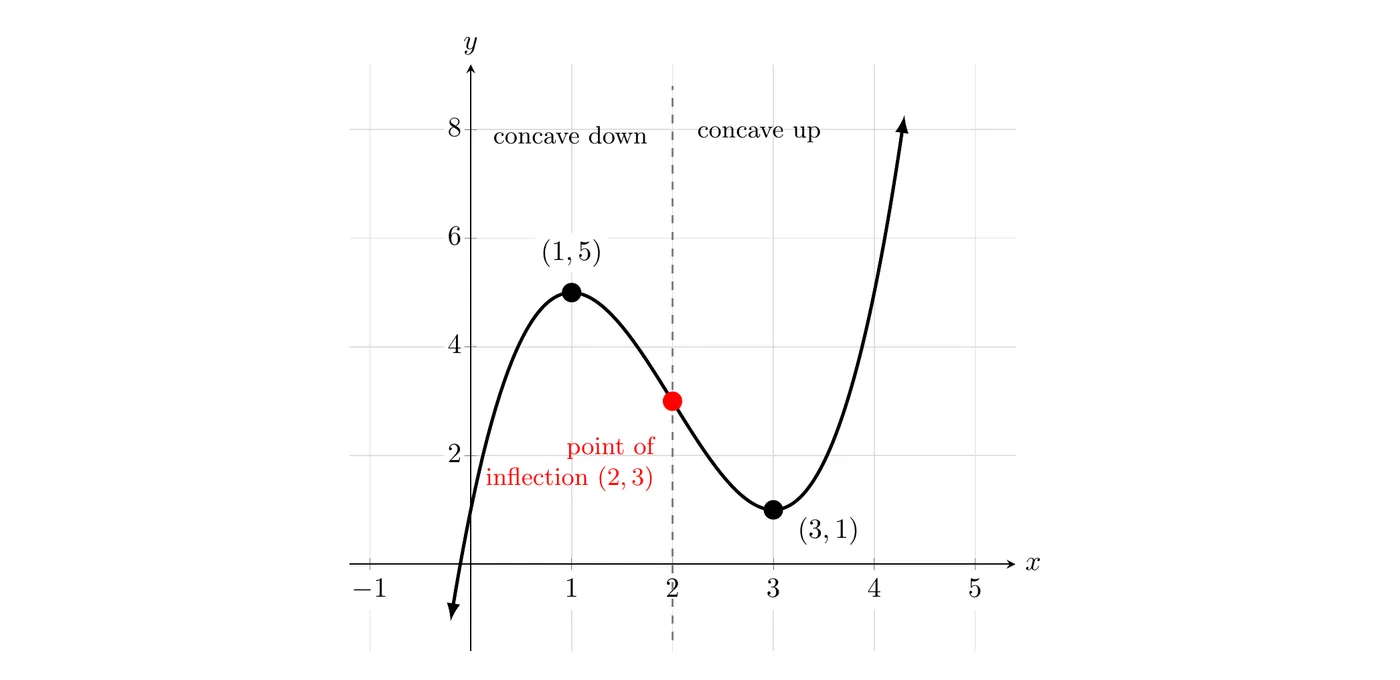
The graph of is shown above. Use average rates of change over intervals of length to support that the graph has a point of inflection at .
Using , , , , , , and :
Interval | Average rate of change |
To the left of , the average rates of change decrease (, then , then ), so the graph is concave down there. To the right of , they increase (, then , then ), so the graph is concave up.
Answer: the rate of change switches from decreasing to increasing at , so the graph has a point of inflection at .
Common mistakes
- Reading the leading coefficient before reordering. In , the leading coefficient is , not .
- Skipping the endpoints. On a restricted domain, a global maximum or minimum can be at an endpoint.
- Calling every peak global. A local maximum is only the global maximum if no other output is bigger.
- Thinking odd-degree polynomials have no extrema. They have no global extrema on their full domain, but they can have local ones.
- Mixing up extrema and points of inflection. Extrema are where the function changes direction. Points of inflection are where the rate of change changes direction.