

2.10 - Inverses of Exponential Functions
Overview
Exponential functions are one-to-one, so they have inverses, and those inverses are the logarithmic functions. This topic shows how and undo each other, why their tables and graphs are mirror images, and how their patterns of change are reversed: exponential outputs multiply when inputs add, and logarithmic outputs add when inputs multiply.
The general form of a logarithmic function
A logarithmic function in general form is
- is the base, with the same rules as in Topic 2.9.
- is a vertical dilation. It can't be 0, or the function would just be the constant 0. If , the graph is also reflected over the -axis.
When , you have the basic logarithmic function .
Logarithms and exponentials are inverses
An exponential function with an initial value of 1, , is always increasing (when ) or always decreasing (when ). So it's one-to-one and has an inverse. That inverse is the logarithm with the same base:
This comes straight from the definition in Topic 2.9. Using the swap method from Topic 2.8:
Since they're inverses, composing them in either order gives the identity function:
For example, , , and .
Ordered pairs flip
If is an ordered pair of , then is an ordered pair of . Here's base 2:
0 | 1 | 2 | 3 | |||
1 | 2 | 4 | 8 |
1 | 2 | 4 | 8 | |||
0 | 1 | 2 | 3 |
The pair on matches the pair on , which says . Two pairs come free for every base: on gives on , and on gives on .
Graphs: A reflection over
Because they're inverses, the graph of is the reflection of the graph of over the line , the graph of the identity function .
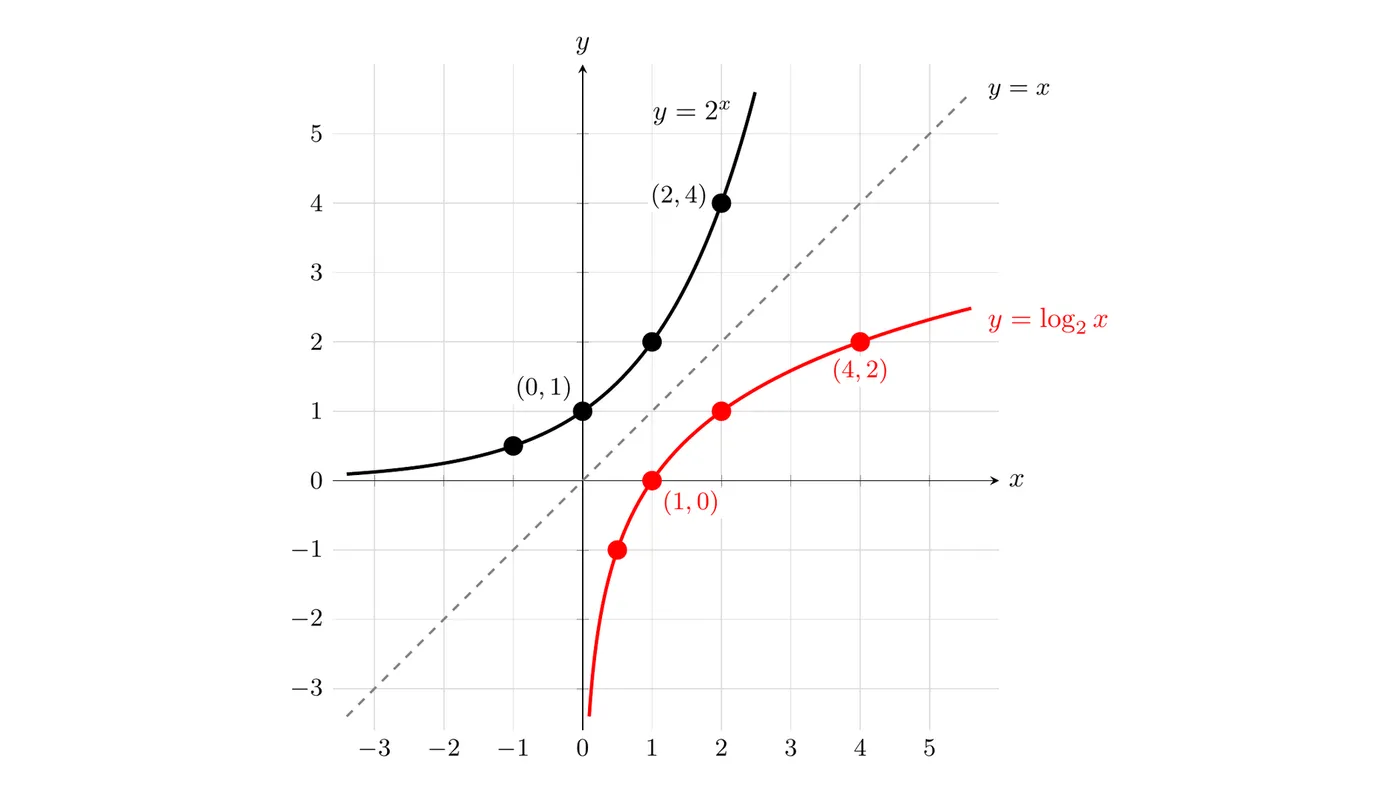
Every feature flips along with the points. The domain and range trade places: accepts every real number and gives only positive outputs, while accepts only positive inputs and gives every real output. The key points and become and , and the horizontal asymptote of the exponential becomes the vertical asymptote of the logarithm. Topic 2.11 lists these features for every base.
How inputs and outputs change together
Exponential and logarithmic functions have reversed patterns of change.
- Exponential, : as the inputs increase in equal-length steps (add the same amount), the outputs change proportionally (multiply by the same factor). Inputs add, outputs multiply.
- Logarithmic, : as the outputs increase in equal-length steps, the inputs change proportionally. Said the other way, when the inputs multiply by the same factor, the outputs add the same amount. Inputs multiply, outputs add.
For , each time doubles (1, 2, 4, 8, 16), the output goes up by 1 (0, 1, 2, 3, 4). For , each doubling of adds 3 to the output.
This is why logarithms grow so slowly. To raise from 10 to 20, has to go from all the way to .
To spot a logarithmic pattern in a table, check whether the inputs have a constant ratio while the outputs change by a constant amount.
Example 1: The inverse of an exponential function
Let . (a) Write the inverse of . (b) The point is on the graph of . What point is on the graph of ? (c) Find and .
Part (a). .
Part (b). Flip the pair: . This says .
Part (c). Since , . Since , .
Example 2: Finding the base from a point
The graph of passes through . Write the inverse of and name the point on its graph that matches .
Since , we need . Because , the base is . So and
The point on becomes on , which checks out: .
Example 3: Recognizing a logarithmic pattern (AP-style)
Values of a function are shown in the table.
1 | 3 | 9 | 27 | 81 | |
0 | 2 | 4 | 6 | 8 |
(a) Explain why a logarithmic function is a good model for . (b) Write a formula for in the form . (c) Find and the input with .
Part (a). As the outputs increase in equal steps of 2, the inputs are multiplied by 3 each time (1, 3, 9, 27, 81). The inputs change proportionally over equal-length output intervals, which is the pattern of a logarithmic function.
Part (b). Use the point :
So . Check another point: . It matches.
Part (c). Since :
For :
That fits the pattern: one more step after 81 multiplies the input by 3 (to 243) and adds 2 to the output (to 10).
Common mistakes
- Reflecting over the wrong line. , which equals , is the reflection of over the -axis, not its inverse. The inverse is , the reflection over .
- Forgetting the domain flip. only accepts , because only outputs positive numbers.
- Flipping only part of a point. Every point on becomes on . Both coordinates swap.
- Mixing up the patterns. Exponential: add to the input, multiply the output. Logarithmic: multiply the input, add to the output.
- Using the identity for nonpositive inputs. only holds for , because the log isn't defined for .