

2.9 - Logarithmic Expressions
Overview
A logarithm answers one question: what exponent do I need? Logarithms undo exponents, and the rest of Unit 2 uses them as the inverses of exponential functions. This topic covers what a logarithm means, how to evaluate one by hand or with technology, and how logarithmic scales work.
What a logarithm means
The expression is the exponent you raise to in order to get :
Here is the base, with and . In words, “log base of ” asks: to what power gives ?
- because .
- because .
Why the restrictions?
- The input must be positive (). A positive base raised to any power is positive, so no exponent makes zero or negative. That means and are undefined.
- The base can't be 1 (). Every power of 1 is 1, so would have no answer.
- The base must be positive (). Powers of a negative base flip between positive and negative and aren't even defined for some exponents, like .
The common log and the natural log
When no base is written, the base is 10. This is the common logarithm: because . You'll also see , the natural logarithm, which has base . It gets more attention in Topic 2.12.
Switching between forms
Every log statement is an exponential statement in disguise. The base stays the base, and the value of the log is the exponent.
Logarithmic form | Exponential form |
Evaluating logarithms
Values you can find by hand
Many logs can be found with basic arithmetic: rewrite as a power of , and the exponent is the answer.
Example 1: Evaluating without a calculator
Evaluate without a calculator: (a) (b) (c) (d) (e) (f)
(a) , so .
(b) , so .
(c) , so .
(d) , so .
(e) Write both numbers as powers of 2: and . We need , so and . So .
(f) , so .
Two facts to memorize: and for any valid base .
Estimating, then using technology
Most logs aren't whole numbers or simple fractions. You can still trap one between two integers using powers you know, then use a calculator for the decimal.
Example 2: Estimate, then compute
(a) Between which two consecutive integers is ? (b) Use technology to find and .
Part (a). and . Since :
Part (b). On a TI-84, logBASE( is in the MATH menu: logBASE(50, 2) gives . That's between 5 and 6, as expected. For the common log, use the LOG key: . That makes sense because is between and .
Logarithmic scales
On a normal (linear) scale, each unit adds the same amount: 0, 1, 2, 3, and so on. On a logarithmic scale, each unit multiplies by the base. With base 10, the marks are , which is 1, 10, 100, 1000, and so on.
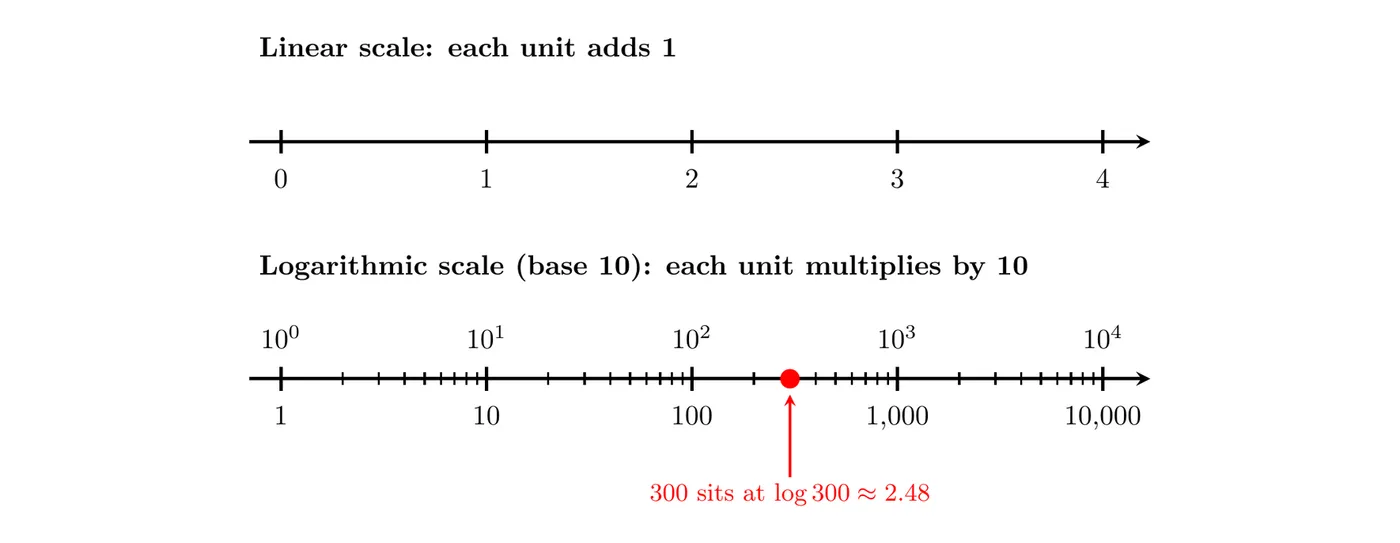
A number's position on a base-10 log scale is its common log. The number 300 sits at , just under halfway from the 100 mark to the 1000 mark. Notice how the small ticks (2, 3, 4, and so on up to 9 times each power of 10) bunch together as they get close to the next power.
Log scales are useful when values cover a huge range, like 1 to 1,000,000. On a linear scale, all the small values would be squished together near 0. You'll see log scales in:
- pH (acidity): a pH that is 1 unit lower means 10 times the hydrogen ion concentration.
- Earthquake magnitude (Richter scale): each 1-unit increase means the measured shaking amplitude is 10 times larger.
- Decibels (loudness): each 10 dB increase means 10 times the sound intensity.
Example 3: Comparing values on a log scale (AP-style)
(a) Lemon juice has a pH of about 2, and black coffee has a pH of about 5. How many times greater is the hydrogen ion concentration in lemon juice?
(b) On a base-10 logarithmic scale, point is at the mark for , and point is 3 units to the right of . What value does represent, and how does it compare to ?
(c) Where would 5,000 be placed on that scale?
Part (a). The pH values differ by units, and each unit is a factor of 10:
The hydrogen ion concentration in lemon juice is about 1,000 times that in black coffee.
Part (b). Moving 3 units right multiplies by 10 three times:
represents 10,000, which is times the value at (which is 10).
Part (c). , so 5,000 sits about 70% of the way from the mark to the mark.
Common mistakes
- Mixing up the roles. In , the base is and the answer is the exponent: . It is not .
- Taking the log of 0 or a negative number. It's undefined. The number inside the log must be positive.
- Thinking a log can't be negative. The log is negative whenever (for a base above 1), like . It's that must be positive, not the answer.
- Reading a log scale like a linear one. Equal spaces on a log scale mean equal ratios, not equal differences.
- Pressing LOG for any base. The LOG key is base 10 only. Use logBASE( for other bases.