

2.1 - Change in Arithmetic and Geometric Sequences
Overview
A sequence is an ordered list of numbers made by a rule. This topic covers the two patterns that matter most in AP Precalculus: arithmetic sequences, which change by adding the same amount each step, and geometric sequences, which change by multiplying by the same amount each step. They are the step-by-step versions of linear and exponential functions, so the rest of Unit 2 builds on them.
What a sequence is
A sequence is a function from the whole numbers to the real numbers. The inputs are and the output for input is written (read "a sub n"). It's called the th term.
Because the inputs are only whole numbers, the graph of a sequence is a set of separate points, not a connected curve. There is a term and a term , but no term .
AP Precalculus usually starts counting at , so is the initial value, the value before any steps have happened. Some problems start at instead, so always check which term comes first.
0 | 1 | 2 | 3 | 4 | |
3 | 7 | 11 | 15 | 19 |
Here , , and so on. Graphed, this sequence is five dots, one above each whole number from 0 to 4.
Arithmetic sequences
The common difference
In an arithmetic sequence, you get each term by adding the same number to the term before it. That number is the common difference, :
The input goes up by 1 each step and the output always changes by , so the common difference is a constant rate of change. It plays the same role that slope plays for a line. If the sequence increases, and if it decreases.
In the table above, , , , and , so the sequence is arithmetic with .
The general term
To reach term from the initial value, you add exactly times:
If you know some other term instead of , start there. Getting from term to term takes steps, and each step adds :
With this becomes , the version many textbooks use when a sequence starts at . Both forms describe the same sequence.
Example 1: An arithmetic sequence from two terms
An arithmetic sequence has and . Find a formula for , then find .
Step 1: find the common difference. Going from term 3 to term 8 is steps, and the value goes up by .
Step 2: write the general term from the known term (so ).
Step 3: simplify to find the initial value.
So . Check: , which matches.
Step 4: evaluate.
Answer: (or ), and .
Geometric sequences
The common ratio
In a geometric sequence, you get each term by multiplying the term before it by the same number. That number is the common ratio, :
Multiplying by the same factor each step is called constant proportional change. Every term is the same multiple of the term before it, which also means the percent change is the same every step. For example, means each term is 5% larger than the one before it.
For increasing or decreasing geometric sequences (the kind this course studies), and . With positive terms, means the sequence increases and means it decreases.
The general term
To reach term from the initial value, multiply by exactly times:
If you know a term instead, multiply by once for each of the steps:
Example 2: A geometric sequence from two terms
A geometric sequence has and . Find a formula for , then find .
Step 1: find the common ratio. From term 1 to term 4 is 3 steps, so you multiply by three times.
Step 2: write the general term from the known term .
Step 3: find the initial value. Going back one step means dividing by , so and .
Step 4: evaluate.
Answer: , and . Check: , which matches.
How arithmetic and geometric growth compare
An increasing arithmetic sequence goes up by the same amount every step. An increasing geometric sequence of positive values goes up by a larger amount every step. Compare two sequences that both start at 2:
0 | 1 | 2 | 3 | 4 | 5 | 6 | |
2 | 5 | 8 | 11 | 14 | 17 | 20 | |
change in | +3 | +3 | +3 | +3 | +3 | +3 | |
2 | 3 | 4.5 | 6.75 | 10.125 | 15.1875 | 22.78125 | |
change in | +1 | +1.5 | +2.25 | +3.375 | +5.0625 | +7.59375 |
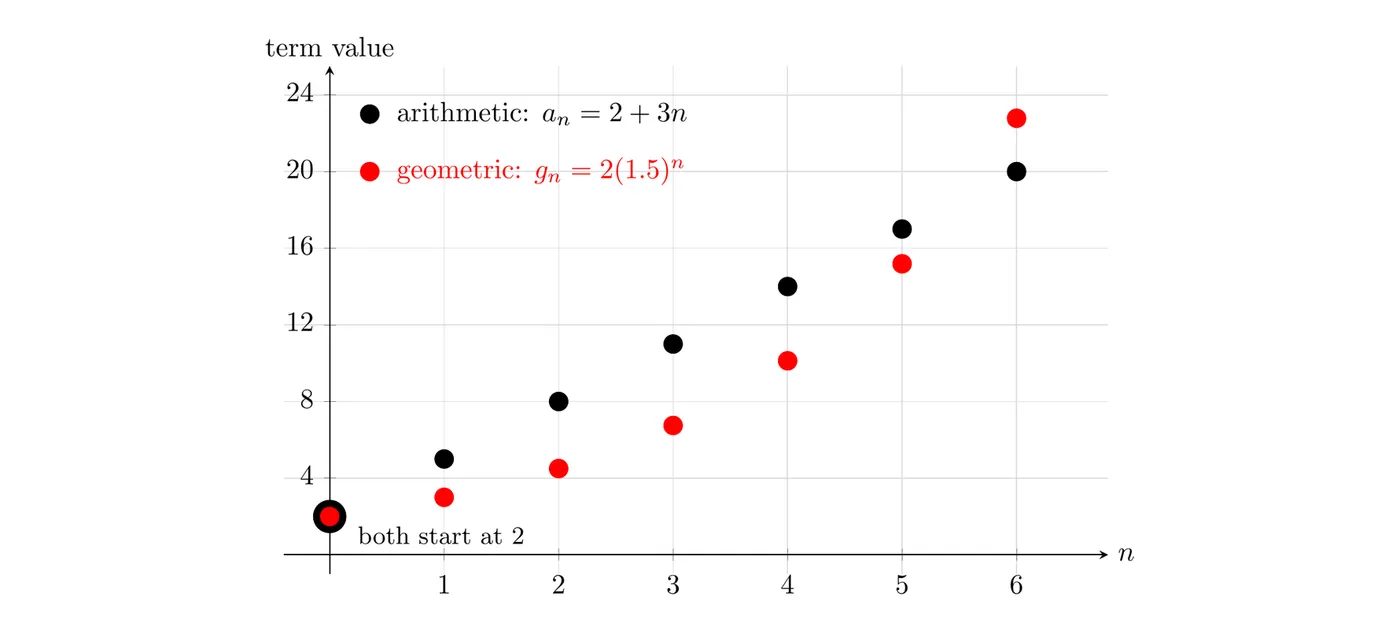
The reason is that each geometric step adds a fixed fraction of the current term:
With , each step adds 50% of the current term. As the terms grow, 50% of them grows too, so the steps keep getting bigger. The geometric sequence starts out slower here, but it passes the arithmetic sequence between and and stays ahead from then on. This is a big idea for all of Unit 2: repeated multiplication eventually beats repeated addition.
Example 3: Which kind of sequence?
Each sequence below starts at . Decide whether it is arithmetic, geometric, or neither, and write a formula when you can.
- Sequence A: 6, 11, 16, 21. The differences are 5, 5, 5, so it's arithmetic with : .
- Sequence B: 6, 9, 13.5, 20.25. The differences 3, 4.5, 6.75 aren't constant, but the ratios are: . It's geometric with : .
- Sequence C: 6, 8, 12, 18. The differences 2, 4, 6 aren't constant, and the ratios , , aren't constant either. It's neither.
Check every pair, not just the first one or two. Sequence C has two equal ratios in a row, but the first ratio doesn't match them.
Example 4: A bouncing ball (AP-style)
A ball is dropped from a balcony. After the 1st bounce it rises to 150 cm, after the 2nd bounce to 120 cm, and after the 3rd bounce to 96 cm.
(a) Is the sequence of bounce heights arithmetic or geometric?
The differences are and . They're not equal, so the sequence is not arithmetic. The ratios are and , so it's geometric with . Each bounce reaches 80% of the height of the bounce before it.
(b) Write a formula for , the height in centimeters after the th bounce.
The first known term is , so use the known-term form with :
(c) How high does the ball rise after the 6th bounce?
After the 6th bounce, the ball rises to about 49.2 cm.
(d) Find and explain what it means.
Go back one step from by dividing by : . If the pattern holds all the way back to the drop, the ball was dropped from a height of 187.5 cm.
Common mistakes
- Connecting the dots. A sequence's graph is separate points. A curve through them suggests terms like that don't exist.
- Counting steps wrong. From to is 5 steps, not 8. In , the number of steps is .
- Mixing up the starting term. If the first term is , then , not .
- Subtracting to find a ratio. The common ratio comes from dividing consecutive terms, .
- Checking only one pair. A sequence is arithmetic or geometric only if every consecutive pair has the same difference or the same ratio.