

2.13 - Exponential and Logarithmic Equations and Inequalities
Overview
This topic is about solving equations and inequalities where the variable is in an exponent or inside a log. The main tool is the inverse relationship: logs undo exponentials, and exponentials undo logs. You'll also check for extraneous solutions, rewrite exponentials in a different base, and build the inverse of a transformed exponential or log function. These skills show up all over the AP exam, especially in modeling questions.
The main tools
- Inverse relationship: for every , and for .
- Switching forms: means the same thing as .
- One-to-one: exponential and log functions are always increasing or always decreasing, so if then , and if (with ) then .
- Properties of exponents (Topic 2.4) and properties of logs (Topic 2.12) to combine or split terms.
Solving exponential equations
Strategy: get the exponential part by itself. Then either rewrite both sides with the same base, or take a log of both sides.
Example 1: Matching bases
Solve .
Both 9 and 27 are powers of 3, so rewrite both sides with base 3:
The bases match, so the exponents must be equal:
Check: and . So .
Example 2: Isolate, then take a log
Solve .
Isolate the exponential part:
Rewrite in log form (this is the same as taking of both sides):
Check: .
Example 3: Different bases on both sides
Solve .
The bases can't be matched, so take of both sides and use the power property to bring the exponents down:
Now is in two places. Gather the terms on one side and factor out :
Check: and .
Solving logarithmic equations
Strategy: use the properties from Topic 2.12 to combine everything into a single log, then rewrite in exponential form. Then check every answer in the original equation.
Example 4: Combine, then rewrite (AP-style)
Solve .
Use the product property to combine the left side:
Rewrite in exponential form and solve the quadratic:
Check both in the original equation. For : , so it works. For : is undefined, so is extraneous.
Answer:
Extraneous solutions
An extraneous solution is a value you get from correct algebra that doesn't actually work in the original equation. Whether you solve with algebra or with a graph, you have to check your results against the limits of the math and of the context. With exponentials and logs, extraneous solutions come from three places:
- Combining logs widens the domain. In Example 4, needs , but also works for . That's how sneaked in.
- Impossible exponential values. is always positive, so any step that leads to something like gives no solution.
- Context limits. A model might only make sense for , or for whole numbers of people. A negative time can be fine mathematically and still be meaningless in the context.
Habit: before you solve a log equation, write down its domain (the input of every log must be positive). After you solve, cross out anything outside it.
Solving with a graph
You can also solve an equation by graphing each side as its own function and finding where the graphs intersect. For Example 4, graph and (on a TI-84, use logBASE or type as ), then use the intersect tool. You'll only find , because doesn't exist for . A graph of the original equation never shows answers outside its domain (the extraneous ones), so it's a good way to check your algebra. You still have to check its answers against the context.
Solving inequalities
Solve inequalities the same way as equations, with one extra question at every step: does this step keep the inequality pointing the same way?
- If , then and are increasing. Applying them to both sides keeps the direction: if , then .
- If , they're decreasing, so applying them flips the direction.
- Dividing both sides by a negative number flips it too. Watch out: and are negative when .
- For a log inequality, the answer also has to stay inside the domain.
Example 5: A base less than 1
Solve .
Take of both sides. Since is increasing, the direction stays the same:
Now divide by , which is negative (about ), so the inequality flips:
Answer: . This makes sense: is decreasing, so the outputs get smaller as gets bigger. , and every past 3 gives something smaller still.
Example 6: A log inequality
Solve .
Domain first: , so .
Since is increasing, raise 2 to the power of each side without flipping:
Answer: put both conditions together: .
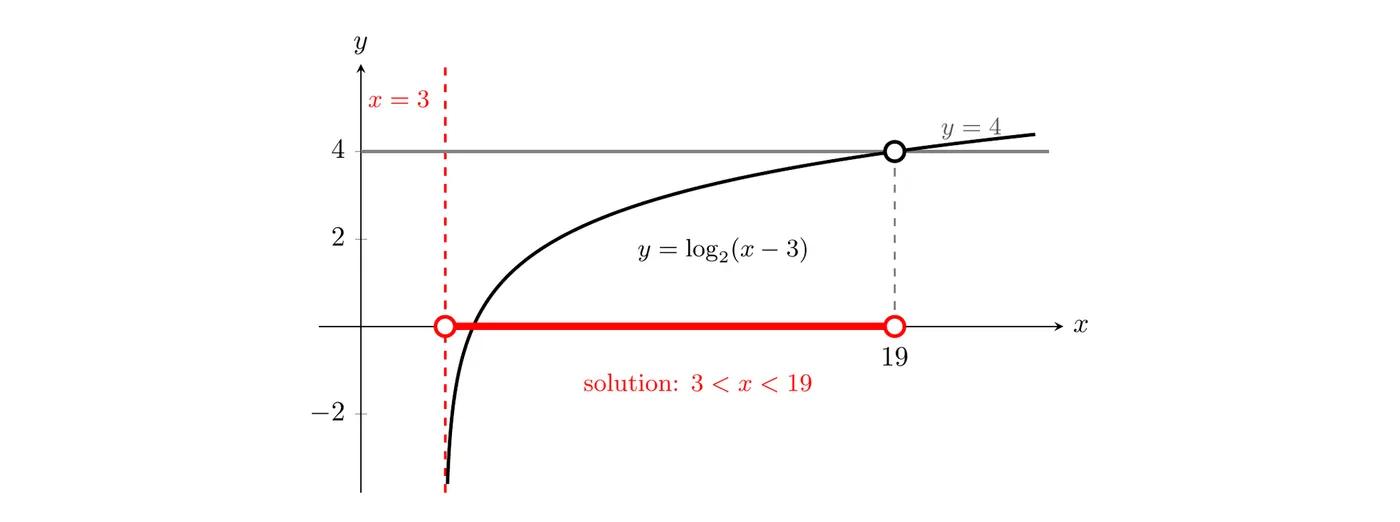
The graph shows it: the curve is below the line from the asymptote at up to . If you forgot the domain, you'd write , which wrongly includes values like where the log doesn't exist.
Example 7: An inequality in context (AP-style)
Suppose a town's population is modeled by , where is the number of years since 2020. When will the population be more than 2000?
Take of both sides, then divide by . It's positive, so the direction stays:
Answer: the population passes 2000 about 10.5 years after 2020, partway through 2030. (Check: and .)
Rewriting exponentials in a different base
Logs let you rewrite an exponential with any other base (with and ):
Why it works: by the inverse relationship, . So .
This can reveal helpful information: it lets you compare functions with different bases on the same footing, and it lets you write a model in base or base 10 when a problem asks for it.
- , so is with a horizontal dilation by a factor of .
Example 8: Rewriting a model in base
Write in the form .
Use , so :
Answer: . Both forms give the same outputs; for example, either way (as long as you use the unrounded ).
Inverses of exponential and logarithmic functions
In Topic 2.10 you saw that and are inverses. Now the functions have additive transformations on them:
To find the inverse, reverse the mapping: list what does to , in order, then undo each step in the opposite order. (Swapping and and solving for does the same thing.) For the exponential:
Step | What does to | How the inverse undoes it |
1 | add | subtract (last) |
2 | raise to that power | take |
3 | multiply by | divide by |
4 | add | subtract (first) |
So the inverse is
The same idea for the log: the inverse of is
Don't memorize these formulas. Rebuild them by undoing the steps. Also remember that the domain and range swap: the horizontal asymptote of the exponential becomes the vertical asymptote of its inverse.
Example 9: Inverse of an exponential function
Find the inverse of and give its domain.
Write , swap and , and solve for :
Domain: the range of is (its horizontal asymptote is ), so the domain of is . The formula agrees: means .
Check: , and .
Example 10: Inverse of a logarithmic function (AP-style)
Let . Find and describe how the two graphs are related.
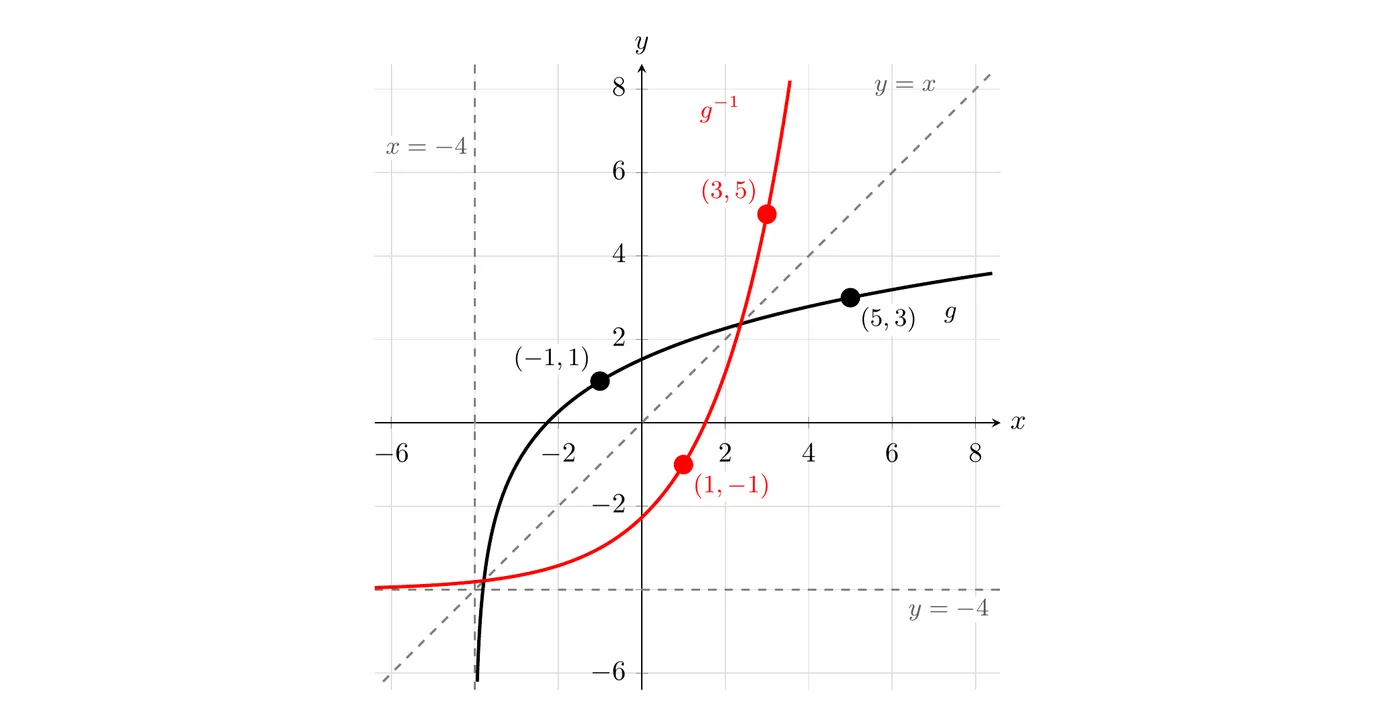
Answer: . The graphs are reflections of each other over , so every point swaps its coordinates. Since , the point is on and is on . Likewise , so and match up. The vertical asymptote of becomes the horizontal asymptote of .
Common mistakes
- Taking a log of a sum term by term. is not . Isolate the exponential before taking a log.
- Skipping the check. Log equations often produce extraneous solutions. Plug every answer back into the original equation.
- Not flipping the inequality when you divide by or with . Those logs are negative.
- Forgetting the domain in a log inequality. is , not just .
- Undoing steps in the wrong order when building an inverse. Undo the last thing did first (usually subtract ).