The same exponential function can be written in many ways: 2x+3 and 8⋅2x look different, but they're the exact same function. This topic covers the exponent rules that let you switch between forms, and what each rule means for the graph. AP questions often ask you to rewrite an expression in a specific form, like abx, and that takes exactly these skills.
The product property
bmbn=bm+n
Why it works:bm is m factors of b and bn is n more, so together there are m+n factors. For example, 23⋅24=(2⋅2⋅2)(2⋅2⋅2⋅2)=27.
What it means for the graph
Apply the product property to a horizontal translation of y=bx:
bx+k=bx⋅bk=abx,where a=bk
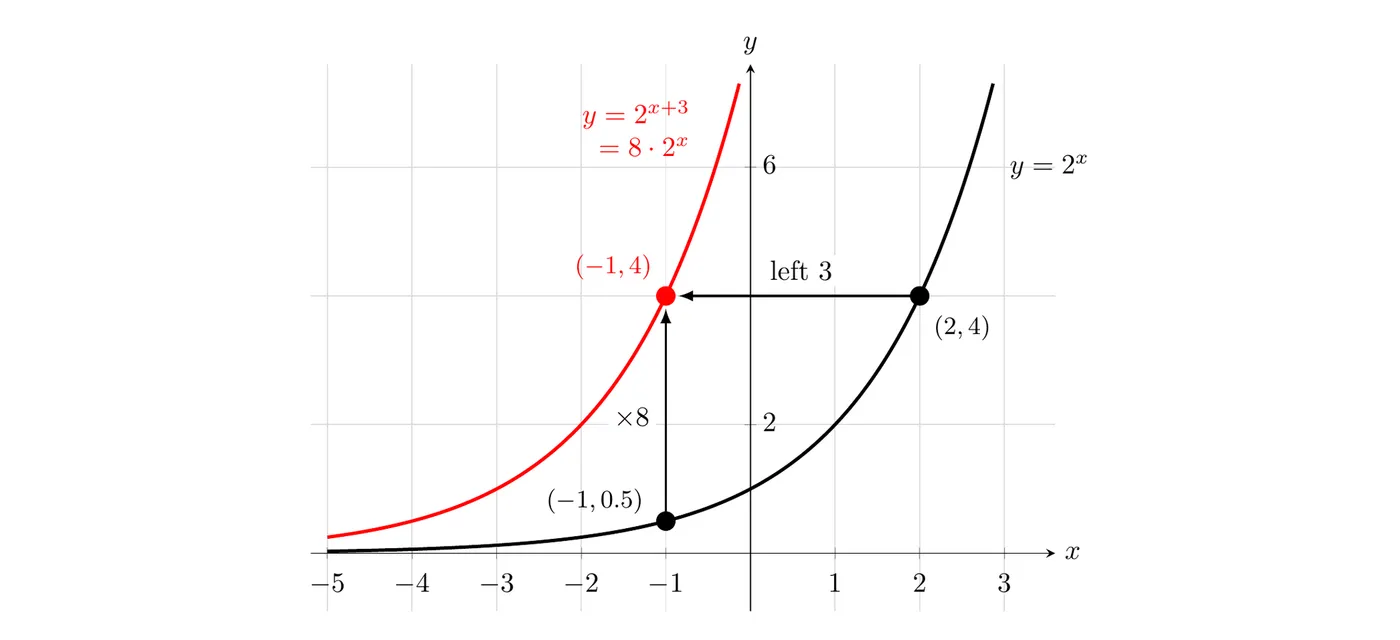
So every horizontal translation of an exponential function is also a vertical dilation. For example,
2x+3=23⋅2x=8⋅2x
Shifting y=2x left 3 units gives exactly the same graph as stretching it vertically by a factor of 8. In the figure, the point (2,4) moves left 3 to (−1,4), and the point (−1,0.5) stretches up by a factor of 8 to the same point (−1,4).
A shift to the right works the same way, but it gives a vertical compression: 2x−1=2−1⋅2x=21⋅2x.
Related rule: dividing powers with the same base subtracts exponents, bnbm=bm−n. It comes from the product property together with negative exponents (below).
The power property
(bm)n=bmn
Why it works:(bm)n is n copies of bm multiplied together, and each copy has m factors of b, for mn factors in all. For example, (23)2=23⋅23=26.
What it means for the graph
Apply the power property to a horizontal dilation of y=bx:
bcx=(bc)x,c=0
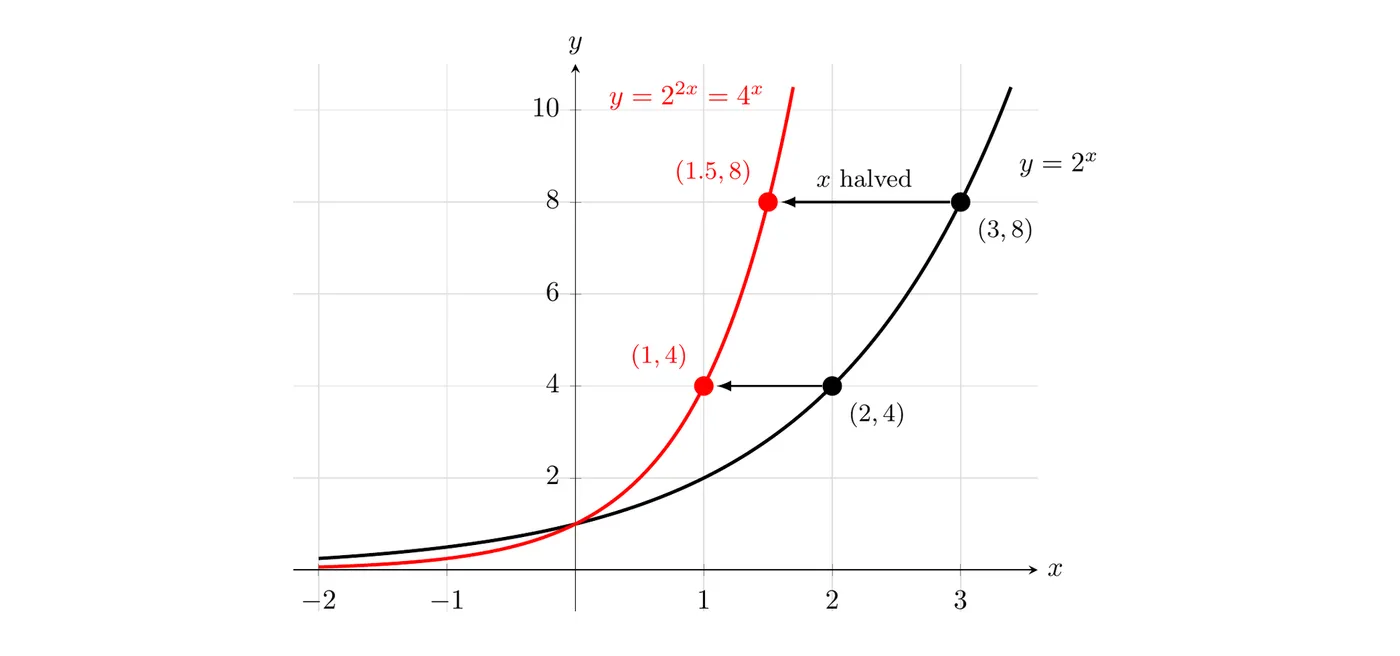
Since bc is just a constant, this is an exponential function with a new base. So every horizontal dilation of an exponential function is a change of base. For example,
22x=(22)x=4x
Compressing y=2x horizontally by a factor of 21 gives y=4x. Every point's x-coordinate is cut in half: (2,4) moves to (1,4), and (3,8) moves to (1.5,8).
It works with fractions too: 9x/2=(91/2)x=3x.
The negative exponent property
b−n=bn1
Why it works: by the product property, bn⋅b−n=b0=1, so b−n is the number you multiply bn by to get 1. That's the reciprocal, bn1.
A negative exponent does not make the value negative: 2−3=81, not −8.
For graphs, combine it with the power property (using c=−1):
2−x=(2−1)x=(21)x
Reflecting y=2x over the y-axis gives y=(21)x. Any growth function reflected over the y-axis becomes a decay function, and the new base is the reciprocal of the old one.
Unit fraction exponents and roots
An exponent of the form k1, where k is a natural number, means the kth root:
b1/k=kb
Why it works: by the power property, (b1/k)k=b(1/k)⋅k=b1=b. So b1/k is the number whose kth power is b, which is exactly what the kth root means. For example, 81/3=2 because 23=8, and 811/4=3 because 34=81.
The root has to exist. (−8)1/3=−2 is fine, but (−16)1/4 is not a real number, since no real number to the 4th power is negative. In exponential functions the base is always positive, so this never causes a problem there.
Other fraction exponents combine a root and a power: bm/k=(b1/k)m. For example, 272/3=(271/3)2=32=9.
Property
Rule
What it means for y=bx
Product
bmbn=bm+n
A horizontal translation is a vertical dilation: bx+k=bk⋅bx
Power
(bm)n=bmn
A horizontal dilation is a change of base: bcx=(bc)x
Negative exponent
b−n=bn1
A reflection over the y-axis gives base b1: b−x=(b1)x
Unit fraction
b1/k=kb
Rewrites bases with roots, like 4x/2=2x
Example 1: Translation to dilation
Write f(x)=5⋅3x−2 in the form abx.
f(x)=5⋅3x⋅3−2=5⋅91⋅3x=95⋅3x
Answer:f(x)=95(3)x, so a=95 and b=3. Shifting y=5⋅3x right 2 units is the same as multiplying its outputs by 91.
Example 2: Changing the base
Write each function in the form abx: (a)g(x)=7⋅4x/2 and (b)h(x)=10(21)−2x.
(a) Use the power property with c=21:
g(x)=7(41/2)x=7⋅2x
(b) Use the power property with c=−2, then the negative exponent property:
h(x)=10((21)−2)x=10(22)x=10⋅4x
Answer:g(x)=7⋅2x and h(x)=10⋅4x. Both show exponential growth, even though h was written with a base less than 1.
Example 3: Evaluating without a calculator
323/5=(321/5)3=23=8
9−1/2=91/21=31
16−3/4=(161/4)31=231=81
(81)−2/3=82/3=(81/3)2=22=4
Take the root first. It keeps the numbers small.
Example 4: Rewriting a combined expression (AP-style)
Rewrite k(x)=8x/32x+3⋅4x−1 in the form abx. Does k show exponential growth or decay?
Step 1: write every factor with base 2, since 4=22 and 8=23.
4x−1=(22)x−1=22x−28x/3=(23)x/3=2x
Step 2: combine with the product and quotient rules.
k(x)=2x2x+3⋅22x−2=2(x+3)+(2x−2)−x=22x+1
Step 3: split off the constant and change the base.
22x+1=21⋅22x=2(22)x=2⋅4x
Answer:k(x)=2⋅4x. Since a=2>0 and b=4>1, k shows exponential growth: its output is multiplied by 4 each time x increases by 1. Check with x=1: the original gives 81/324⋅40=216=8, and 2⋅41=8.
Common mistakes
Multiplying exponents when you should add.bmbn=bm+n, not bmn. Multiplying exponents is for a power of a power.
Combining the coefficient with the base.3⋅2x is not 6x. The exponent only applies to the 2.
Treating a negative exponent as a negative number.2−3=81.
Not distributing the exponent.4x−1=22(x−1)=22x−2, not 22x−1.
Turning a sum in the exponent into a sum of powers.2x+3=2x⋅23, not 2x+23.