Logs follow a few rules that let you rewrite them: the product property, the power property, and the change of base property. Each one comes straight from an exponent rule, and each one also says something about graphs. On the AP exam you'll use them to rewrite expressions, to solve equations (Topic 2.13), and to see when one log function is a transformation of another.
Where the properties come from
A log is an exponent: logbx is the power you raise b to in order to get x. So every exponent rule turns into a log property:
Exponent rule
Log property
bm⋅bn=bm+n
logb(xy)=logbx+logby
bnbm=bm−n
logb(yx)=logbx−logby
(bm)n=bmn
logb(xn)=nlogbx
All of these need x>0 and y>0, since you can only take logs of positive numbers.
The product property
logb(xy)=logbx+logby
Why it works: let m=logbx and n=logby, so x=bm and y=bn. Then xy=bm⋅bn=bm+n, which means logb(xy)=m+n=logbx+logby.
Examples:log224=log2(8⋅3)=log28+log23=3+log23. Going the other way, log4+log25=log100=2.
What it means for graphs
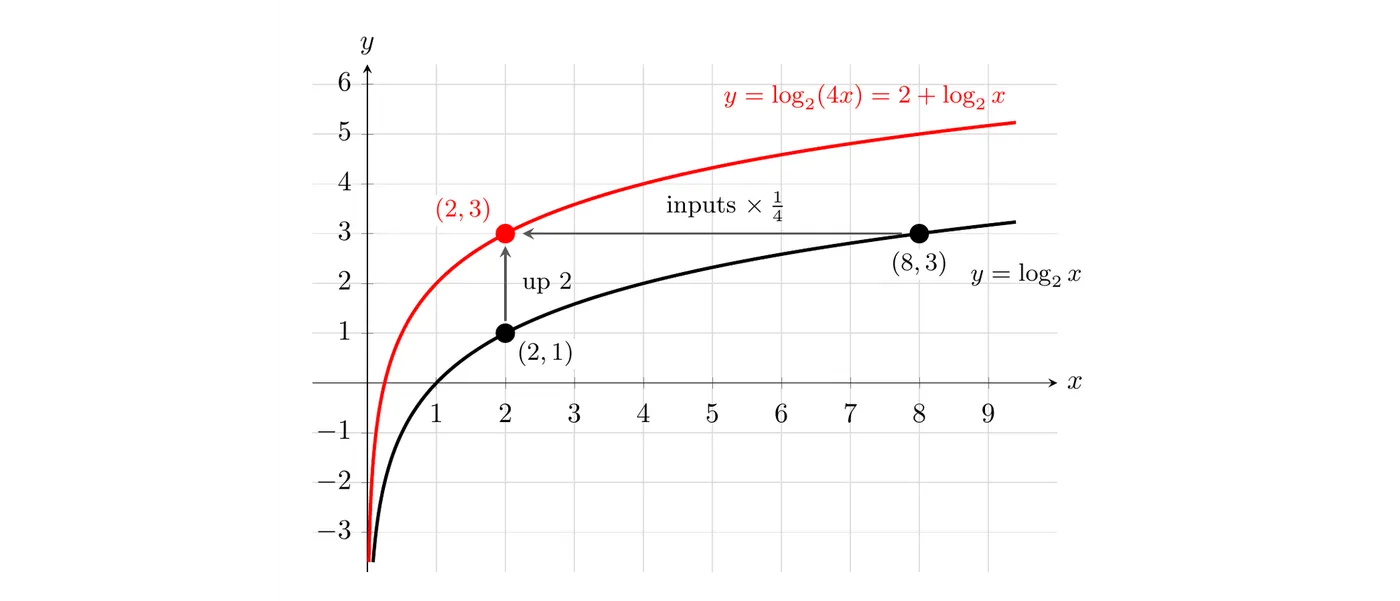
Take f(x)=logb(kx) with k>0. Multiplying the input by k is a horizontal dilation by a factor of k1. But the product property splits it into a sum:
So every horizontal dilation of a log function is the same as a vertical translation. For example, log2(4x)=log24+log2x=2+log2x. Squeezing y=log2x toward the y-axis by a factor of 41 gives exactly the same graph as shifting it up 2.
In the graph, the point (8,3) on y=log2x moves to (2,3) when the inputs are multiplied by 41, and the point (2,1) moves to (2,3) when you shift up 2. Both moves land on the same red curve.
The quotient property
You'll also use a quotient property. It comes from the product and power properties, since dividing by y is multiplying by y−1:
logb(yx)=logbx+logb(y−1)=logbx−logby
Example:log3(9x)=log3x−log39=log3x−2. On a graph, dividing the input by 9 (a horizontal stretch by a factor of 9) is the same as shifting down 2.
The power property
logb(xn)=nlogbx
Why it works: if m=logbx, then x=bm, so xn=(bm)n=bmn. That means logb(xn)=mn=nlogbx.
Raising the input to a power, f(x)=logb(xk), gives f(x)=klogbx. That's a vertical dilation by a factor of k. So y=log3(x4) is y=log3x stretched vertically by a factor of 4: every output is 4 times as big.
Domain warning:log3(x4) is defined for every x=0, since x4>0, but 4log3x only works for x>0. The two match for x>0. This difference is one way extraneous solutions show up in Topic 2.13.
The change of base property
logbx=logablogax,where a>0 and a=1
Why it works: let y=logbx, so by=x. Take loga of both sides: loga(by)=logax. The power property turns this into ylogab=logax, so y=logablogax.
Use 1, calculators. Most calculators only have log (base 10) and ln (base e). To find log350:
log350=ln3ln50≈1.09863.9120≈3.561
That makes sense: 33=27 and 34=81, so the answer should be between 3 and 4. (Check: 33.561≈50.)
Use 2, graphs. The denominator logab is just a number, so logbx=logab1⋅logax. That means all logarithmic functions are vertical dilations of each other. For example, since log28=3:
log8x=log28log2x=31log2x
So the graph of y=log8x is the graph of y=log2x compressed vertically by a factor of 31.
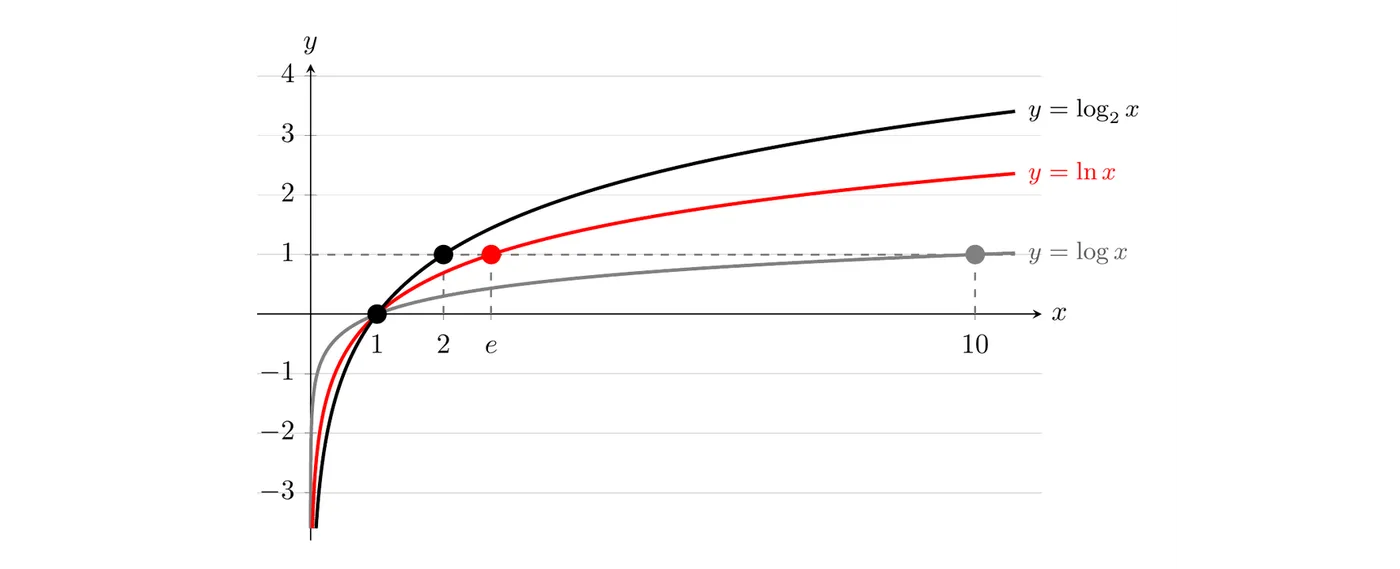
All three curves pass through (1,0), and each one reaches a height of 1 at its own base: (2,1), (e,1), and (10,1). Each is a vertical dilation of the others. For example, log2x=ln2lnx≈1.443lnx.
The natural logarithm
The natural logarithm is the log with base e≈2.718: lnx=logex. It's a logarithmic function like any other, so every property above works for it.
ln1=0 and lne=1
ln(ex)=x for every x, and elnx=x for x>0, because lnx and ex are inverses
ln(5x)=ln5+lnx, ln(x3)=3lnx, and logbx=lnblnx
You'll see ln a lot in modeling (Topic 2.14) and in calculus, because e shows up naturally in continuous growth.
Summary
Property
Rule
What it means for a graph
Product
logb(xy)=logbx+logby
a horizontal dilation is the same as a vertical translation
Quotient
logb(yx)=logbx−logby
dividing the input is also a vertical translation
Power
logb(xn)=nlogbx
raising the input to a power is a vertical dilation
Change of base
logbx=logablogax
every log function is a vertical dilation of every other
Examples
Example 1: Expanding a log
Write log2(y8x3) as a sum and difference of simpler logs. Assume x>0 and y>0.
Split the quotient, then the product, then use the power property:
Use the power property first, so every log has a coefficient of 1. Then combine with the product and quotient properties:
2lnx+ln(x+1)−ln5=ln(x2)+ln(x+1)−ln5=ln(5x2(x+1))
Answer:ln(5x2(x+1)), for x>0.
Example 3: Log functions as transformations of each other (AP-style)
Let f(x)=log2(8x5), g(x)=log2x, and h(x)=log4x.
Write f(x) in the form f(x)=c+klog2x.
Describe how the graph of f is related to the graph of g.
Write h as a transformation of g.
Part 1: use the product property, then the power property:
f(x)=log28+log2(x5)=3+5log2x
Part 2: the graph of f is the graph of g dilated vertically by a factor of 5, then translated up 3. (Check with x=2: f(2)=log2256=8, and 3+5log22=8.)
Part 3: use change of base with base 2:
h(x)=log4x=log24log2x=21log2x=21g(x)
Answer:f(x)=3+5log2x, a vertical dilation of g by 5 and a shift up 3. The graph of h is the graph of g dilated vertically by a factor of 21. (Check: h(16)=2 and 21log216=2.)
Common mistakes
logb(x+y) is notlogbx+logby. The product property is about the log of a product, not a sum. logb(x+y) can't be split.
(logbx)2 is not2logbx. The power property only works when the power is on the input: logb(x2)=2logbx.
logbylogbx is notlogb(yx). A quotient of logs is a change of base: logbylogbx=logyx.
Flipping change of base. The input goes on top and the base on the bottom: log350=ln3ln50, not ln50ln3.
Combining before using the power property. In 2lnx+ln(x+1), turn 2lnx into ln(x2) first. The 2 does not multiply (x+1).