

2.8 - Inverse Functions
Overview
An inverse function undoes what a function does: if sends to , the inverse sends back to . This topic covers when a function has an inverse, how to find it from a table, a graph, or an equation, and what it means in context. Inverses are the bridge to logarithms, which are the inverses of exponential functions.
When does a function have an inverse?
On a given domain, a function has an inverse function, or is invertible, if each output value comes from exactly one input value. A function like this is called one-to-one.
Why this matters: the inverse has to send each output back to a single input. If two inputs share an output, the inverse wouldn't know which one to return, so it wouldn't be a function.
Horizontal line test: a function is one-to-one if no horizontal line crosses its graph more than once.
Restricting the domain
A function that isn't one-to-one can be made invertible by restricting its domain. For , both and give an output of , so is not invertible on all real numbers. On the restricted domain , every output comes from just one input, and is invertible.
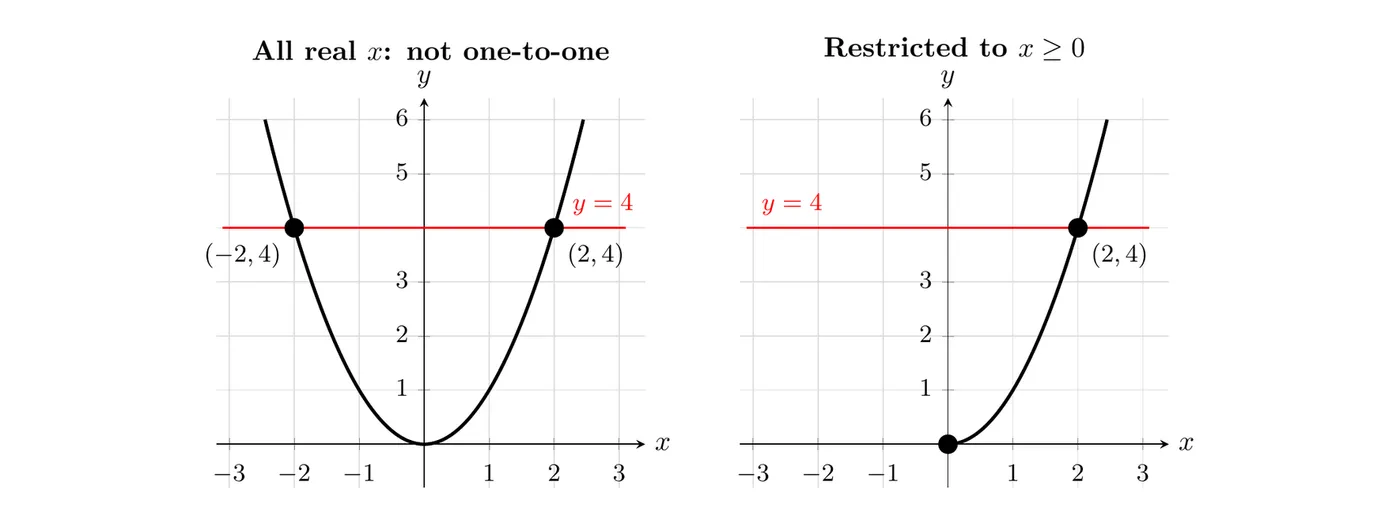
There are many ways to restrict a domain. Restricting to also works. Functions that are always increasing or always decreasing, like linear functions with a nonzero slope and exponential functions, are invertible on their whole domain.
The inverse as a reverse mapping
The inverse of , written , maps each output of back to the input it came from:
In terms of ordered pairs: if contains the input-output pair , then contains the pair .
Notation warning: means the inverse function, not . The is not an exponent here.
Domain and range swap
Because every pair flips, the domain of (on its invertible domain) becomes the range of , and the range of becomes the domain of . For a table, you find the inverse by swapping the input and output rows.
Example 1: Inverses from a table
Use the table of below.
0 | 1 | 2 | 3 | 4 | |
1 | 3 | 7 | 15 | 31 |
(a) Make a table for . (b) Find and . (c) Can you find from the table?
Part (a). Swap the rows:
1 | 3 | 7 | 15 | 31 | |
0 | 1 | 2 | 3 | 4 |
Part (b). Since , . Since and , we get .
Part (c). No. The number 4 is not an output in the table of , so it isn't an input in the table of . The inputs of are exactly the outputs of .
Compare a table that is not invertible:
0 | 1 | 2 | |||
4 | 1 | 0 | 1 | 4 |
Here , so would need two answers. The function is not invertible on this domain.
Composing a function with its inverse
A function and its inverse undo each other, so composing them in either order returns the original input:
In other words, and are both the identity function from Topic 2.7 (on the right domains). This is how you check that two functions are inverses: compose them both ways and see if you get .
Graphs of inverse functions
Swapping every to swaps the roles of the - and -axes. On a graph, that's a reflection over the line , the graph of the identity function.
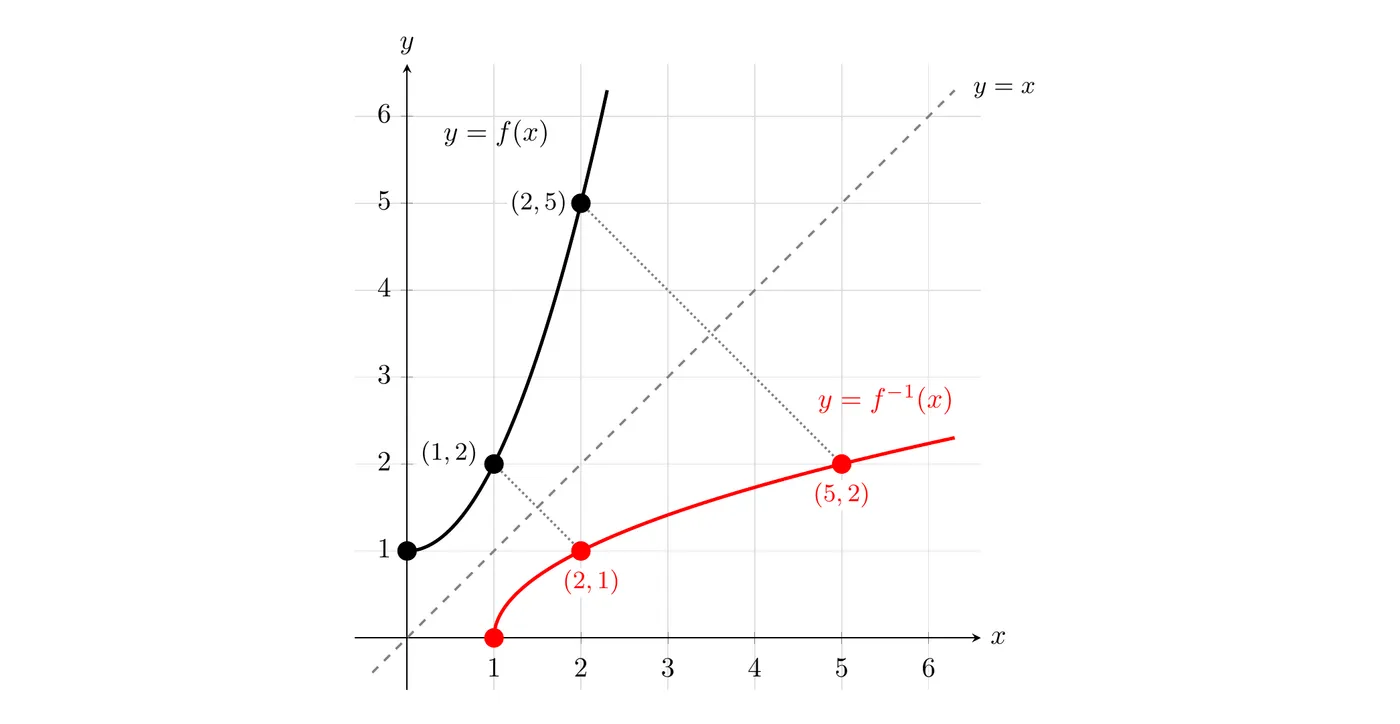
Here on the domain (black), and its inverse is in red. The point on becomes on , and the segment joining them crosses at a right angle, right at its midpoint. The same goes for and , and for the endpoints and .
Finding an inverse algebraically
To find the inverse of a function given by an equation, reverse the roles of and :
- Write .
- Swap and .
- Solve for . The result is .
- State the domain of (the range of ), and check your answer with composition.
Example 2: A linear function
Find the inverse of and verify it.
So . Check both compositions:
Both give , so the inverse is correct. Notice that multiplies by 4 then subtracts 7, and undoes those steps in reverse order: add 7, then divide by 4.
Example 3: A rational function
Find the inverse of , where .
Answer: , where . The domain makes sense: has a horizontal asymptote at and never outputs 2, so 2 can't be an input of . And never outputs 3, which matches 3 being left out of the domain of .
Example 4: Restricting the domain first
Find the inverse of on the domain (the function graphed above).
On , the range of is . Swap and solve:
The outputs of have to be the inputs of , which are all at least 0. So take the positive root:
Check: , and . If the domain of had been restricted to instead, the inverse would be .
Inverses in context
In context, the inverse answers the reverse question. Instead of “given the input, what's the output?”, it answers “what input gives this output?” Besides any domain restriction the math needs, the context can limit where the inverse makes sense.
In a context problem, don't blindly swap the letters. Keep track of what each variable means, and solve for the original input in terms of the original output.
Example 5: A dropped ball (AP-style)
A ball is dropped from a height of 64 feet. Its height after seconds is feet, for . (It hits the ground at .)
(a) Find and give its domain. (b) Find and interpret .
Part (a). Let be the height in feet. Solve for :
We take the positive root because time is not negative here. So . The formula works for any , but the ball's height is never negative, so in this context the domain of is , and its range is .
Part (b).
The ball is 28 feet above the ground 1.5 seconds after it is dropped. Check: .
Common mistakes
- Mixing up the inverse and the reciprocal. is the inverse function, not .
- Skipping the domain restriction. If isn't one-to-one, restrict the domain first, and pick the matching sign when you take a square root.
- Forgetting the domain of the inverse. It's the range of the original function.
- Reflecting over the wrong line. An inverse is a reflection over , not over the -axis or -axis.
- Losing the meaning of the variables in context. Solve for the original input; don't just swap letters and forget what each one means.