

2.2 - Change in Linear and Exponential Functions
Overview
Linear functions are the continuous version of arithmetic sequences, and exponential functions are the continuous version of geometric sequences. This topic makes that connection exact and gives you a test you'll use all year: look at how the outputs change over equal-length input-value intervals. Equal differences mean linear. Equal ratios mean exponential.
Arithmetic sequences and linear functions
Put an arithmetic sequence next to a linear function written with its initial value first:
Both are an initial value ( or ) plus repeated addition of a constant rate of change ( or ). The common difference of the sequence plays exactly the role of the slope of the line.
The match continues for the forms built from a known point. An arithmetic sequence can be built from a known difference and a known term . A linear function can be built from a known slope and a known point :
The second equation is point-slope form, solved for the output: start at the known output , then add for every unit moves away from .
Geometric sequences and exponential functions
Both are an initial value ( or ) times repeated multiplication by a constant ratio ( or ).
The point-based forms match too. A geometric sequence can be built from a known ratio and a known term . An exponential function can be built from a known ratio and a known point :
Read the exponential version as: start at the known output , then multiply by once for every unit moves to the right of (and divide by for every unit it moves to the left).
Discrete (sequence) | Continuous (function) | Built on | |
Constant rate of change | arithmetic: | linear: | adding or |
Constant proportional change | geometric: | exponential: | multiplying by or |
Sequences and functions can have different domains
The sequence is only defined for the whole numbers , while the function is defined for every real number. So the function also has values like and .
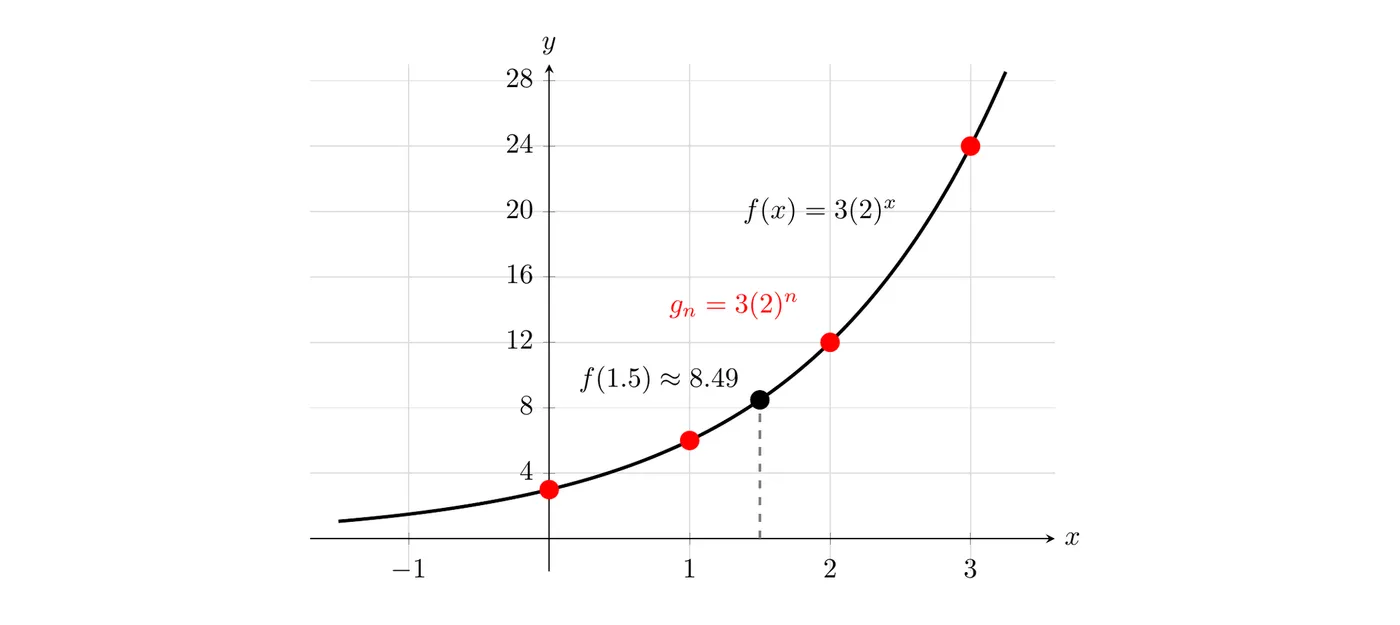
The two agree at every whole number, but the function fills in the gaps with a smooth curve. In a context, the domain can be limited further. If is time since a study began, the model only makes sense for , and if the input counts people or trips, only whole numbers may make sense.
Linear or exponential? Use equal-length intervals
This test shows up constantly on the AP exam, especially with tables. Look at the output values over equal-length input-value intervals:
- If the outputs change at a constant rate (the same difference over each interval), the function is linear.
- If the outputs change proportionally (the same ratio over each interval), the function is exponential.
For an exponential function, that ratio can't be 0 or 1. A ratio of 1 means the outputs never change (a constant function), and a ratio of 0 would make every later output 0.
The intervals don't need to have length 1, but they must all have the same length. For , over any interval of length the ratio is
So if the inputs go up by 2 at a time, the ratio you see in a table is , not .
Example 1: Reading a table
The inputs below go up by 2 each time. Decide whether each function is linear, exponential, or neither.
0 | 2 | 4 | 6 | 8 | |
3 | 7 | 11 | 15 | 19 | |
3 | 6 | 12 | 24 | 48 | |
3 | 5 | 9 | 17 | 33 |
- Linear: . The differences are 4, 4, 4, 4. The slope is the change in output over the change in input, , so .
- Exponential: . The ratios are . Each 2-unit interval multiplies the output by 2, so and . That gives . Check: .
- Neither: . The differences 2, 4, 8, 16 aren't constant, and the ratios , , aren't constant either. (Notice that subtracting 1 from each output gives 2, 4, 8, 16, 32, which is proportional. That's an exponential function shifted up 1, which comes up in Topic 2.3.)
Addition vs. multiplication
Linear functions and exponential functions are both described by an initial value and a constant tied to change. The difference is the operation: linear functions are based on addition, and exponential functions are based on multiplication.
Start both at 100. A linear function with gives 100, 110, 120, 130. An exponential function with gives 100, 110, 121, 133.1. They agree after one step, but the exponential function adds 10% of a growing amount each time, so it pulls ahead.
Two values determine the function
Arithmetic sequences, linear functions, geometric sequences, and exponential functions can each be pinned down by just two distinct values. For a linear function, two points give the slope, then point-slope form gives the rule. For an exponential function, two points give the ratio over the gap between them, and that gives the base.
Example 2: Same two points, two models
Find the linear function and the exponential function that both pass through and . Then compare them at .
Linear. The slope is
so , which simplifies to .
Exponential. Moving from to multiplies the output by twice:
The base must be positive, so , not . Using the point gives . The initial value is , so .
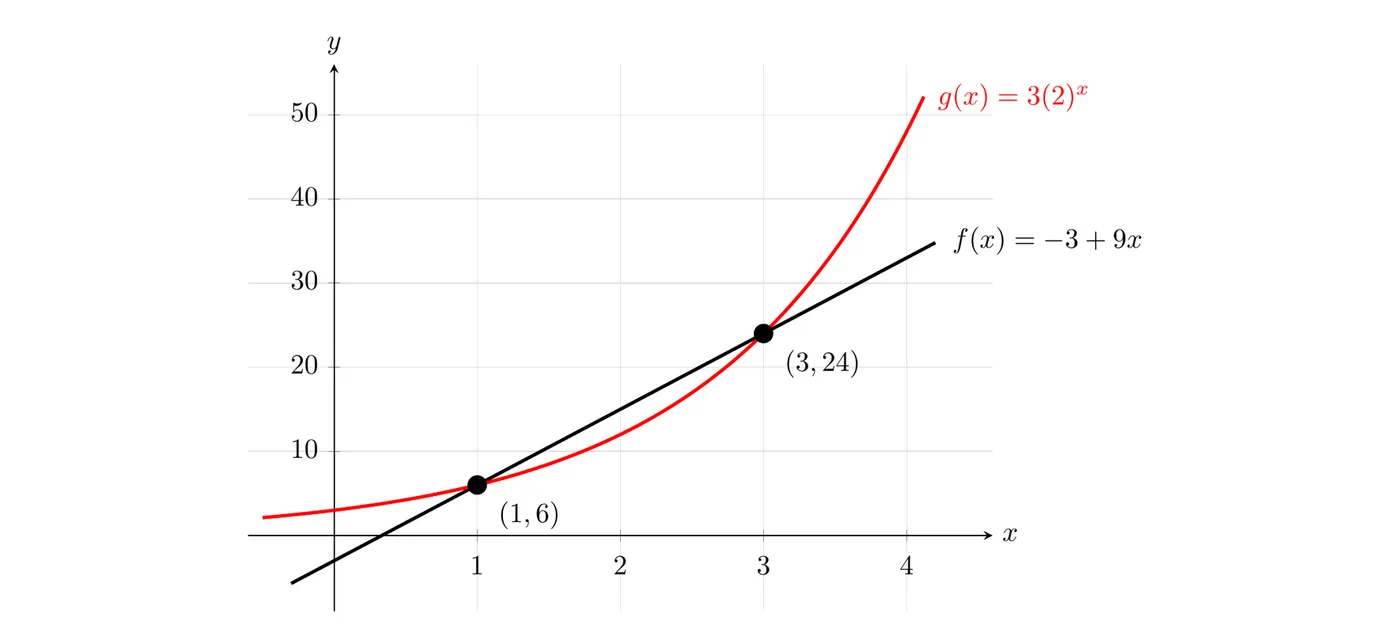
Compare. At , the linear model gives , but the exponential model gives .
Between the two shared points, the line is above the exponential curve (at , but ). Outside them, the exponential curve is above, and the gap grows fast.
Example 3: Bacteria growth (AP-style)
A lab culture has 500 bacteria at hours and 1,500 bacteria at hours.
(a) Write a linear model and an exponential model for the number of bacteria.
Linear: the rate is bacteria per hour, so .
Exponential: over 2 hours the count is multiplied by , so and . That gives .
(b) Predict the number of bacteria at with each model.
(c) Which model fits the situation better? Explain.
The exponential model. Bacteria reproduce by dividing, so the number of new bacteria each hour is proportional to how many are already there. That's constant proportional change, not a constant amount added each hour.
(d) If the bacteria are counted only on the hour, the counts form the geometric sequence for whole numbers . How is that different from ?
The sequence only has values at whole numbers of hours. The function is defined for every , so it also estimates the count between measurements, like bacteria.
Common mistakes
- Unequal intervals. Differences and ratios only mean something when the input steps are the same length. If the inputs are 0, 1, 3, 4, you can't compare all the jumps directly.
- Using the interval ratio as the base. If the output doubles every 2 units, then , so , not 2.
- Forgetting to shift the exponent. A model built from the point is , not , unless .
- Mixing up the two kinds of constant change. A constant amount of change means linear. A constant factor (or constant percent) means exponential.
- Ignoring domain. A sequence has whole-number inputs only, and a context can restrict a function's domain too (for example, ).