

3.10 - Trigonometric Equations and Inequalities
Overview
Now inverse trig functions go to work. In this topic you'll solve equations like and inequalities like . An inverse trig function hands you one solution. Because trig functions repeat, there are usually more, and finding all of them in the domain that matters is the real skill. Free-Response Question 4 on the AP exam (Symbolic Manipulations) can include an equation like these.
Inverse trig gives one solution, not all
To solve , you can apply arcsine: . But arcsine only returns the angle in . Other angles have the same sine, and you find them with the symmetry of the unit circle:
Equation | First solution | Other solution in the same cycle | Why |
and have the same -coordinate on the unit circle | |||
(or ) | and have the same -coordinate | ||
(next period) | tangent has period , so there's one solution per period |
So the inverse function's answer often needs adjusting: you may need to add the second solution, or shift the answer by a period to land in the interval the problem asks for.
Infinitely many solutions
Sine and cosine repeat every , so once you have the solutions in one cycle, adding any whole number of periods gives the rest:
For tangent one family covers everything: .
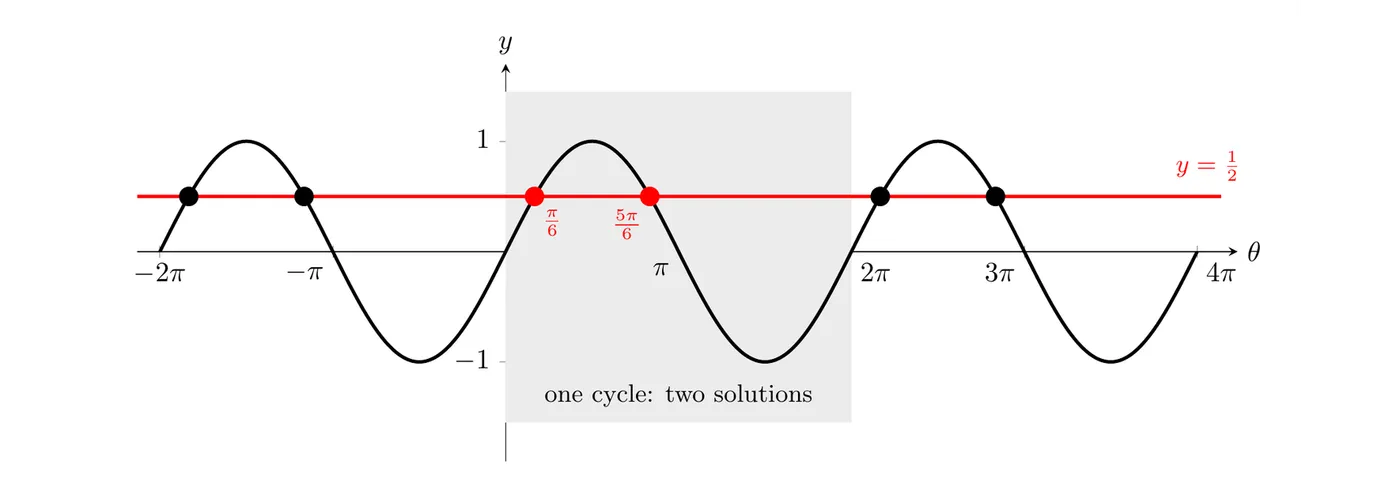
The line crosses twice in every cycle. In the crossings are at and , and every other crossing is one of these plus a multiple of .
Domain restrictions from context
Most problems don't want infinitely many answers. Either they give an interval, like , or the context limits the inputs: time can't be negative, a model only covers one day, a rider is on the wheel for one revolution. Find the general solutions, then keep only the ones in the allowed domain.
A method that always works
- Isolate the trig function, so the equation looks like .
- Check that a solution can exist. For sine and cosine, has to be between and .
- Find the solutions in one cycle: the unit circle for special values, inverse trig plus symmetry for the rest.
- Add multiples of the period to get every solution.
- Keep only the solutions in the required domain. If the input is , solve for over a stretched interval first, then divide by .
Example 1: A basic equation
Solve for all . Then list the solutions in .
Step 1: Isolate: .
Step 2: On the unit circle, cosine is at , and by symmetry at , which is the same angle as .
Step 3: All solutions:
Answer: in , and .
Example 2: Values that aren't special
Solve on : (a) (b)
(a) , which isn't a unit circle value, so use arcsine:
Both are in . Sine is positive in Quadrants I and II, which matches.
(b) , which is not in . Tangent has period , so add until you land in the interval:
Answer: (a) and . (b) and .
Example 3: Factoring
Solve on .
Step 1: This is a quadratic in . Let :
Step 2: So or .
- at and (Quadrants III and IV).
- at .
Answer: .
Example 4: An equation with
Solve on .
Step 1: Let . If , then : two full cycles.
Step 2: at and in the first cycle, and at and in the second.
Step 3: Divide by 2.
Four solutions make sense: has period , so it completes two cycles on , with two solutions in each.
Solving inequalities
To solve a trig inequality, first solve the matching equation to find the boundary points. Then use the graph or the unit circle to decide which intervals between them work.
Example 5: An inequality
Solve on .
Step 1: Isolate: .
Step 2: Boundary points: at and .
Step 3: Between them, the graph of is below (for example ). Outside them it's above.
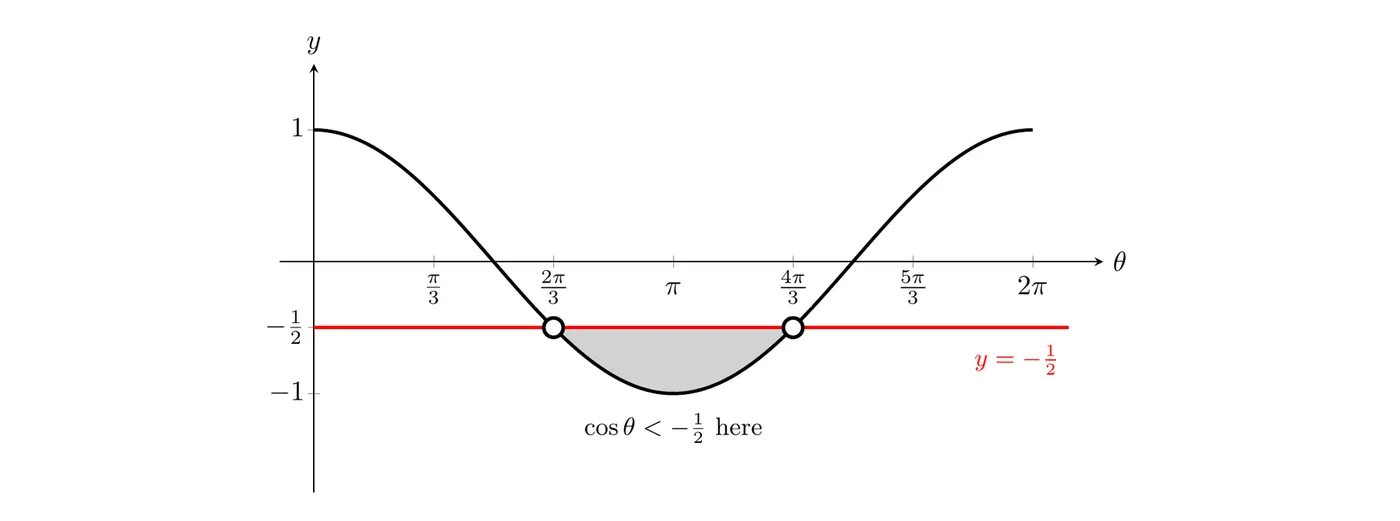
Answer: . The endpoints aren't included because the inequality is strict, which is why the graph shows open circles.
Example 6: Ferris wheel (AP-style)
From Topic 3.7, a rider's height on a Ferris wheel is meters, minutes after boarding. During the first revolution, , for how many minutes is the rider more than 42.5 meters above the ground?
Step 1: Set up and isolate. Dividing by flips the inequality.
Step 2: Use the context's domain. Let . For , runs from to , one cycle.
Step 3: From Example 5, when .
Step 4: Convert back to by multiplying by :
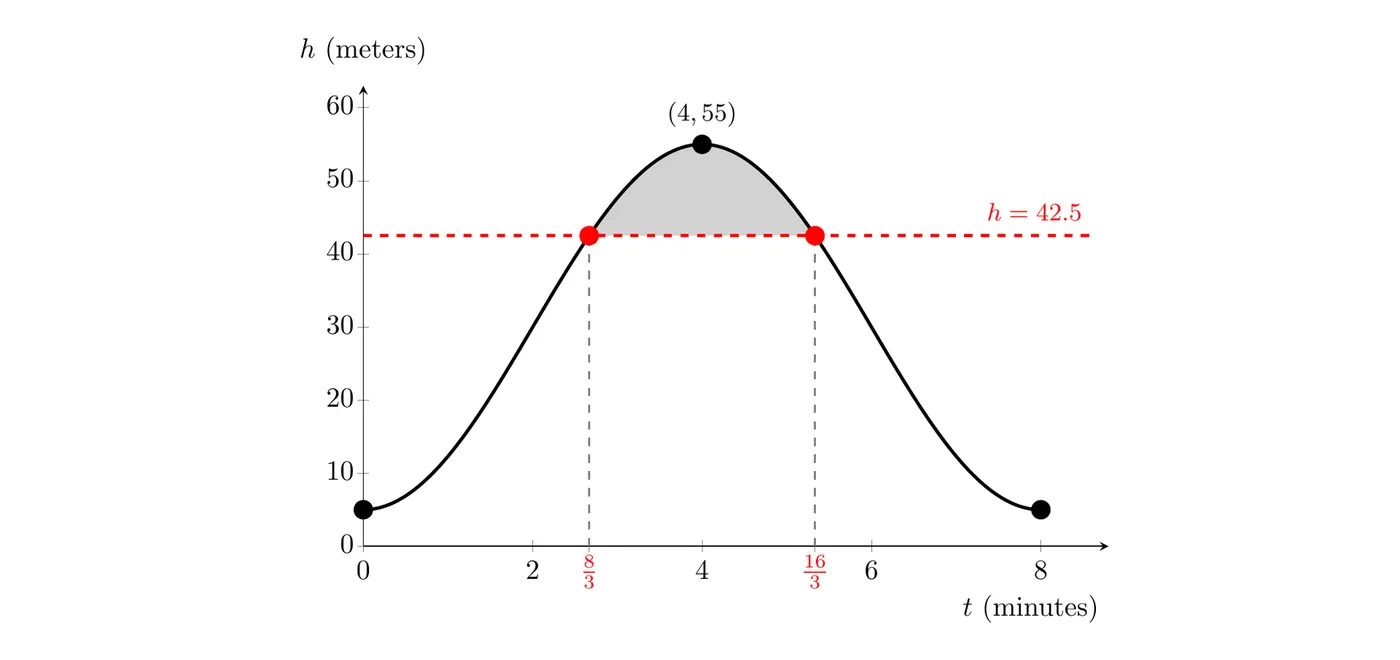
Answer: the rider is above 42.5 meters from about 2.67 to 5.33 minutes after boarding, for a total of minutes, one third of the ride.
Common mistakes
- Stopping at the calculator's answer. Arcsine, arccosine, and arctangent give one solution; find the rest with symmetry and the period.
- Losing solutions when the input is . Stretch the interval for first, then divide by .
- Dividing both sides by a trig function. Turning into loses and , where . Factor instead: .
- Forgetting to flip the inequality when you multiply or divide by a negative number.
- Keeping solutions outside the interval or contextual domain.
- Hunting for solutions that can't exist. has none, because sine is never more than 1.