

3.8 - The Tangent Function
Overview
Sine and cosine come from the coordinates of a point on the unit circle. Tangent comes from the slope of the ray through that point. That one idea explains everything about tangent: why it equals , why its period is instead of , and why its graph has vertical asymptotes. At the end you'll apply the transformations from Topic 3.6 to tangent.
Tangent is the slope of the terminal ray
Draw an angle in standard position. Its terminal ray crosses the unit circle at a point . The tangent of is the slope of that terminal ray.
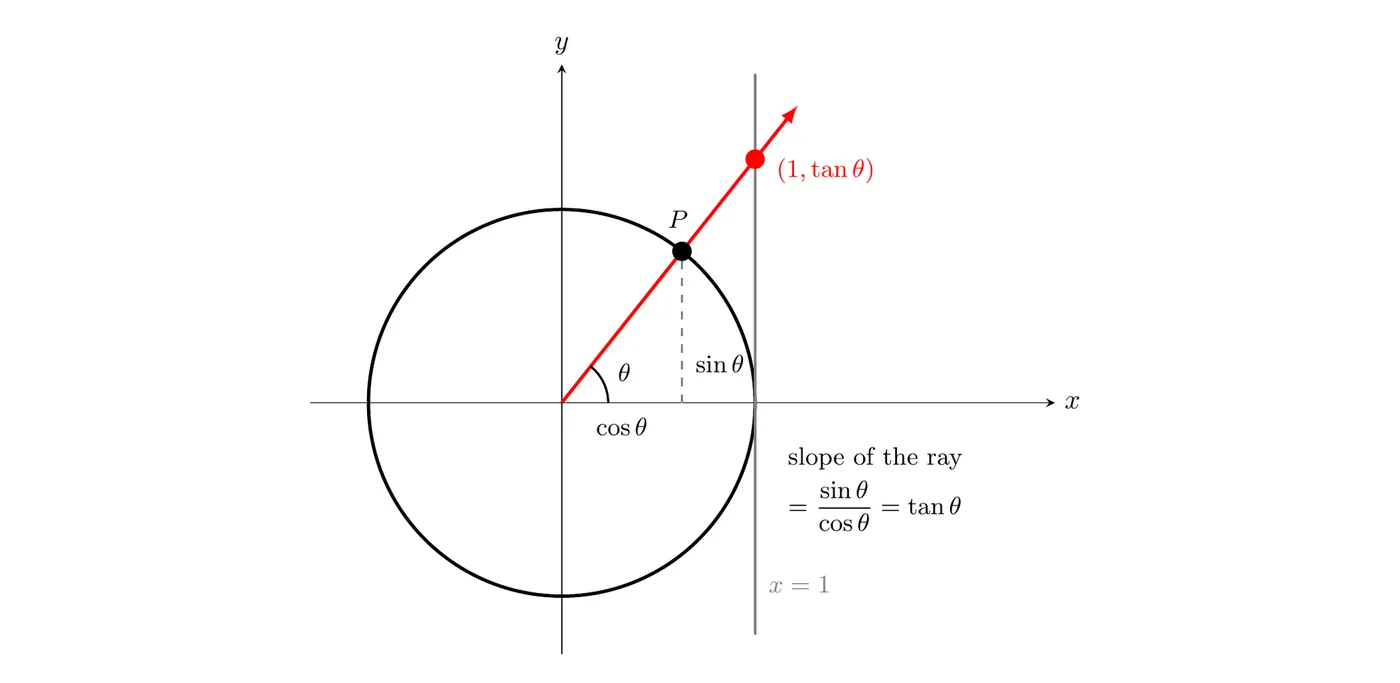
The ray starts at the origin and passes through . Slope is rise over run, so
As in Topic 3.2, any point on the ray works, not just : if is on the terminal ray, then . The figure also shows where the name comes from. Extend the ray until it meets the line , which is tangent to the unit circle at . The ray rises over a run of 1, so it meets that line at .
Tangent as sine over cosine
This is the form you'll use most. It means every tangent value comes from the unit circle:
undefined |
Signs: tangent is positive when sine and cosine have the same sign (Quadrants I and III) and negative when they have opposite signs (Quadrants II and IV). With slopes it's even easier to see: a line through the origin and Quadrant I or III rises to the right, so its slope is positive.
Key characteristics of the tangent function
Period
The angles and point in exactly opposite directions, so their terminal rays lie on the same line and have the same slope. That means tangent repeats every half revolution:
The period of tangent is , half the period of sine and cosine.
Vertical asymptotes
Tangent is undefined wherever , since that would mean dividing by zero. (The terminal ray is vertical there, and a vertical line has no slope.) That happens at
As approaches from the left, is close to 1 and is a tiny positive number, so grows without bound. From the right, is a tiny negative number, so decreases without bound. That's a vertical asymptote, and the pattern repeats every units.
Always increasing between asymptotes
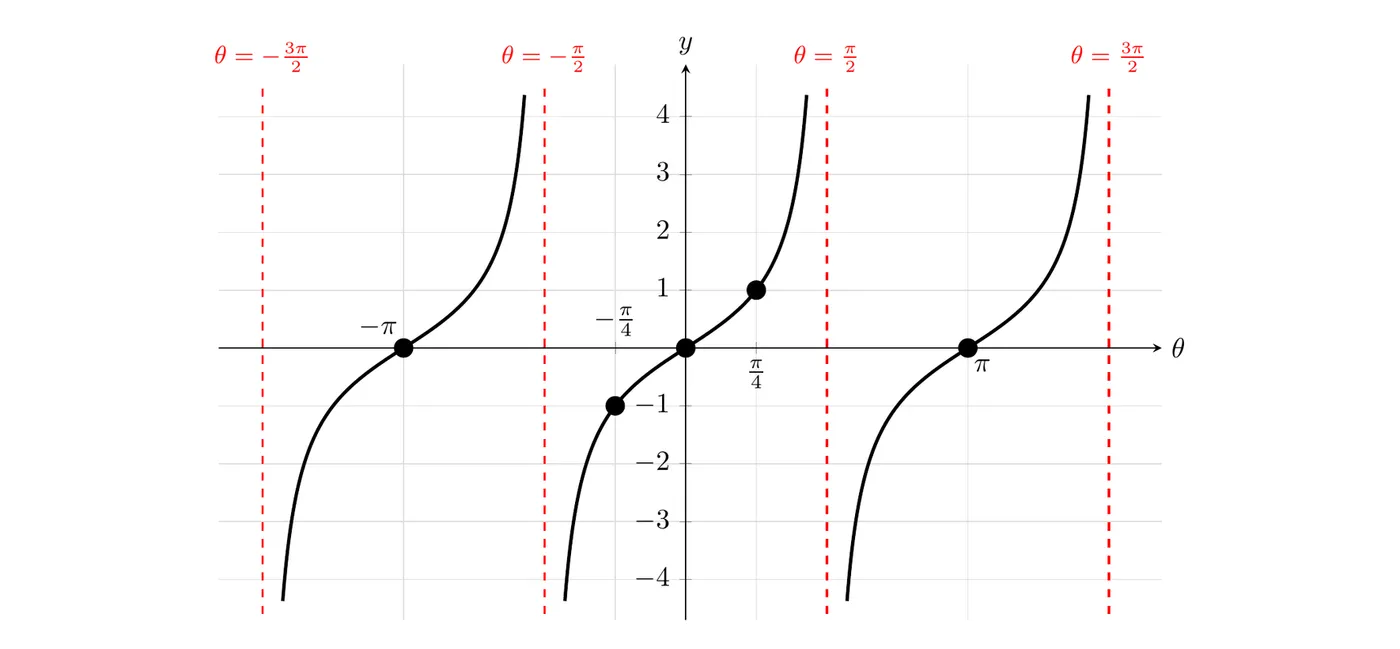
Between any two consecutive asymptotes, is always increasing. Each branch comes up from very negative values, passes through a zero, and rises without bound. Each branch is concave down on its left half and concave up on its right half, so every zero, , is a point of inflection.
The middle branch passes through , , and . Those three points and the two asymptotes are all you need to sketch a branch.
Feature | |
Domain | |
Range | All real numbers |
Period | |
Vertical asymptotes | |
Zeros (points of inflection) | |
Between asymptotes | Increasing; concave down, then concave up |
Tangent has no maximum or minimum value, so it has no amplitude.
Transformations of tangent
The four constants from Topic 3.6 work on tangent too, with two differences: the period uses instead of , and there's no amplitude.
Constant | What it does to |
Vertical dilation by a factor of . If , it also reflects over the horizontal axis. | |
Horizontal dilation by a factor of , so the period becomes . If , it also reflects over the vertical axis. | |
Phase shift of units (left if , right if ). | |
Vertical translation by units. The points of inflection move to the line . |
Tangent has no max or min, so instead of a midline we track the line containing the points of inflection. For it's , and for it's .
To find the vertical asymptotes of a transformed tangent, set the input of tangent equal to where the parent's asymptotes are:
The points of inflection are where the input of tangent equals .
Example 1: Tangent values
Find each value exactly. (a) (b) (c) (d) , if the terminal ray of passes through
(a) On the unit circle, and .
(b) and , so . This matches , as it should: , and the period is .
(c) , so is undefined. The graph has a vertical asymptote there.
(d) The ray goes from through , so its slope is . So , negative as expected for a ray in Quadrant II.
Example 2: Key features of a transformed tangent
Find the period, phase shift, vertical asymptotes, and points of inflection of . Then sketch it.
Step 1: Factor out of the input.
So , , , and .
Step 2: Period . Phase shift to the right. Vertical dilation by a factor of 2. The points of inflection lie on .
Step 3: Asymptotes, where the input of tangent is :
Step 4: Points of inflection, where the input of tangent is : , at height 1.
Step 5: Two more points help the sketch. When the input of tangent is , or :
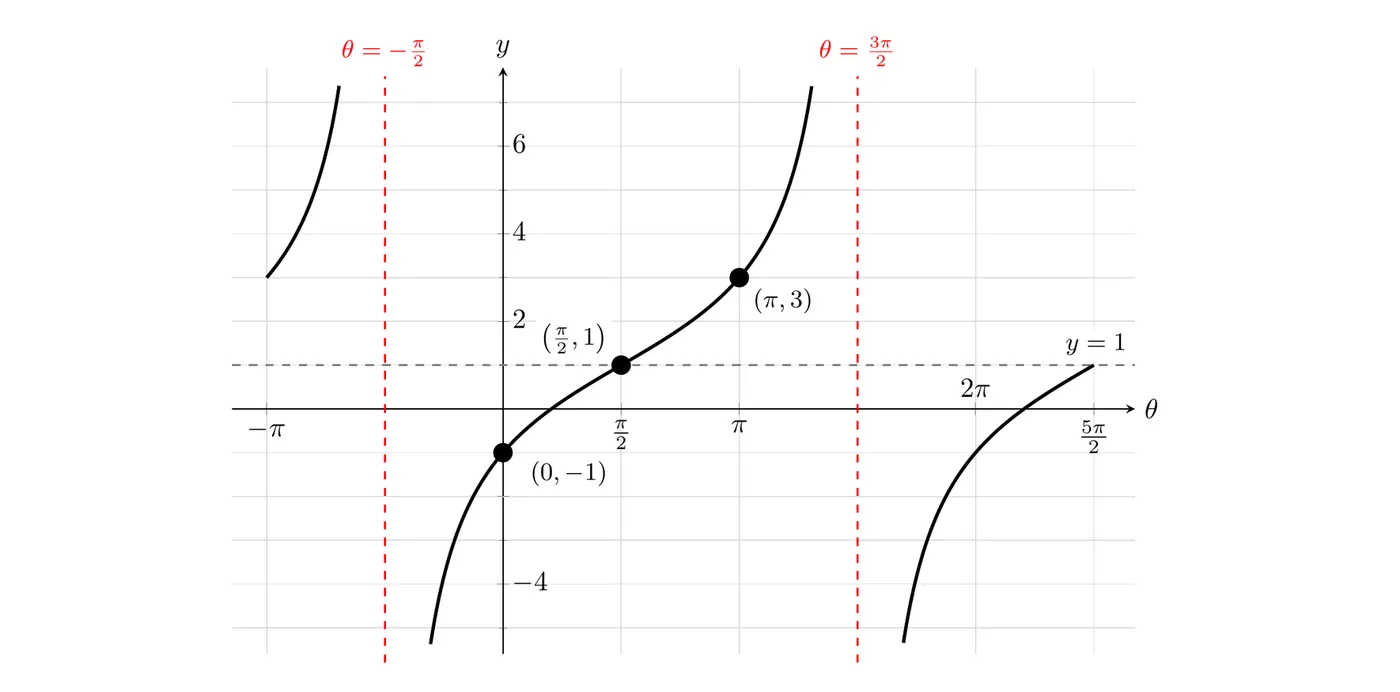
Answer: period ; phase shift right; vertical asymptotes at (for example and ); points of inflection at .
Example 3: Writing a tangent equation from a graph (AP-style)
The graph of is shown, with and . It has consecutive vertical asymptotes at and , a point of inflection at , and passes through and . Find , , , and .
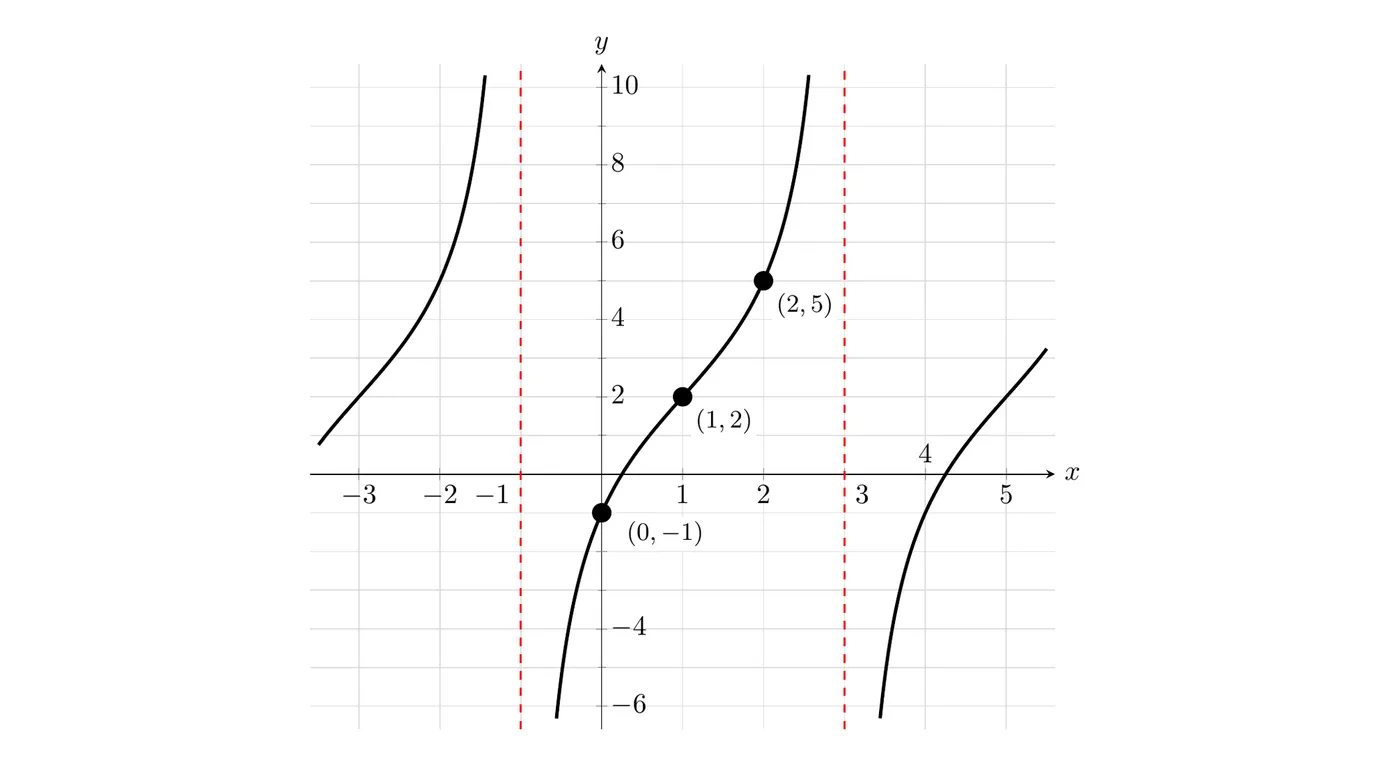
Step 1: Period. Consecutive asymptotes are one period apart: .
Step 2: Shifts. The parent's point of inflection moved to : right 1 and up 2. So and .
Step 3: Vertical dilation. Use :
Step 4: Check : . Check the asymptote at : the input of tangent is , where tangent is undefined. Both match.
Common mistakes
- Using for the period of tangent. Tangent's period is .
- Giving tangent an amplitude. It has none; is only a vertical dilation factor.
- Putting asymptotes where . Asymptotes are where . Where , tangent equals 0.
- Saying decreases somewhere. Between asymptotes it only increases. (A transformed tangent with exactly one of and negative is reflected, so it only decreases.)
- Reading the phase shift before factoring out , the same trap as with sine and cosine.