

3.2 - Sine, Cosine, and Tangent
Overview
In geometry, sine, cosine, and tangent were ratios of side lengths in a right triangle, so they only worked for acute angles. In precalculus we define them using a circle, which makes them work for any angle at all: obtuse angles, negative angles, and angles bigger than a full turn. This topic sets up angles in standard position, radian measure, and the circle definitions of sine, cosine, and tangent that the rest of Unit 3 is built on.
Angles in standard position
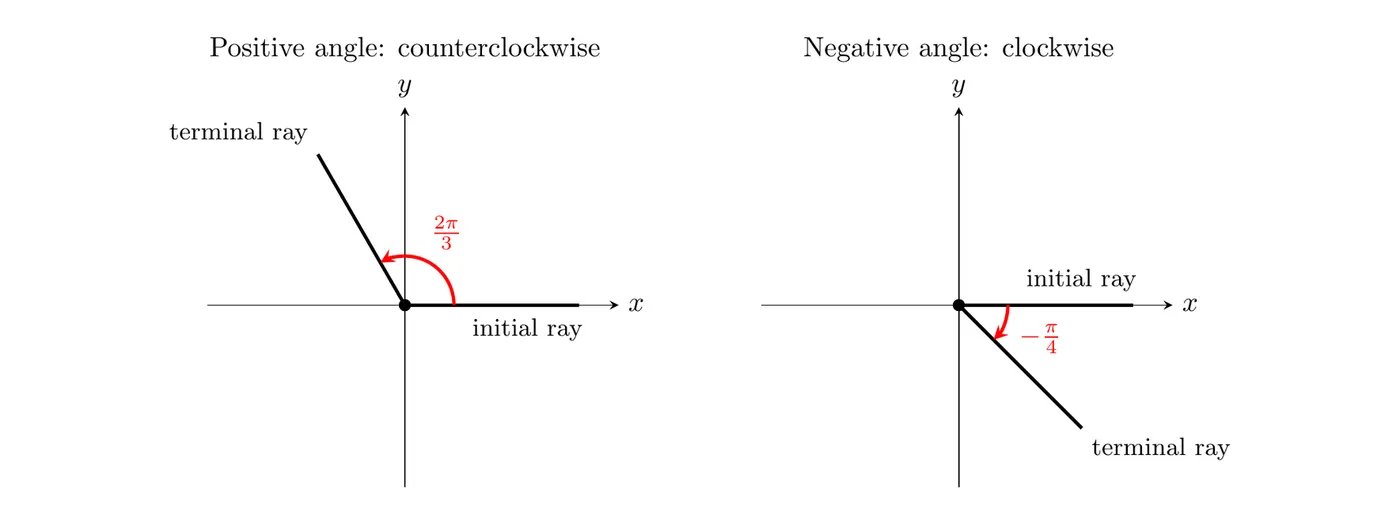
An angle in the coordinate plane is in standard position when its vertex is at the origin and one of its rays, the initial ray, lies along the positive -axis. The other ray is the terminal ray. The angle measures the rotation from the initial ray to the terminal ray.
- A positive angle rotates counterclockwise from the positive -axis.
- A negative angle rotates clockwise from the positive -axis.
Coterminal angles
A full revolution brings you right back to where you started. So angles that differ by a whole number of revolutions end on the same terminal ray. These are called coterminal angles. One revolution is , or radians (radians are explained below), so
Sine, cosine, and tangent depend only on the terminal ray, so coterminal angles always have the same sine, cosine, and tangent. That's the reason these functions turn out to be periodic.
Example 1: Finding coterminal angles
For each angle, find a coterminal angle between and : (a) (b) (c)
(a) is more than , so subtract one revolution:
(b) The angle is negative, so add one revolution:
(c) One revolution isn't enough here, so add two:
Answer: , , and .
Radian measure
Degrees split a full turn into 360 equal parts, a number picked long ago for convenience. Radians measure an angle using the circle itself. For a circle centered at the origin, the radian measure of an angle in standard position is the ratio of the length of the arc the angle cuts off (the arc it subtends) to the radius of the circle:
On the unit circle, which has radius 1, this becomes : the radian measure is the arc length. So one radian is the angle at the center of the unit circle that cuts off an arc of length 1. On any circle, one radian cuts off an arc exactly as long as the radius.
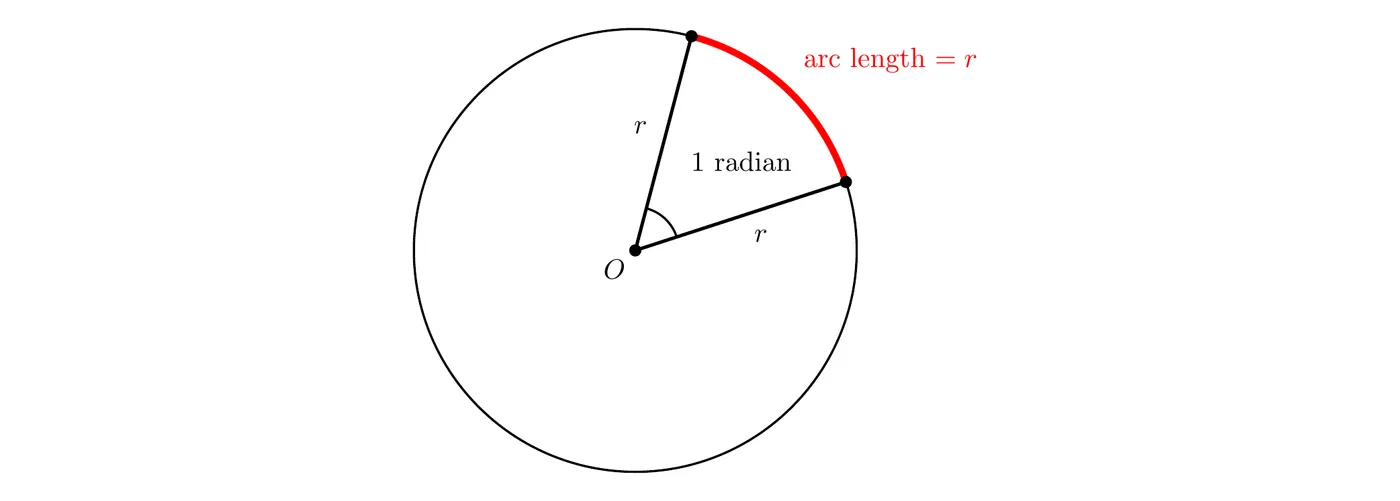
Because divides a length by a length, radians have no units. That's one reason precalculus and calculus use them.
Converting between degrees and radians
The whole circumference is , so a full revolution measures radians. That gives
- Degrees to radians: multiply by .
- Radians to degrees: multiply by .
Degrees | ||||||||
Radians |
One radian is about , a little less than . On the AP exam, angles are in radians unless you see a degree symbol, so keep your calculator in radian mode.
Example 2: Radians from arc length
A circle centered at the origin has a radius of 5 cm. An angle in standard position cuts off an arc of length 12 cm. (a) Find the angle's radian measure. (b) Convert it to degrees. (c) Which quadrant is its terminal ray in?
(a) Use the definition:
(b) Multiply by :
(c) and . Since is between them, the terminal ray is in Quadrant II.
Answer: The angle measures 2.4 radians, about , and its terminal ray is in Quadrant II.
The formula also runs backward as . For example, on a circle of radius 3, an angle of cuts off an arc of length .
Sine and cosine on a circle
Start with an angle in standard position and a circle of radius centered at the origin. The terminal ray crosses the circle at a point . Dropping a vertical segment from to the -axis makes a right triangle with hypotenuse .
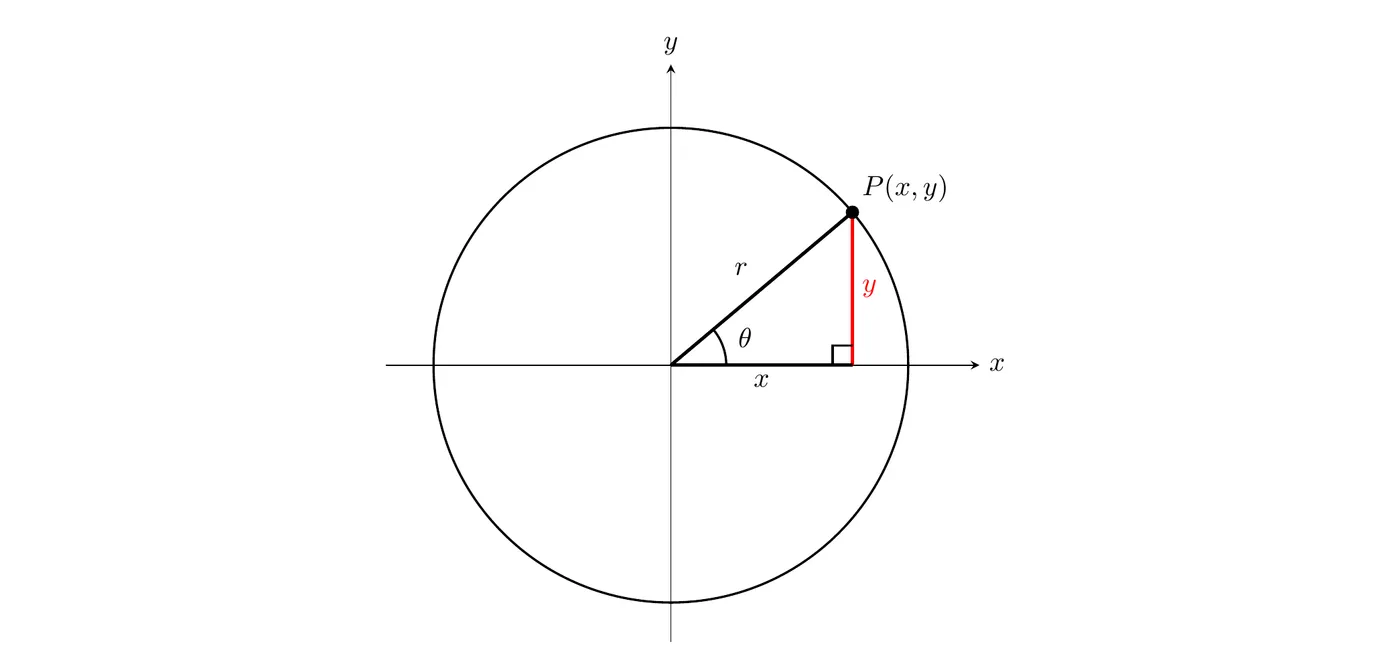
- The sine of is the ratio of the vertical displacement of from the -axis to the distance from the origin to :
- The cosine of is the ratio of the horizontal displacement of from the -axis to the distance from the origin to :
Displacement means the coordinates keep their signs. If is below the -axis, is negative, so is negative. If is left of the -axis, is negative. The distance is always positive.
These ratios don't depend on how big the circle is. A bigger circle makes a bigger triangle with the same shape (similar triangles), so and stay the same. For an acute angle, this matches the geometry definitions you already know, opposite over hypotenuse and adjacent over hypotenuse. The circle version just extends them to every angle.
On the unit circle
When the ratios simplify:
So the point where the terminal ray meets the unit circle is
Cosine is the -coordinate and sine is the -coordinate. This one fact drives almost everything in the rest of the unit.
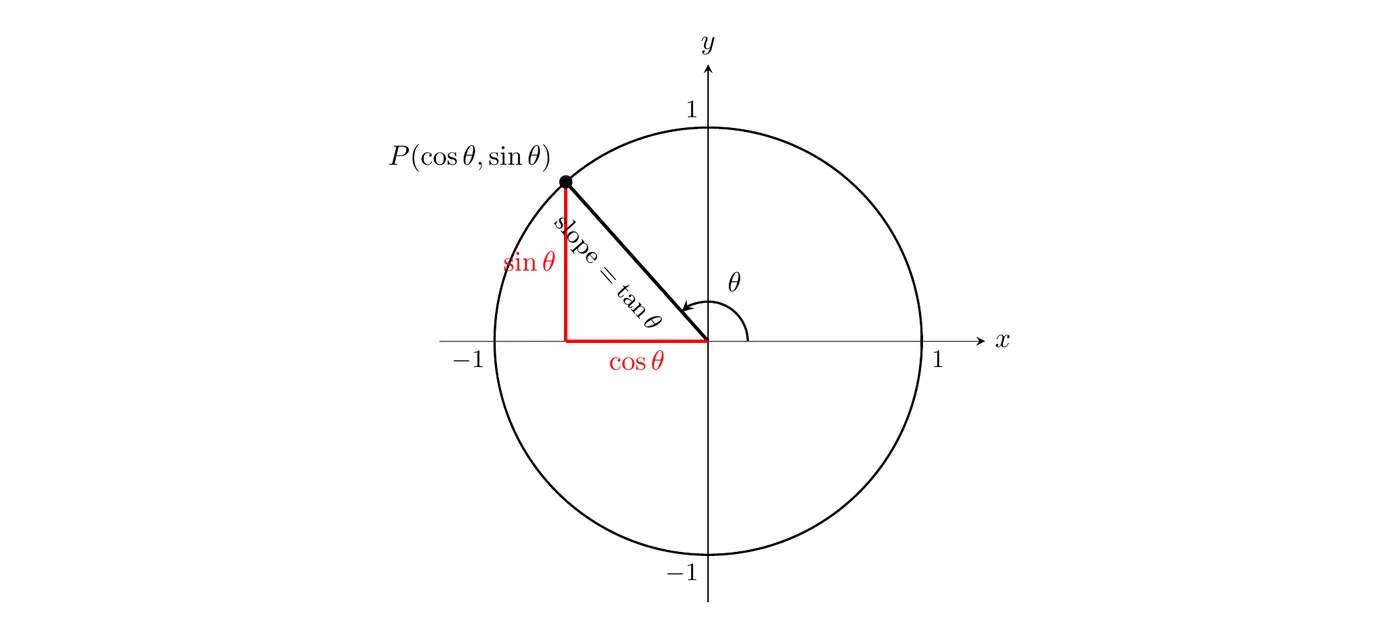
Here ends in Quadrant II, so is left of the -axis () and above the -axis ().
Tangent
The tangent of is the slope of the terminal ray, if that slope exists. Slope is vertical change over horizontal change. From the origin to , that's , so
On the unit circle, and , which gives an identity you'll use all the time:
Since a line has the same slope everywhere, works for every point on the terminal ray. The point on the circle is just one choice.
When tangent is undefined: a vertical terminal ray has no slope. That happens when , which is at , at , and at every angle coterminal with them. All of these can be written as for an integer .
Signs in each quadrant
Sine is , cosine is , and tangent is , so the quadrant of the terminal ray decides every sign.
Quadrant | (sign of ) | (sign of ) | (sign of ) |
I | |||
II | |||
III | |||
IV |
A common memory aid is "All Students Take Calculus": in Quadrants I, II, III, and IV, the positive ones are All three, Sine, Tangent, and Cosine.
Example 3: Values from a point on the terminal ray
The terminal ray of an angle in standard position passes through the point . Find , , and .
Step 1: Find the distance from the origin to the point. This is the radius of the circle the point sits on.
Step 2: Use the definitions.
Step 3: Check the signs. is in Quadrant II, where sine is positive and cosine and tangent are negative. That matches.
Answer: , , and .
Example 4: Tangent as a slope (AP-style)
An angle in standard position has its terminal ray in Quadrant III, and . Find and , and the point where the terminal ray meets the unit circle.
Step 1: Turn the slope into a point. A slope of means a rise of 3 for every run of 4. In Quadrant III both coordinates are negative, so go left 4 and down 3. The point is on the terminal ray, and its slope is .
Step 2: Find the distance to the origin.
Step 3: Find sine and cosine.
Step 4: Check.
Answer: and , so the terminal ray meets the unit circle at .
Common mistakes
- Calculator in degree mode. AP questions use radians unless there's a degree symbol.
- Rotating the wrong way. Positive angles go counterclockwise from the positive -axis, and negative angles go clockwise.
- Swapping sine and cosine on the unit circle. Cosine goes with (horizontal) and sine goes with (vertical). Alphabetical order helps: lines up with .
- Dropping signs. A point in Quadrant II has a negative -coordinate, so its cosine is negative, even though the triangle's side length is positive.
- Writing tangent upside down. Tangent is slope, rise over run: , not .
- Forgetting tangent can be undefined. doesn't exist, because and the terminal ray is vertical.