

3.3 - Sine and Cosine Function Values
Overview
Topic 3.2 defined sine and cosine with a circle. This topic uses those definitions to get actual values. First you'll find the coordinates of any point on a circle centered at the origin. Then you'll use two special right triangles to find exact values of sine and cosine for the angles that show up again and again on the AP exam: multiples of and .
Coordinates of a point on a circle
From Topic 3.2, if the terminal ray of meets a circle of radius centered at the origin at the point , then
Multiply both equations by to solve for the coordinates:
So the point is
Think of it as the unit-circle point stretched out by a factor of . This shows up any time something moves around a circle: a seat on a Ferris wheel, the tip of a clock hand, a point on a spinning wheel.
Example 1: A point on a circle, with a calculator
A circle centered at the origin has radius 10. Find the coordinates of the point where the terminal ray of radians meets the circle.
Check the quadrant. 2 radians is between and , so the point should be in Quadrant II, with a negative -coordinate and a positive -coordinate. It is.
Answer: .
Exact values from special right triangles
For most angles, sine and cosine are messy decimals that you'd get from a calculator. But for angles that are multiples of () or (), geometry gives exact values. Two triangles do all the work. Put each one inside the unit circle so its hypotenuse is a radius, with length 1.
The isosceles right triangle:
An angle of makes an isosceles right triangle. Both acute angles are , so both legs have the same length, call it . With a hypotenuse of 1, the Pythagorean theorem gives
So .
Half of an equilateral triangle: and
Start with an equilateral triangle whose sides are all 1 and whose angles are all . Cut it in half with a line from one vertex straight down to the middle of the opposite side. Each half is a right triangle with a hypotenuse of 1, a short leg of (half of a side), and acute angles of and . The long leg is
The short leg is always across from the smaller angle. So:
- At , the vertical leg is the short one: .
- At , the vertical leg is the long one: .
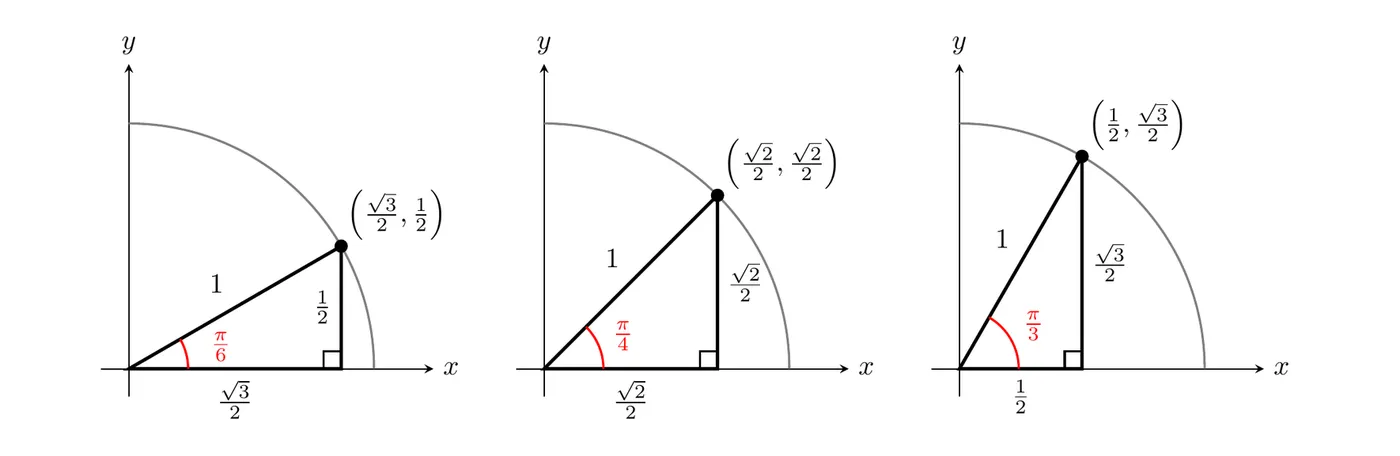
Together with the points on the axes, which come straight from the unit circle, here are the Quadrant I values:
A pattern that helps you remember: as goes from to , sine climbs through , and cosine runs through the same list backward.
Angles in other quadrants: Reference angles
For an angle like that doesn't end in Quadrant I, use its reference angle: the acute angle between the terminal ray and the -axis. The triangle made with the reference angle is one of the special triangles, so the coordinates have the same sizes as in Quadrant I. Only the signs change, and the quadrant tells you which signs to use.
- If needed, add or subtract until you have a coterminal angle between and .
- Find the quadrant and the reference angle.
- Look up the Quadrant I values for the reference angle.
- Attach signs: (cosine) is negative in Quadrants II and III, and (sine) is negative in Quadrants III and IV.
Terminal ray in | Reference angle |
Quadrant II | |
Quadrant III | |
Quadrant IV |
Doing this for every multiple of and gives the full unit circle:
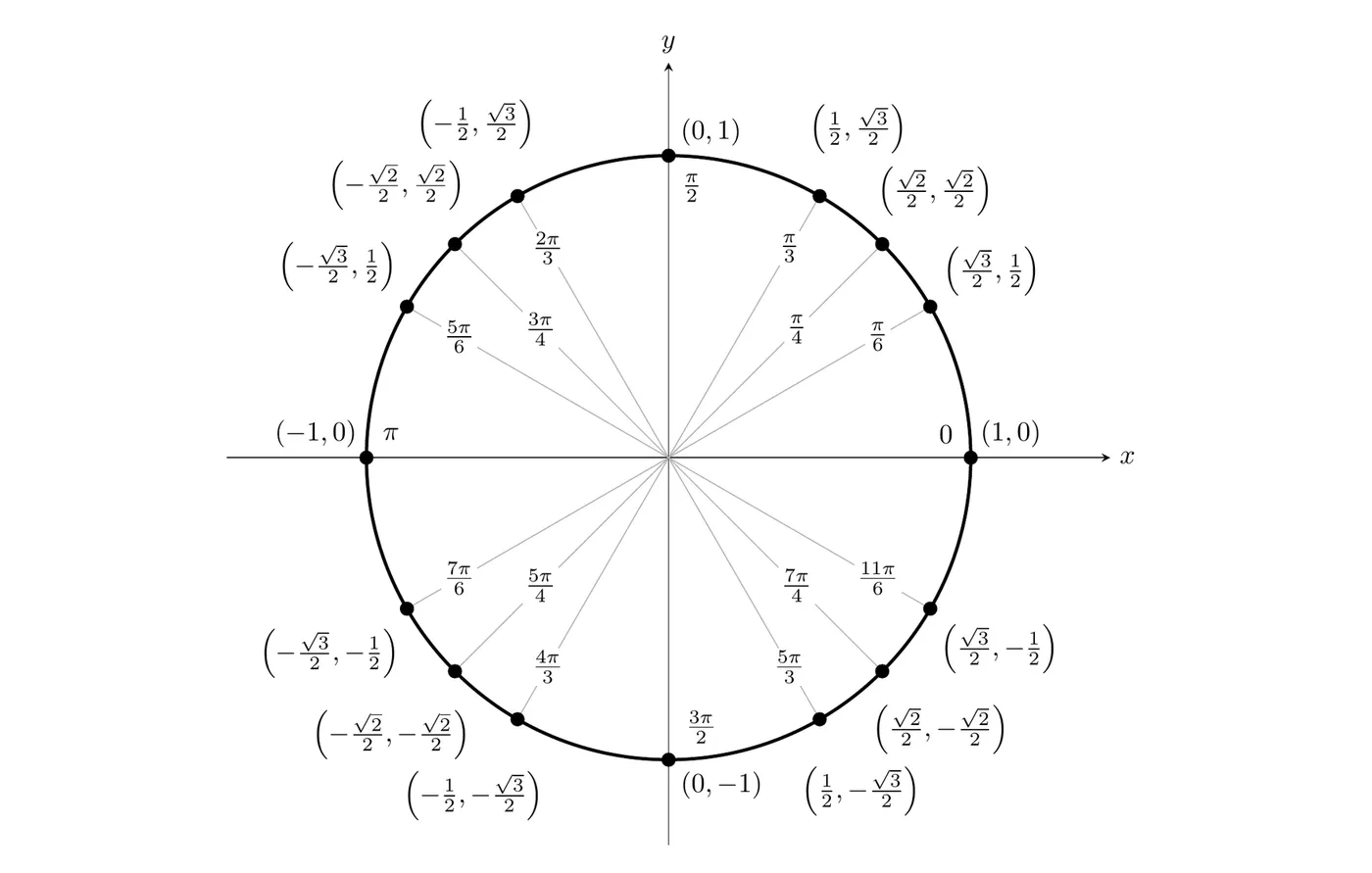
You don't need to memorize this picture point by point. If you know the three Quadrant I points and the sign rules, you can rebuild any part of it in a few seconds, and that's less likely to go wrong under exam pressure.
Example 2: An angle in Quadrant II
Find the exact values of and .
Step 1: Quadrant and reference angle. is between and , so it's in Quadrant II. The reference angle is
Step 2: Quadrant I values. For , the point is .
Step 3: Signs. In Quadrant II, is negative and is positive.
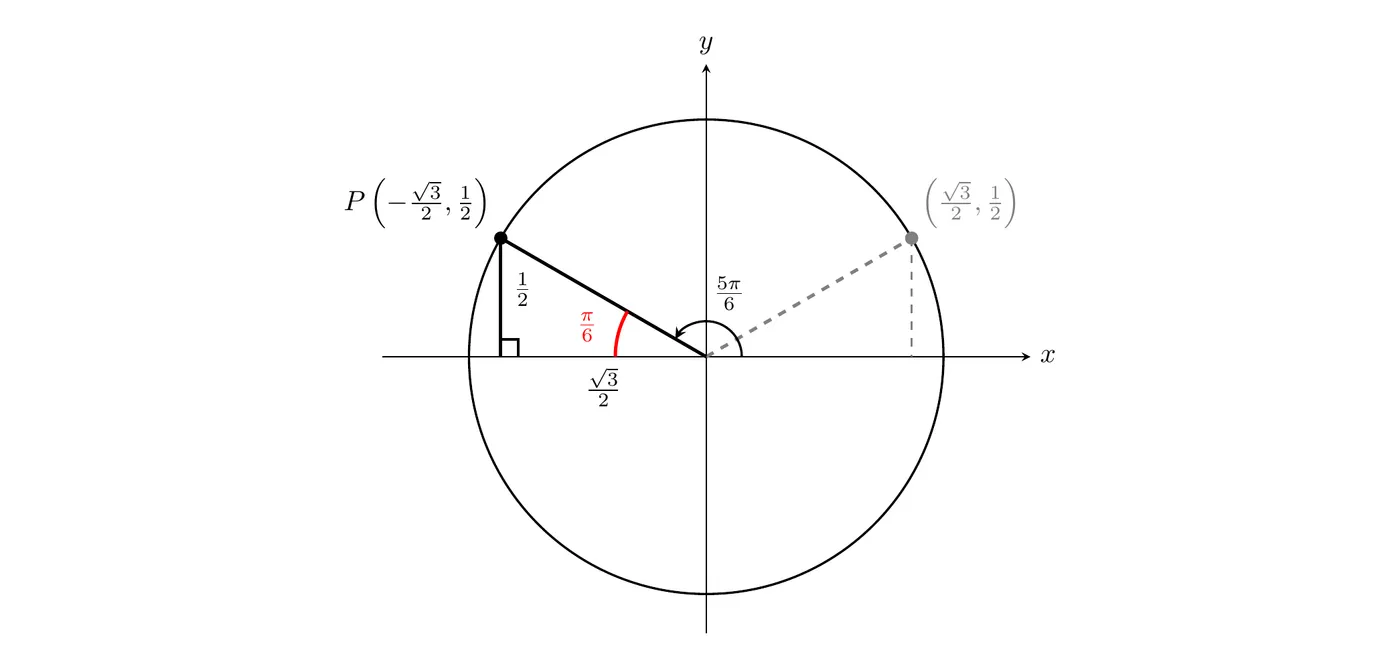
The point for is the mirror image of the point for (gray) across the -axis. Same triangle, opposite side.
Answer: and .
Example 3: A negative angle
Find the exact values of , , and .
Step 1: Coterminal angle. , which is between and , so it's in Quadrant III.
Step 2: Reference angle.
Step 3: Signs. Both coordinates are negative in Quadrant III.
Answer: , , and .
Example 4: An angle bigger than
Find the exact values of and .
Step 1: Coterminal angle. , which is between and , so it's in Quadrant IV.
Step 2: Reference angle. , and the Quadrant I point for is .
Step 3: Signs. In Quadrant IV, is positive and is negative.
Answer: and .
Example 5: A spinning wheel (AP-style)
A bicycle sits on a repair stand, and its back wheel, with a radius of 35 cm, is free to spin. Put the center of the wheel at the origin. A reflector on the rim starts at , level with the center, and the wheel turns counterclockwise. The center of the wheel is 60 cm above the floor.
(a) After the wheel turns through radians, find the exact coordinates of the reflector. (b) How high above the floor is the reflector then? (c) The wheel keeps turning until it has turned through radians in total. How high above the floor is the reflector now?
(a) Use with and the values from Example 2:
That's about : left of the center and above it, as expected for Quadrant II.
(b) The -coordinate is the reflector's height above the center, so its height above the floor is
(c) is in Quadrant III with reference angle , so . The reflector is below the center:
Answer: (a) . (b) 77.5 cm above the floor. (c) About 29.689 cm above the floor, which is about 30.311 cm below the center of the wheel.
Common mistakes
- Swapping two special values. The values for and are easy to mix up, so picture the point. At the point is low and far to the right, so its -coordinate (sine) is the small one, .
- Forgetting signs outside Quadrant I. The triangle gives the sizes, and the quadrant gives the signs.
- Measuring the reference angle to the y-axis. The reference angle is always measured to the -axis.
- Forgetting the radius. On a circle of radius , the point is , not .
- Not recognizing equivalent forms. and are the same number. Answer choices usually use .