

3.5 - Sinusoidal Functions
Overview
Sine and cosine are the parent functions of a whole family of wave-shaped graphs called sinusoidal functions. This topic gives you the vocabulary for describing any sinusoid: period, frequency, amplitude, midline, concavity, and symmetry. You'll learn each one on and first. On the AP exam, you'll use these words to describe sinusoidal graphs and to justify the models you build from them.
What is a sinusoidal function?
A sinusoidal function is any function you can make from using additive and multiplicative transformations: adding constants and multiplying by constants, inside or outside the sine. For example, , , and are all sinusoidal. They all have the same smooth wave shape, just stretched, squeezed, flipped, or slid. (Topic 3.6 covers exactly what each transformation does.)
Cosine is sinusoidal too. Its graph is the sine graph shifted to the left:
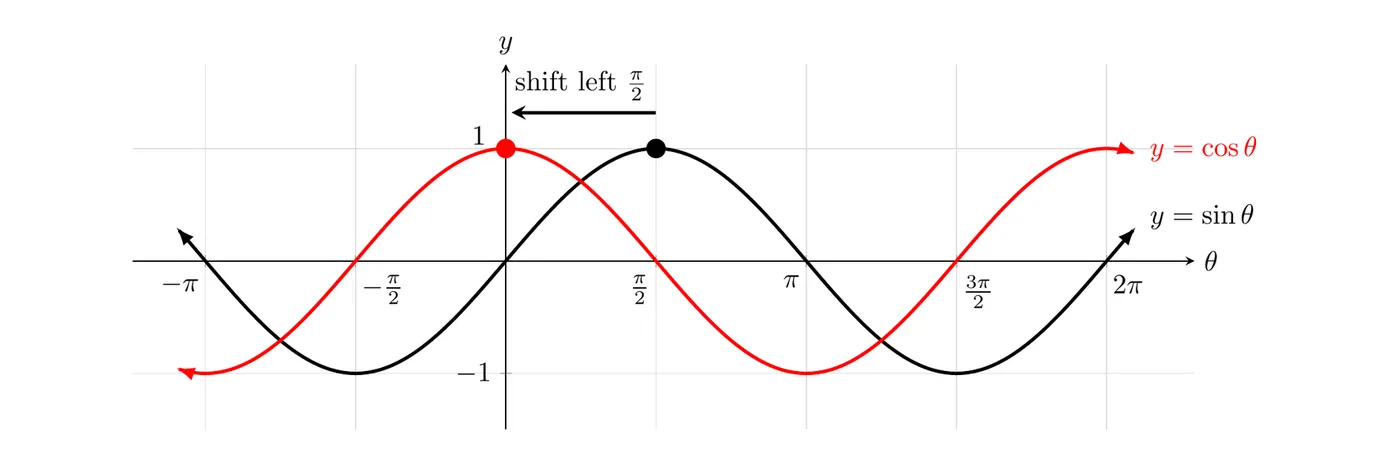
Why this works: on the unit circle, adding to an angle turns a quarter turn counterclockwise. A quarter turn moves a point to , so the new -coordinate equals the old -coordinate. In other words, the sine of the new angle equals the cosine of the old one. Check it at :
Period and frequency
The period (from Topic 3.1) is the length of one full cycle along the input axis. The frequency is the number of cycles per one unit of input. They are reciprocals:
For example, if a wave completes one cycle every 4 seconds, its period is 4 seconds and its frequency is cycle per second.
For sine and cosine, one cycle is one full trip around the unit circle, so
To read the period from a graph, measure the horizontal distance between two consecutive maximums, two consecutive minimums, or any two points where the cycle starts over.
Amplitude
The amplitude of a sinusoidal function is half the difference between its maximum and minimum values:
It measures how far the graph rises above its middle (and how far it falls below it). Amplitude is a distance, so it's always positive. For sine and cosine, the maximum is 1 and the minimum is :
Midline
The midline is the horizontal line halfway between the maximum and minimum. Its height is the average (arithmetic mean) of the maximum and minimum values:
The graph spends half of each cycle above the midline and half below it. For sine and cosine:
so the midline of both and is , the horizontal axis.
All four features on one graph
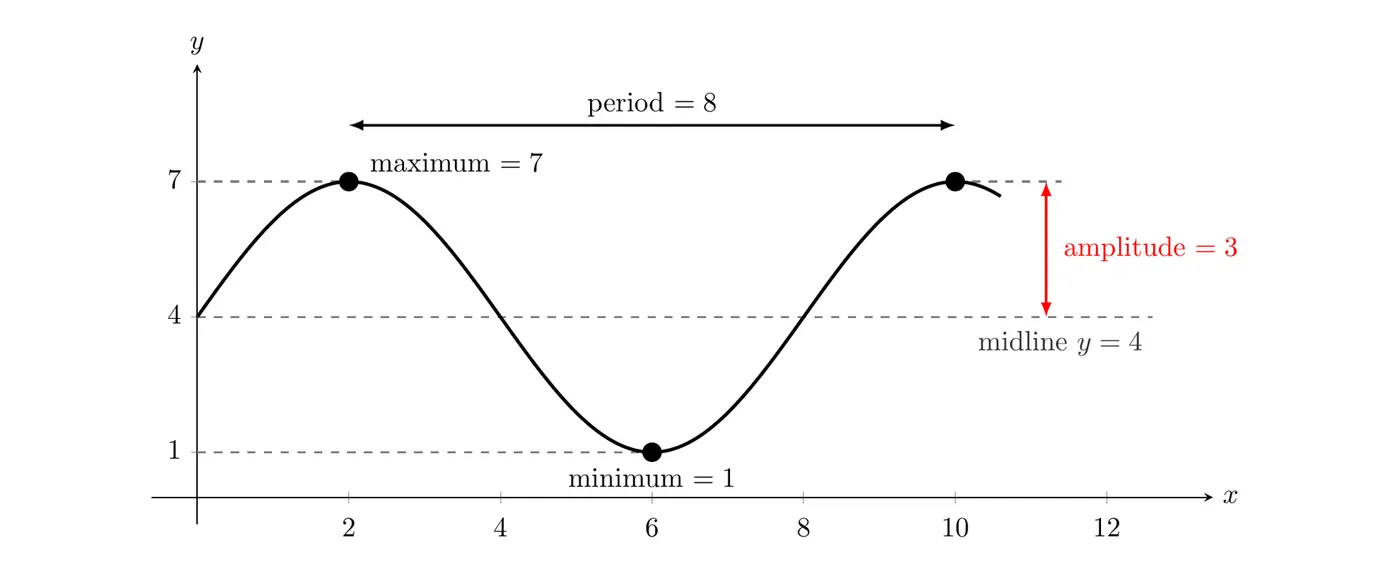
This sinusoidal graph has a maximum of 7 and a minimum of 1:
- amplitude
- midline:
- consecutive maximums at and , so the period is and the frequency is
Notice that the maximum is the midline plus the amplitude (), and the minimum is the midline minus the amplitude (). That's true for every sinusoid.
Concavity
As the input increases, a sinusoidal graph keeps switching between concave down and concave up. It's concave down around each maximum (shaped like ) and concave up around each minimum (shaped like ). Concavity changes where the graph crosses its midline, so those crossings are the points of inflection.
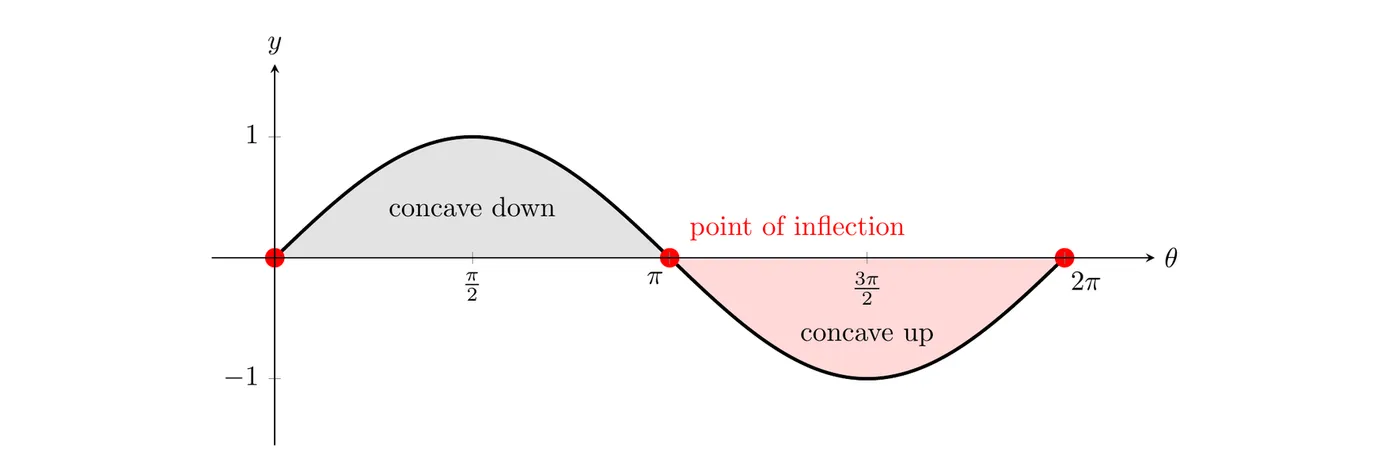
For on :
- concave down on , around the maximum at
- concave up on , around the minimum at
- points of inflection at , , and (and in general at )
For , the graph is concave down on around its maximum at 0, concave up on around its minimum at , and has points of inflection at .
This connects to rates of change from Unit 1. Concave down means the rate of change is decreasing, and concave up means it's increasing. A sinusoid is steepest at its points of inflection (on the midline) and flat at its maximums and minimums. That's the Ferris wheel from Topic 3.1: the height changes fastest when the rider is level with the center.
Symmetry: Sine is odd, cosine is even
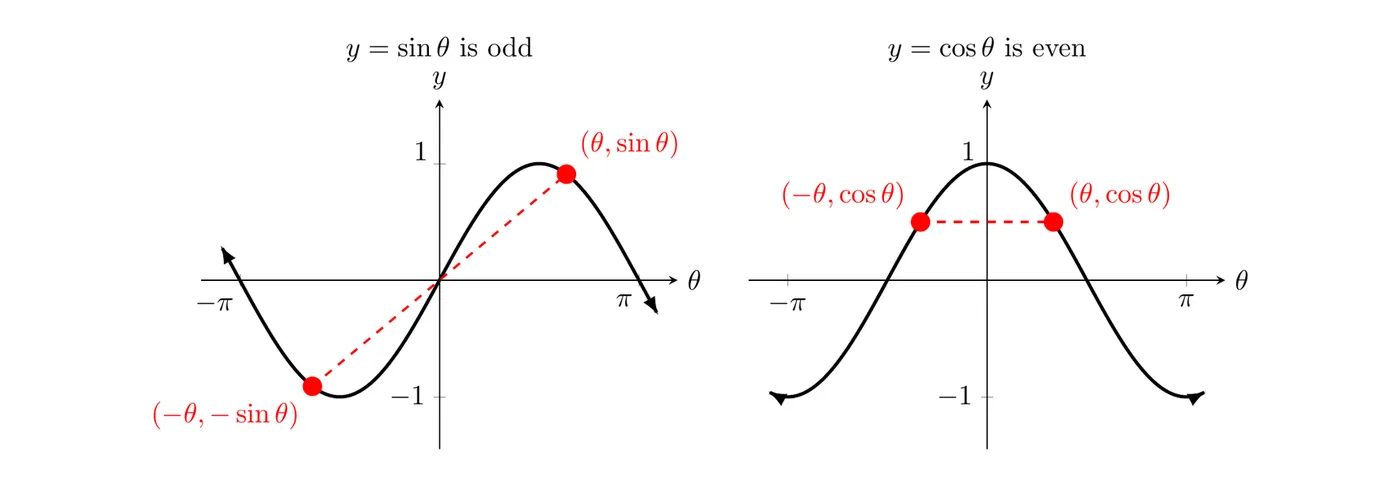
- Sine is an odd function. Its graph has rotational symmetry about the origin: rotate it around the origin and it lands on itself. In equation form:
- Cosine is an even function. Its graph has reflective symmetry over the vertical axis: fold it along that axis and the two sides match. In equation form:
Why, using the unit circle: the angles and are mirror images of each other across the -axis. Reflecting across the -axis gives . The -coordinate stays the same, so cosine doesn't change. The -coordinate flips sign, so sine flips sign.
Example 1: Key features from a graph
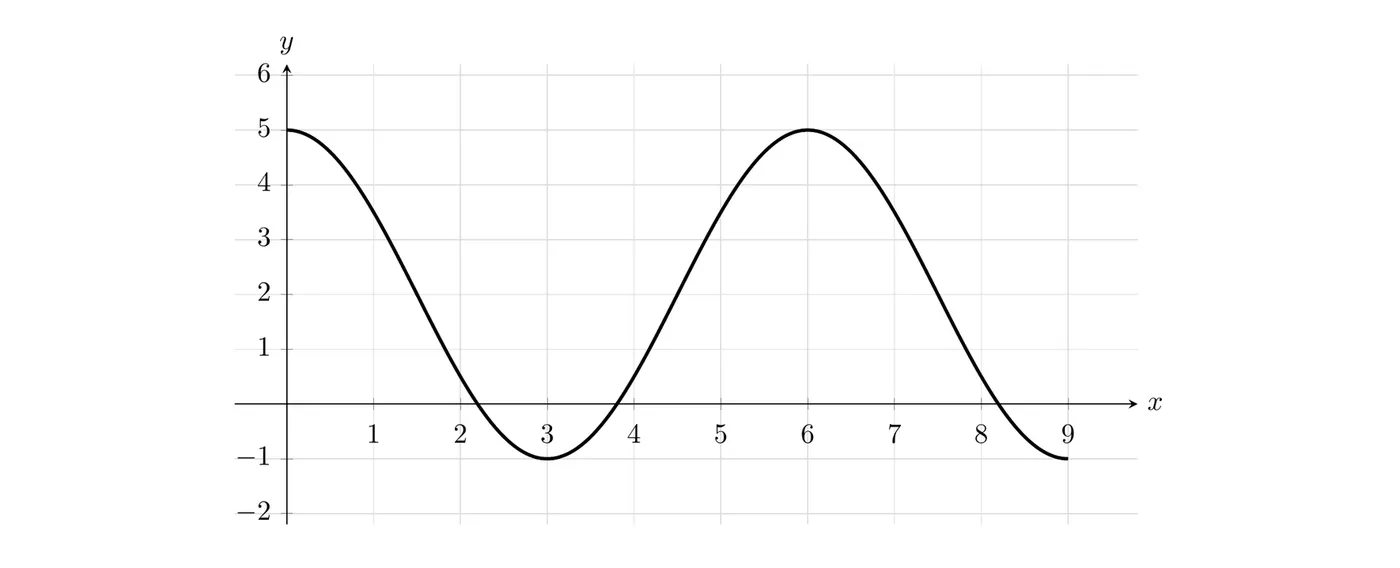
The graph shows a sinusoidal function for . Find the amplitude, midline, period, and frequency of . Then find the intervals in where is concave up and where it is concave down.
Step 1: Read the maximum and minimum. The highest points are and , and the lowest points are and . So the maximum is 5 and the minimum is .
Step 2: Amplitude and midline.
Step 3: Period and frequency. Consecutive maximums are at and , so the period is and the frequency is .
Step 4: Concavity. The points of inflection are where crosses its midline, . Each one is halfway between a maximum and the next minimum: , , and . The graph is concave down around the maximums at and , and concave up around the minimums at and .
Answer: The amplitude is 3, the midline is , the period is 6, and the frequency is . On , is concave down on and and concave up on and .
Example 2: Key features from a description (AP-style)
A sinusoidal function has a maximum value of 18 at . The next minimum after that is , at .
(a) Find the amplitude, midline, period, and frequency of . (b) Find the next maximum and the next minimum after , and the value of at each. (c) Find the point of inflection between and , and decide whether is concave up or concave down on .
(a) Amplitude and midline come from the maximum and minimum:
Going from a maximum to the very next minimum is half of a cycle, so half the period is . The period is , and the frequency is .
(b) Maximums and minimums alternate every half period, which is 5 units. After the minimum at , the next maximum is at , and the minimum after that is at . Every maximum has the same value, and so does every minimum: and .
(c) The point of inflection is on the midline, halfway between the maximum and the minimum:
Points of inflection are also half a period apart, so the next one is at . The interval runs between two consecutive points of inflection and contains the minimum at , so is concave up there.
Answer: (a) Amplitude 11, midline , period 10, frequency . (b) The next maximum is , and the next minimum is . (c) The point of inflection is , and is concave up on .
Example 3: Using symmetry and the shift
Suppose and . Find , , and .
Sine is odd:
Cosine is even:
The shift identity: holds for every , including :
Answer: , , and .
Summary
Feature | ||
Domain | all real numbers | all real numbers |
Range | ||
Period | ||
Frequency | ||
Amplitude | ||
Midline | ||
Value at | (a maximum) | |
Concave down on | ||
Points of inflection | ||
Symmetry | odd: rotational about the origin | even: reflective over the vertical axis |
Common mistakes
- Forgetting to divide by 2 for the amplitude. Maximum minus minimum is twice the amplitude.
- Calling the distance from a maximum to the next minimum the period. That's only half a period.
- Mixing up period and frequency. Period is the length of one cycle; frequency is cycles per unit of input. They're reciprocals.
- Giving a negative amplitude. Amplitude is a distance. Even has amplitude 3.
- Writing the midline as a number. The midline is a line, so write , not just 4.
- Swapping odd and even. (even), but (odd).
- Putting points of inflection at the maximums and minimums. They sit on the midline, halfway between a maximum and a minimum.