

3.11 - The Secant, Cosecant, and Cotangent Functions
Overview
Sine, cosine, and tangent each have a reciprocal function: secant, cosecant, and cotangent. Each one is 1 divided by a function you already know, so every feature of its graph (where it's undefined, its range, where it increases or decreases) comes straight from the original function. On the AP exam you need to evaluate these functions, connect their graphs to sine, cosine, and tangent, and describe their key characteristics.
The three reciprocal functions
The reciprocal of a number is 1 divided by that number. The reciprocal of 4 is , and the reciprocal of is . The three new trig functions are defined the same way.
Function | Definition | Undefined when |
Secant: | ||
Cosecant: | ||
Cotangent: |
To keep the pairs straight, notice that each pair has exactly one “co”: secant goes with cosine, cosecant goes with sine, and cotangent goes with tangent.
Values from the unit circle
If the terminal ray of meets the unit circle at , then and . So:
A reciprocal always has the same sign as the original value. Cosine is negative in Quadrants II and III, so secant is negative there too. Sine is negative in Quadrants III and IV, so cosecant is too. Cotangent has the same sign as tangent: positive in Quadrants I and III, negative in Quadrants II and IV.
Example 1: Exact values
Find the exact value of each expression, or state that it is undefined.
- : since , .
- : since , .
- : .
- : and , so .
- : , so is undefined.
Part 4 is a common trap. is undefined, but is defined and equals 0. Always compute cotangent as , not as “1 over tangent.”
The secant function
is defined everywhere except where , which happens at for any integer . The graph shows in black, with in gray for comparison.
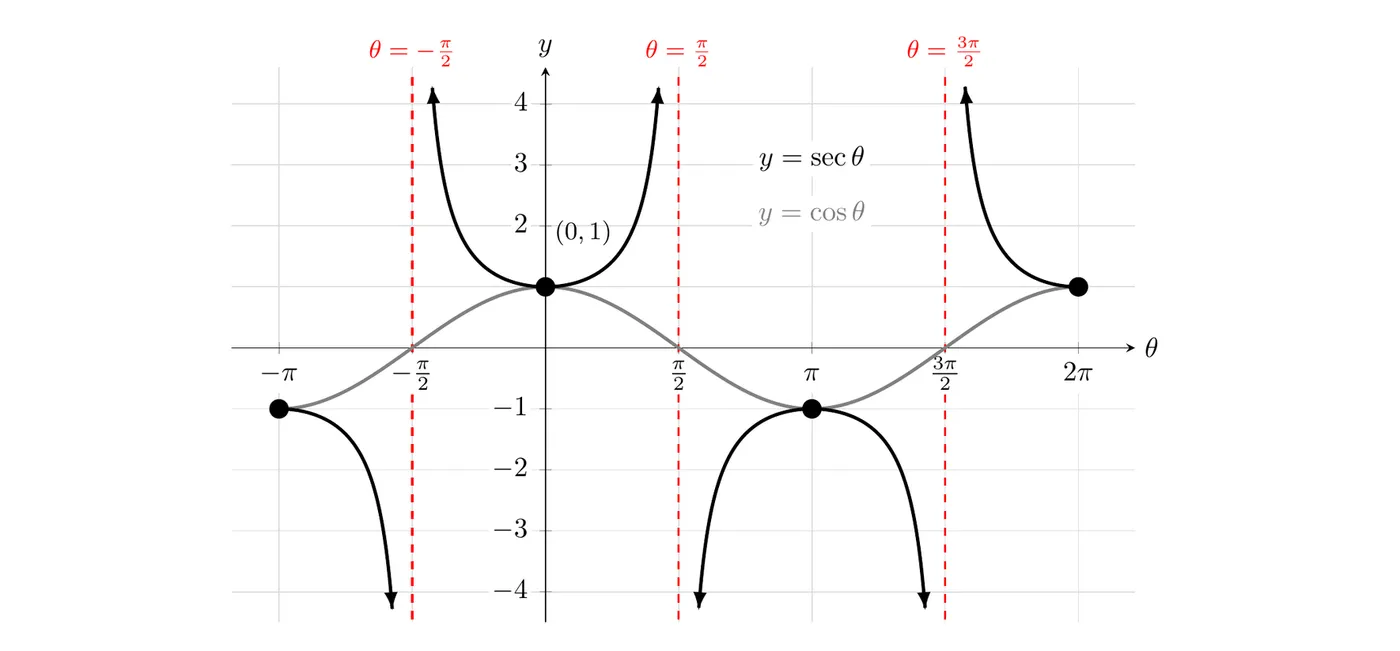
- Vertical asymptotes where cosine is 0. As gets close to 0, its reciprocal gets huge in size, so the graph shoots up or down along the dashed lines .
- Range: . Cosine is always between and 1, and 1 divided by a nonzero number between and 1 is at least 1 in size. So secant never takes a value strictly between and 1.
- Where the graphs touch. Where or , secant has the same value, since and . These are the dots: the bottoms of the upward U shapes and the tops of the downward ones.
- Period and symmetry. Secant has period , like cosine. It is an even function, , because cosine is even, so its graph is symmetric about the y-axis.
- Increasing and decreasing flip. Wherever cosine is increasing, secant is decreasing, and the other way around. That's because is decreasing on each side of : a bigger input gives a smaller output, as long as you don't cross 0.
The cosecant function
is defined everywhere except where , at . That includes , so the y-axis itself is one of the asymptotes.
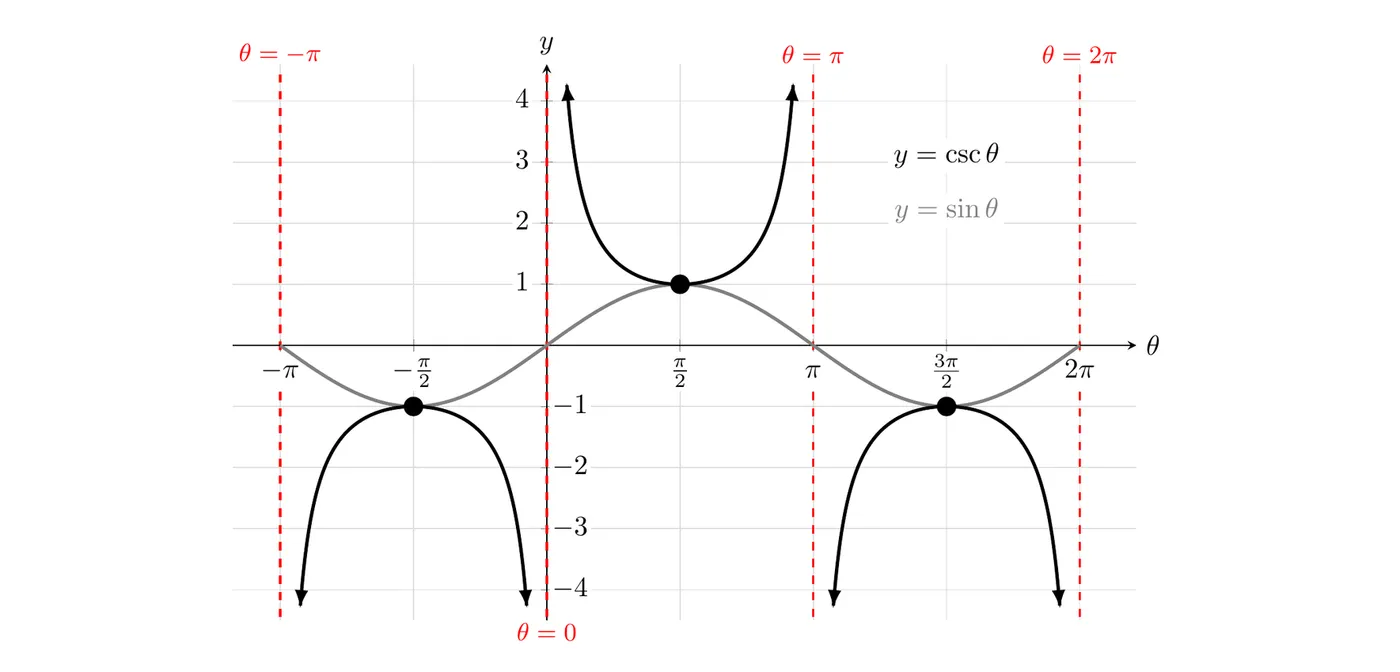
- Vertical asymptotes at , where sine is 0.
- Range: , for the same reason as secant.
- Touch points at and , where sine is 1 or .
- Period and symmetry. Cosecant has period . It is an odd function, , because sine is odd.
- Same shape as secant, shifted. The sine graph is the cosine graph shifted right by , so the cosecant graph is the secant graph shifted right by .
Example 2: Describing secant on an interval
Describe on the interval : where it is undefined, where it is increasing or decreasing, and its relative extrema.
Step 1: Find where it's undefined. at inside this interval, so has a vertical asymptote there.
Step 2: Use the behavior of cosine, flipping each direction:
Interval | is | is |
positive, increasing | positive, decreasing | |
positive, decreasing | positive, increasing | |
negative, decreasing | negative, increasing | |
negative, increasing | negative, decreasing |
Step 3: Find the extrema. At , switches from decreasing to increasing, so it has a relative minimum of . At , switches from increasing to decreasing, so it has a relative maximum of .
Answer: is decreasing on and , and increasing on and . It has a relative minimum of 1 at and a relative maximum of at . The relative maximum value is smaller than the relative minimum value, which is possible because they sit on separate pieces of the graph.
Don't combine the two increasing intervals into . The function isn't defined at , so it can't be increasing across it.
The cotangent function
Cotangent is the reciprocal of tangent: where . Since , flipping it gives the equivalent form
Use this second form. It also covers angles like , where tangent is undefined but .
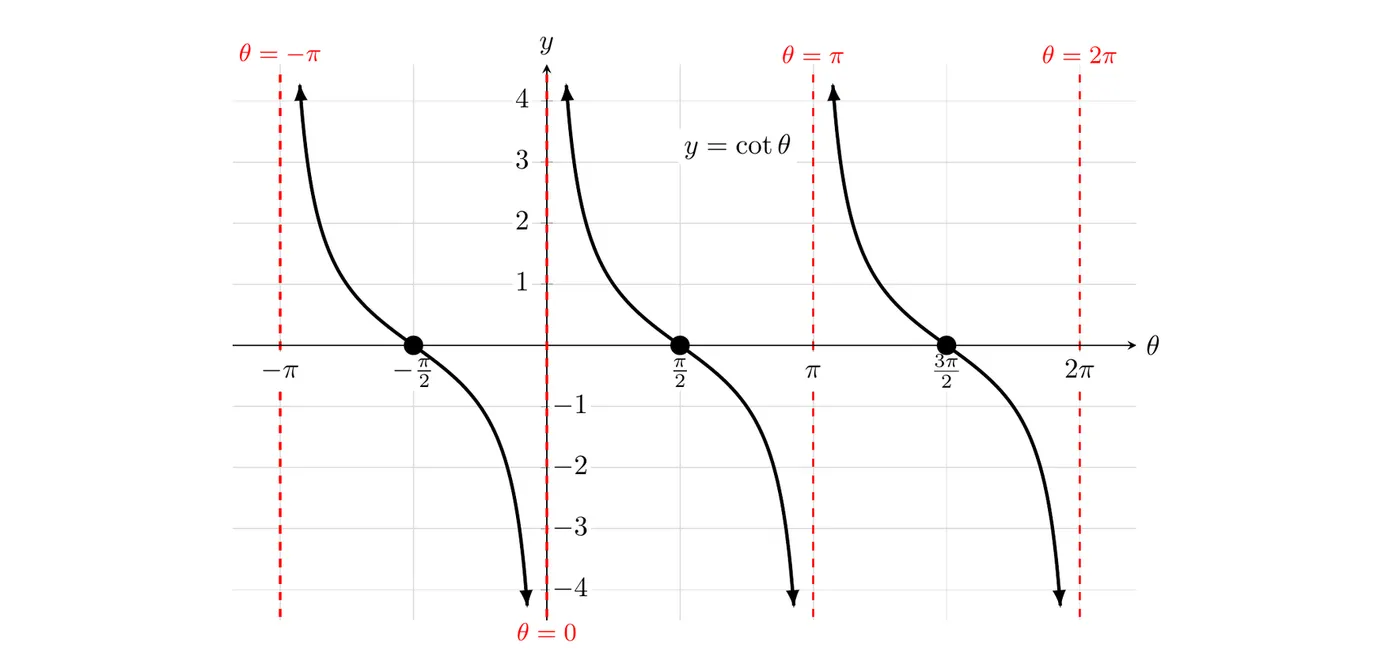
- Vertical asymptotes where , which is where : at , including the y-axis.
- Zeros where : at . These are exactly where tangent has its asymptotes.
- Decreasing between consecutive asymptotes. On the graph falls from down to , and the same thing repeats between every pair of neighboring asymptotes. Tangent is increasing between its asymptotes, and taking the reciprocal flips that.
- Range and period. The range is all real numbers, and the period is , the same as tangent. Cotangent is an odd function.
Example 3: Behavior near an asymptote
Describe the behavior of as approaches from each side.
From the left ( slightly less than , in Quadrant II): is close to and is a tiny positive number. A number near divided by a tiny positive number is a huge negative number.
From the right ( slightly more than , in Quadrant III): is still close to , but is a tiny negative number, so the quotient is a huge positive number.
This matches the graph: the branch on falls toward , and the next branch comes down from .
Example 4: Using one value to find the others (AP-style)
If and , find and .
Step 1: Pick a point on the terminal ray. For any point on the terminal ray, . In Quadrant II, and , so use and .
Step 2: Find its distance from the origin.
Step 3: Find cosine and sine, then take reciprocals.
Answer: and . The signs check out: in Quadrant II, cosine (and so secant) is negative, and sine (and so cosecant) is positive.
Summary
Reciprocal of | |||
Domain | |||
Range | all real numbers | ||
Vertical asymptotes | |||
Zeros | none | none | |
Period | |||
Symmetry | even | odd | odd |
Here is any integer.
Common mistakes
- Mixing up the pairs. and , not the other way around.
- Confusing reciprocal with inverse. equals , but it is not , which means arccosine (an angle).
- Calling undefined. It equals 0. Only the “1 over tangent” form breaks there.
- Writing an interval across an asymptote. Secant is increasing on and on , but not on .
- Forgetting the range gap. An equation like has no solution, because secant never takes values strictly between and 1.