3.12 - Equivalent Representations of Trigonometric Functions
Overview
Trig expressions can be written in many equivalent ways. An identity is an equation that is true for every input where both sides are defined, so you can swap one side for the other whenever it helps. This topic covers the Pythagorean identity and the sum, difference, and double-angle identities for sine and cosine, and how to use them to rewrite expressions, verify other identities, and solve equations.
The Pythagorean identity
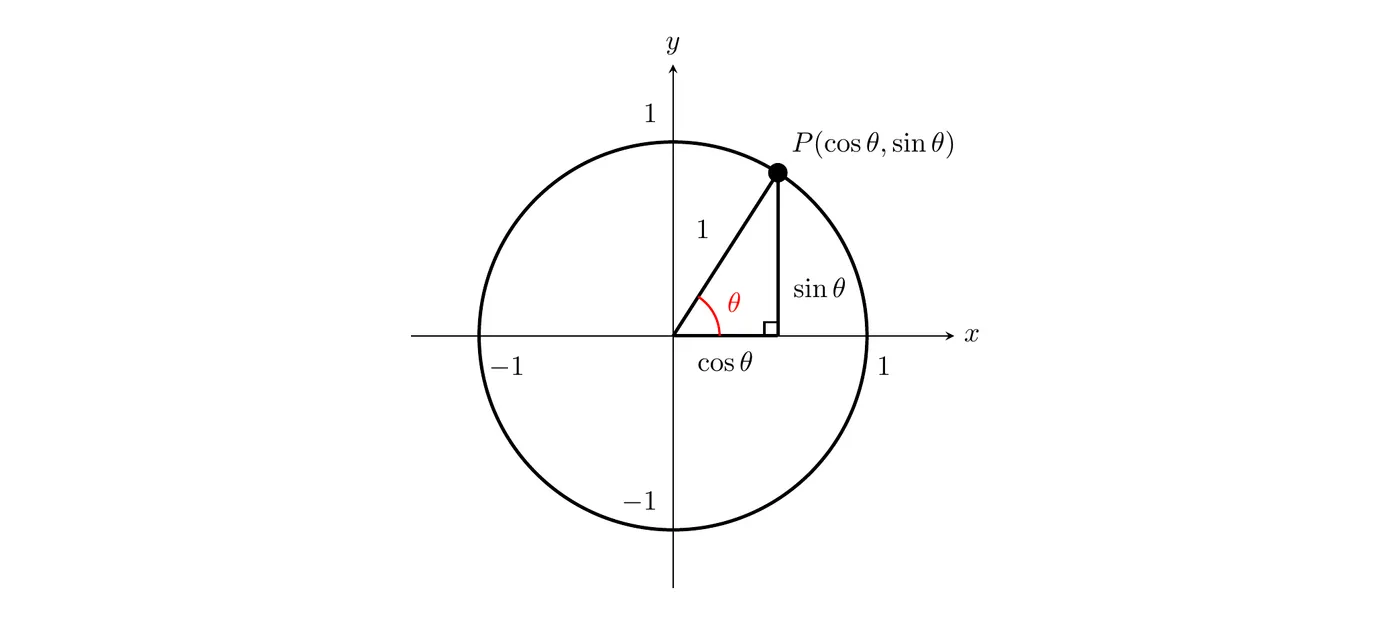
Take the point P=(cosθ,sinθ) where the terminal ray of θ meets the unit circle. A vertical segment from P down to the x-axis makes a right triangle. Its legs have lengths ∣cosθ∣ and ∣sinθ∣, and its hypotenuse is a radius of the circle, so it has length 1.
The Pythagorean Theorem, a2+b2=c2, gives
sin2θ+cos2θ=1
This holds for every angle. Squaring removes the signs, so it works in every quadrant, and it still works at angles like θ=0 where the triangle flattens out: 02+12=1. Remember that sin2θ means (sinθ)2.
Other forms
Dividing every term by cos2θ (where cosθ=0) gives a version with tangent and secant:
cos2θsin2θ+cos2θcos2θ=cos2θ1⟹tan2θ+1=sec2θ
Dividing by sin2θ instead (where sinθ=0) gives 1+cot2θ=csc2θ. Each identity can be rearranged, and the rearranged form is often the one you need.
Identity
Useful rearrangements
sin2θ+cos2θ=1
sin2θ=1−cos2θ and cos2θ=1−sin2θ
1+tan2θ=sec2θ
tan2θ=sec2θ−1
1+cot2θ=csc2θ
cot2θ=csc2θ−1
Example 1: Finding cosine and tangent from sine
If sinθ=−135 and π<θ<23π, find cosθ and tanθ.
Step 1: Use the Pythagorean identity.
cos2θ=1−sin2θ=1−16925=169144
Step 2: Choose the sign.cosθ=±1312. The angle is in Quadrant III, where cosine is negative, so cosθ=−1312.
Step 3: Find tangent.
tanθ=cosθsinθ=−12/13−5/13=125
Answer:cosθ=−1312 and tanθ=125. The identity gives the size, and the quadrant gives the sign.
Connecting inverse trig functions
The Pythagorean identity also links the inverse trig functions. For example, for 0≤x≤1
arcsinx=arccos(1−x2)
Why it works: let θ=arcsinx. Then sinθ=x, and since 0≤x≤1, θ is between 0 and 2π. By the Pythagorean identity, cosθ=±1−x2, and cosine is not negative on [0,2π], so cosθ=1−x2. That angle is in the output range of arccosine, so θ=arccos(1−x2).
Why the domain restriction matters: try x=−21. The left side is arcsin(−21)=−6π, but the right side is arccos(23)=6π. They disagree, because arccosine never outputs a negative angle.
Sum and difference identities
These identities expand the sine or cosine of a sum of two angles:
A way to remember them: the sine identity mixes the functions (sin cos, then cos sin) and keeps the plus sign. The cosine identity keeps like functions together (cos cos, then sin sin) and flips the sign.
Difference identities. Replace β with −β. Cosine is even, cos(−β)=cosβ, and sine is odd, sin(−β)=−sinβ, so
Answer:sin2θ=−2524 and cos2θ=257. Check with the Pythagorean identity: (−2524)2+(257)2=625576+49=1.
What the AP exam covers: the identities in the CED are the Pythagorean identity (and the forms you get by rearranging it) and the sum, difference, and double-angle identities for sine and cosine. Half-angle identities and the sum and difference identities for tangent aren't in the CED.
Verifying identities
To verify an identity, rewrite one side step by step until it matches the other side. Work on one side only, usually the more complicated one. Don't add, multiply, or cross-multiply across the equals sign, because that assumes the identity is already true.
Strategies that usually work:
Rewrite everything in terms of sine and cosine.
Look for a Pythagorean identity to substitute, like 1−cos2θ=sin2θ.
Expand double angles, or combine fractions over a common denominator.
Factor, then cancel common factors.
Example 5: A double-angle identity
Verify that 1+cos2θsin2θ=tanθ.
Start with the left side. The denominator has a 1+ in it, so use the form cos2θ=2cos2θ−1, which makes the 1s cancel:
The moves were: rewrite secant with cosine, combine over a common denominator, use 1−cos2θ=sin2θ, then split off a tangent.
Choosing a useful form
Sometimes rewriting a function makes its key features easy to read.
Example 7: Reading features from an equivalent form
(a) Find the maximum value and the period of f(θ)=4sinθcosθ.
4sinθcosθ=2(2sinθcosθ)=2sin2θ
Now f is a sinusoid with amplitude 2 and period 22π=π. Its maximum value is 2, reached when 2θ=2π, at θ=4π (and every π after that).
(b) Show that g(θ)=sinθ+cosθ is a sinusoid with amplitude 2. Expand 2sin(θ+4π) with the sum identity:
2sin(θ+4π)=2(sinθ⋅22+cosθ⋅22)=sinθ+cosθ
So g(θ)=2sin(θ+4π): amplitude 2, period 2π, and maximum value 2 at θ=4π. None of that is obvious from sinθ+cosθ.
Solving equations with identities
An equation that mixes functions (like sinθ and cos2θ) or mixes angles (like 2θ and θ) is hard to solve as written. Use an identity to rewrite it in terms of one function of one angle, then factor and solve.
Example 8: Using the Pythagorean identity
Solve 2cos2θ+3sinθ−3=0 for 0≤θ<2π.
Step 1: Rewrite with only sine. Replace cos2θ with 1−sin2θ:
Step 3: Solve each factor.sinθ=21 gives θ=6π or 65π. sinθ=1 gives θ=2π.
Answer:θ=6π,2π,65π.
Example 9: An equation and an inequality (AP-style)
For 0≤θ<2π, (a) solve sin2θ=3sinθ, and (b) solve sin2θ>3sinθ.
(a) Step 1: Rewrite the double angle and move everything to one side.
2sinθcosθ−3sinθ=0
Step 2: Factor.
sinθ(2cosθ−3)=0
Don't divide both sides by sinθ. That would throw away the solutions where sinθ=0.
Step 3: Solve each factor.sinθ=0 gives θ=0 or π. cosθ=23 gives θ=6π or 611π.
So the solutions are θ=0,6π,π,611π.
(b) The inequality is sinθ(2cosθ−3)>0. The solutions from part (a) split [0,2π) into intervals where the product keeps one sign. Check the sign of each factor:
Interval
sinθ
2cosθ−3
Product
0<θ<6π
+
+
+
6π<θ<π
+
−
−
π<θ<611π
−
−
+
611π<θ<2π
−
+
−
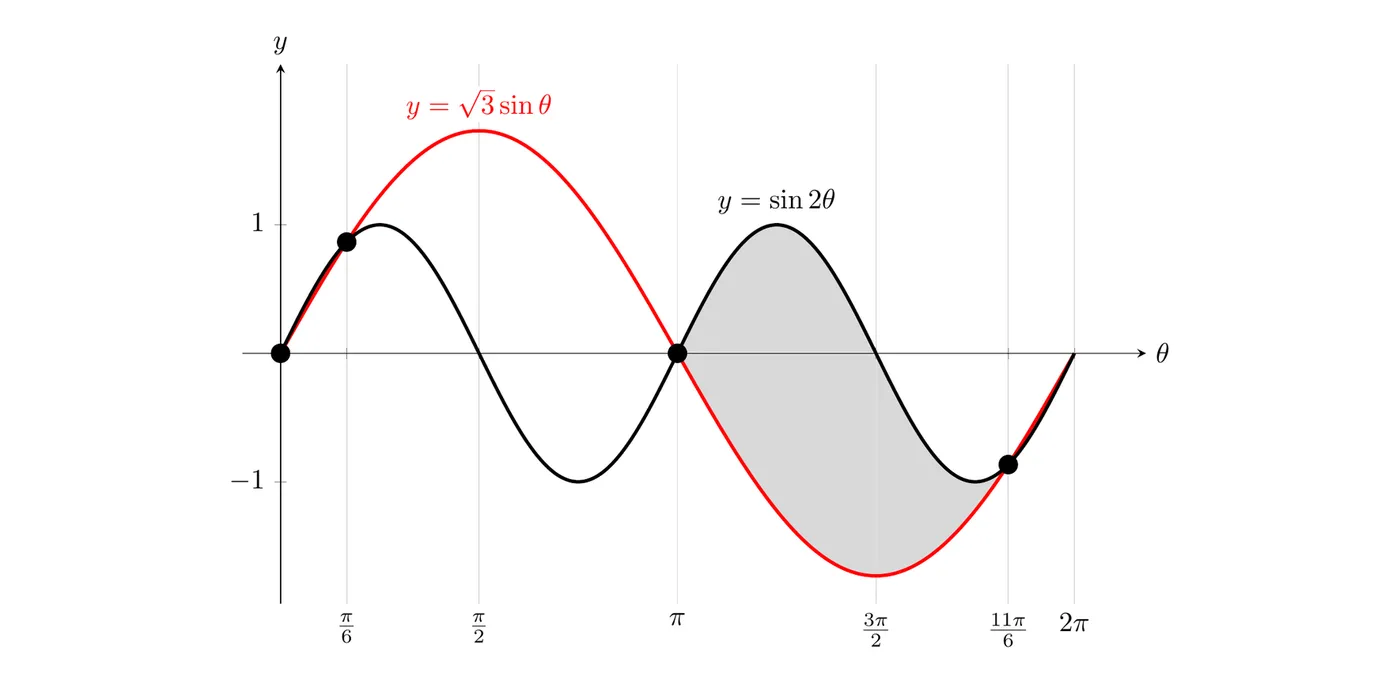
Answer:0<θ<6π or π<θ<611π. The solutions from part (a) are left out, because the product is 0 there, not positive. The graph confirms it: the shaded regions are exactly where y=sin2θ (black) is above y=3sinθ (red). The first region is only a thin sliver, because the two curves stay close together between 0 and 6π.
Common mistakes
Distributing sine or cosine.sin(α+β) is not sinα+sinβ, and sin2θ is not 2sinθ.
Sign errors in the cosine identities. The sum identity has a minus, cos(α+β)=cosαcosβ−sinαsinβ, and the difference identity has a plus.
Dividing by a trig function. Dividing both sides by sinθ loses every solution where sinθ=0. Factor instead.
Ignoring the quadrant after a square root.cosθ=±1−sin2θ, and the quadrant decides the sign.
Working both sides of an identity at once. Transform one side until it matches the other.