Every point in the plane has rectangular coordinates (x,y): how far right and how far up. Polar coordinates describe the same point with an angle and a distance from the origin. Trigonometry converts between the two systems, and the same idea gives complex numbers a polar form.
The polar coordinate system
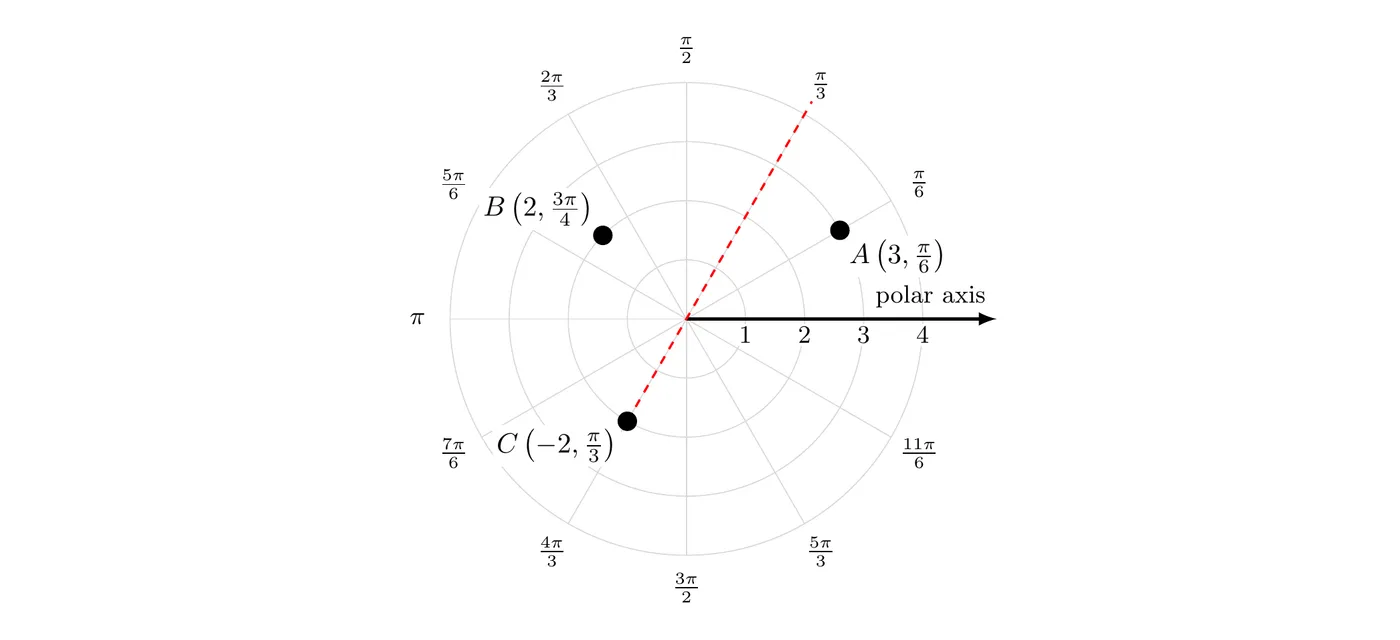
The polar grid is built from circles centered at the origin and lines through the origin. The origin is called the pole, and the positive x-axis is called the polar axis. Angles are measured from the polar axis, counterclockwise for positive angles.
A point's polar coordinates are an ordered pair (r,θ):
θ is the measure of an angle in standard position whose terminal ray lies on a line through the point.
r is the radial displacement: the signed distance from the origin along that line.
To plot (r,θ), rotate to the angle θ, then move r units out along the terminal ray. In the figure, A=(3,6π) is 3 units out along the 6π ray, and B=(2,43π) is 2 units out along the 43π ray.
Negative values of r
When r is negative, move along the line containing the terminal ray, but in the opposite direction. To plot C=(−2,3π), face the 3π ray, then go 2 units backward through the origin (the red dashed line). C lands in Quadrant III, on the 34π ray.
So (−2,3π) and (2,34π) name the same point. In general, (r,θ) and (−r,θ+π) are always the same point.
One point, many names
Adding or subtracting 2π lands on the same ray, so (r,θ) and (r,θ+2π) are the same point. Combined with negative values of r, this gives every point infinitely many polar representations. The origin is (0,θ) for any θ.
Example 1: Other names for a point
Give three other polar representations of (3,6π) with −2π≤θ≤2π.
Subtract 2π: (3,6π−2π)=(3,−611π).
Use −r and add π: (−3,6π+π)=(−3,67π).
Use −r and subtract π: (−3,6π−π)=(−3,−65π).
All of these, along with the original, plot at point A in the figure.
Converting polar to rectangular
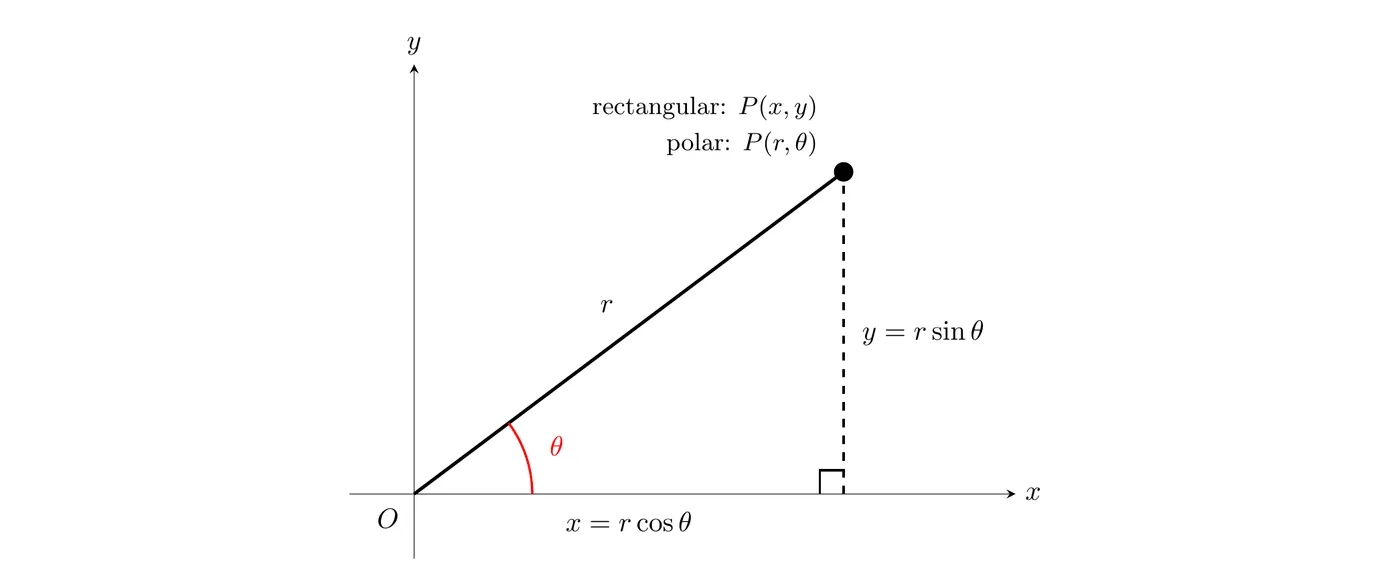
Picture a point P at distance r from the origin, at angle θ. Dropping a perpendicular to the x-axis makes a right triangle with hypotenuse r, horizontal leg x, and vertical leg y.
From the triangle, cosθ=rx and sinθ=ry. Multiplying both by r:
x=rcosθy=rsinθ
These formulas work for every point, including negative values of r and angles in any quadrant. The signs take care of themselves.
Example 2: Polar to rectangular
Convert (4,65π) and (−2,3π) to rectangular coordinates.
(a)
x=4cos65π=4(−23)=−23y=4sin65π=4(21)=2
The point is (−23,2), in Quadrant II, as expected for an angle of 65π with positive r.
(b)
x=−2cos3π=−2(21)=−1y=−2sin3π=−2(23)=−3
The point is (−1,−3). That's point C in the figure: the negative r put it in Quadrant III.
Converting rectangular to polar
Going the other way, the Pythagorean Theorem gives r and the tangent ratio gives θ:
r=x2+y2θ=arctan(xy) for x>0θ=arctan(xy)+π for x<0
Why addπ? Arctangent only outputs angles between −2π and 2π, which point into Quadrants I and IV, the right half of the plane. If the point has x<0, it's in the left half, so adding π turns the angle onto the correct ray.
If x=0, the point is on the y-axis: use θ=2π when y>0 and θ=23π (or −2π) when y<0. These formulas give the name with r≥0. Any of the other names for the point is also correct.
Example 3: Rectangular to polar
Convert (−3,3) and (2,−23) to polar coordinates.
(a)r=(−3)2+32=18=32. Since x<0, add π:
θ=arctan(−33)+π=−4π+π=43π
The point is (32,43π). Without the +π you'd get −4π, which points into Quadrant IV, the wrong side of the origin.
(b)r=22+(−23)2=16=4. Since x>0:
θ=arctan(2−23)=arctan(−3)=−3π
The point is (4,−3π), or equivalently (4,35π).
Example 4: With a calculator (AP-style)
Point P has rectangular coordinates (−5,−12). Find two polar representations of P with 0≤θ<2π: one with r>0 and one with r<0.
Step 1:r=(−5)2+(−12)2=169=13.
Step 2:x<0, so add π. With the calculator in radian mode:
Step 3: For a negative r, use the opposite ray: θ−π≈1.176.
Answer:(13,4.318) and (−13,1.176). Check the second one: x=−13cos(1.176)≈−13(0.385)=−5.0 and y=−13sin(1.176)≈−13(0.923)=−12.0.
Complex numbers in polar form
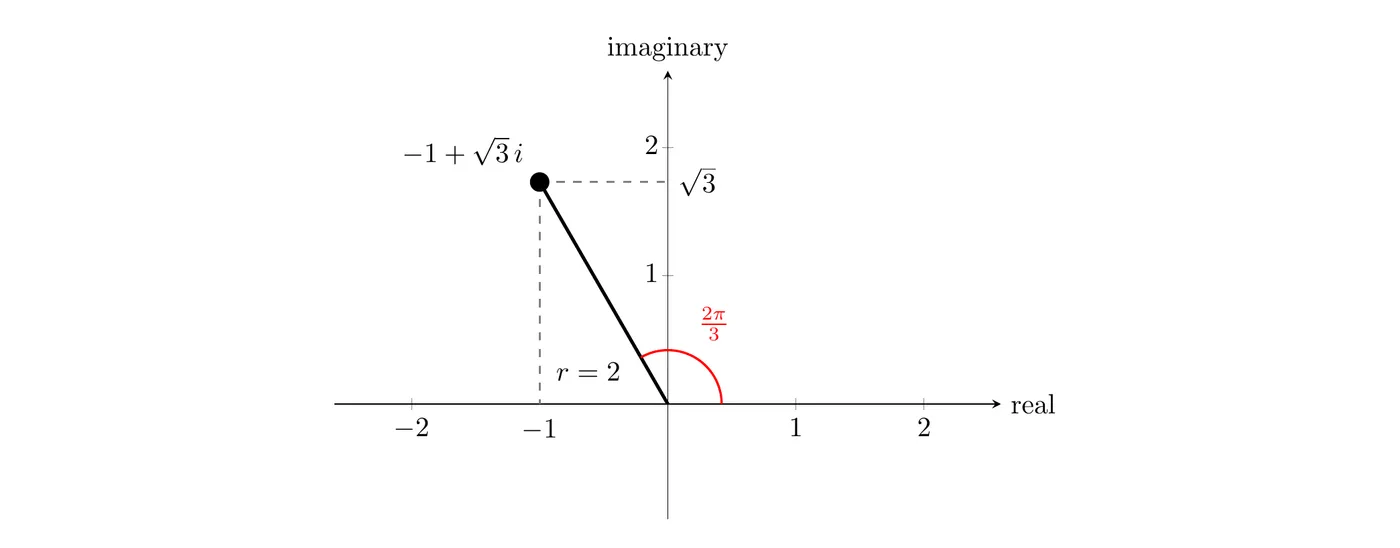
A complex number a+bi can be plotted as the point (a,b) in the complex plane, where the horizontal axis is the real axis and the vertical axis is the imaginary axis. For example, −1+3i is the point (−1,3).
Like any point, it also has polar coordinates (r,θ). Substituting a=rcosθ and b=rsinθ gives the polar form of the complex number:
a+bi=(rcosθ)+i(rsinθ)
Here r=a2+b2 is the number's distance from 0 in the complex plane, and θ is found exactly as for any other point.
Example 5: Writing a complex number in polar form
Write z=−1+3i in polar form.
Step 1:a=−1 and b=3, so r=1+3=2.
Step 2:a<0, so add π:
θ=arctan(−13)+π=−3π+π=32π
Answer:z=2cos32π+i(2sin32π). Check: 2cos32π=−1 and 2sin32π=3.
Example 6: Polar form back to a+bi
Write 6cos67π+i(6sin67π) in the form a+bi.
a=6cos67π=6(−23)=−33b=6sin67π=6(−21)=−3
Answer:−33−3i.
Common mistakes
Forgetting the+πwhenx<0. Arctangent alone always points into Quadrant I or IV.
Plotting a negativeralong the terminal ray. A negative r goes in the opposite direction, through the origin.
Swapping the formulas.x goes with cosine and y goes with sine.
Using degree mode. An angle like 1.176 only makes sense in radians.
Thinking a point has only one name.(r,θ), (r,θ+2π), and (−r,θ+π) are all the same point.