

3.9 - Inverse Trigonometric Functions
Overview
Sine, cosine, and tangent take an angle and give back a number. Their inverses work the other way: give them a number, and they give back an angle. The catch is that trig functions repeat, so lots of angles share the same sine. In this topic you'll see how restricting the domain fixes that, and how to evaluate and graph arcsine, arccosine, and arctangent.
Inputs and outputs switch
For any inverse function, the inputs and outputs trade places (Topic 2.8). So for an inverse trig function:
- The input is a value from the range of the trig function, like , , or .
- The output is an angle measure, in radians.
For example, , so . Read as "the angle whose sine is ."
Names and notation
Function | Inverse function | Also written |
(arcsine) | ||
(arccosine) | ||
(arctangent) |
The in means inverse function, not reciprocal. is , and it is not . That reciprocal has its own name, (Topic 3.11).
Why the domain must be restricted
A function has an inverse only if it is one-to-one: every output comes from exactly one input. That's the horizontal line test from Topic 2.8, and sine fails it badly. The line crosses infinitely many times, at , , , and so on. So "the angle whose sine is " has no single answer.
The fix is to keep one piece of the graph that passes the horizontal line test and still reaches every output, and invert only that piece.
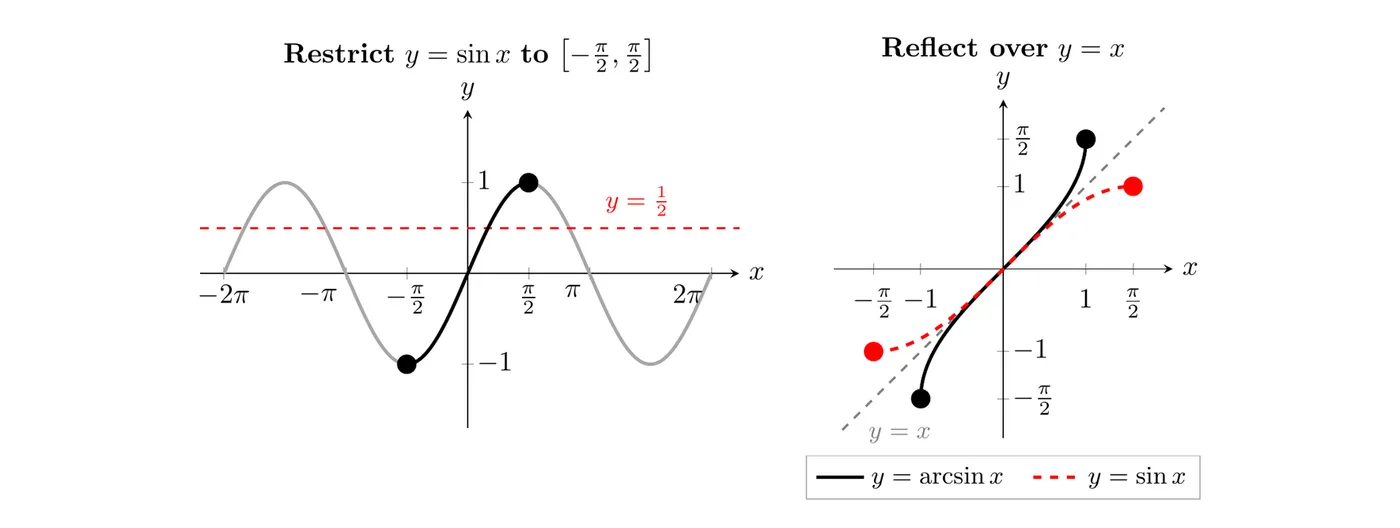
On the left, the full sine graph (gray) crosses four times between and , but the black piece on crosses it exactly once. On the right, reflecting that piece over gives the graph of . Its endpoints and become and .
The restricted domains
These are the standard restrictions. Memorize them, because they set the range of each inverse function, and every answer has to land in that range.
Function | Restricted domain | Inverse | Domain of inverse | Range of inverse |
All real numbers |
Each restricted piece is always increasing or always decreasing (so it's one-to-one) and still covers every output of the original function. The tangent interval is open because are asymptotes.
On the unit circle, the ranges tell you where an answer can be:
- and give angles in Quadrant I or Quadrant IV, between and . A negative input gives a negative angle.
- gives angles in Quadrant I or Quadrant II, between and . A negative input gives an angle in Quadrant II.
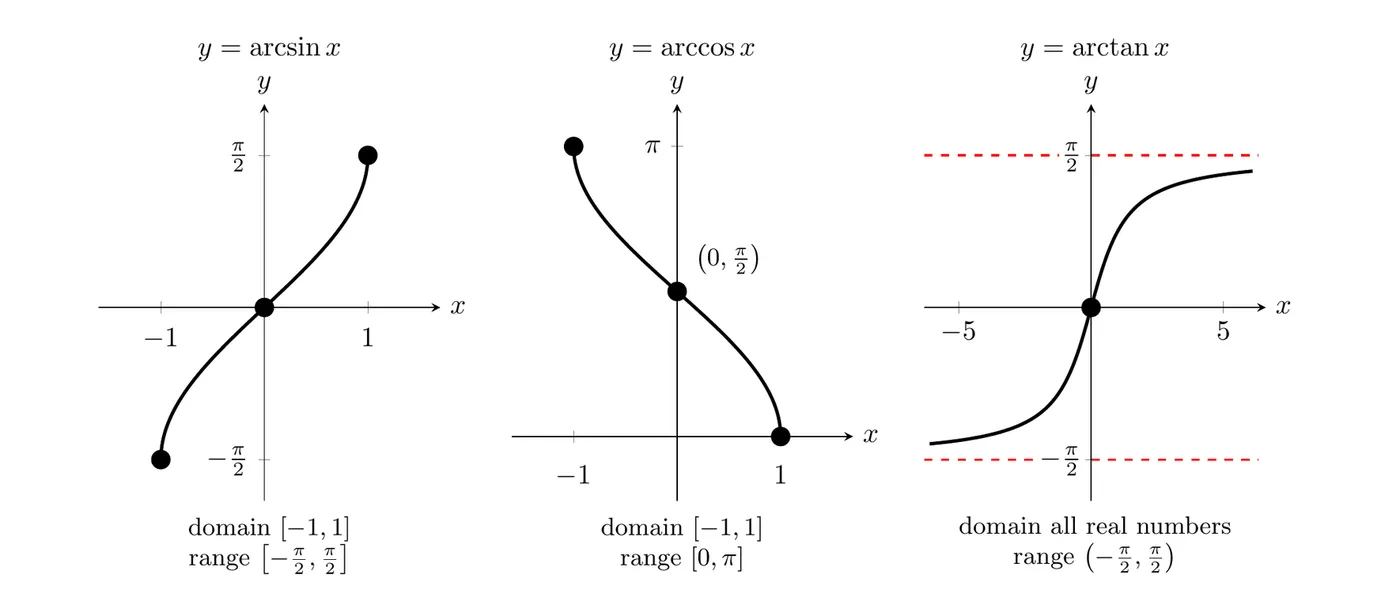
Notice that has horizontal asymptotes at . Swapping and turns tangent's vertical asymptotes into horizontal ones.
Evaluating inverse trig functions
Ask: which angle in the range has this sine (or cosine, or tangent)? Find it on the unit circle, then make sure it's inside the range.
On a calculator, use the inverse keys (
2nd then SIN for , and so on) in radian mode. The calculator always returns the one answer in the range.Example 1: Exact values
Evaluate (a) (b) (c) (d)
(a) In , the angle with sine is .
(b) In , the angle with cosine is . ( also has that cosine, but it isn't in the range.)
(c) In , the angle with tangent is . ( is out of range.)
(d) In , the angle with sine is , not .
Example 2: Compositions
A function and its inverse undo each other, but only where the restricted domain allows:
Evaluate (a) (b) (c) (d)
(a) accepts any real number, and undoes it: the answer is .
(b) Work inside out: , and . The answer is , not , because is outside .
(c) , and .
(d) , and .
Example 3: An angle from a ratio (AP-style)
(a) A wheelchair ramp rises 1 foot for every 12 feet of horizontal distance. Find the angle the ramp makes with the ground, in radians. (b) Find the exact value of .
(a) The slope of the ramp is , and slope is the tangent of the angle, so
The output of arctangent is an angle, which is exactly what the question asks for. The ramp makes an angle of about 0.083 radians (about 4.8°) with the ground.
(b) Let . Then and is in . Since the cosine is negative, is in Quadrant II. The point for on the unit circle is , and :
In Quadrant II, is positive, so . Answer: .
Common mistakes
- Giving an answer outside the range. , never , and , never .
- Treating as .
- Assuming for every . It's only true when is already in .
- Plugging a number outside into arcsine or arccosine. is undefined, because no angle has a sine of 2.
- Leaving the calculator in degree mode.