

2.12 - Legacies of the Haitian Revolution
The Global Impact of the Haitian Revolution
The Haitian Revolution, which took place between 1791 and 1804, holds a unique place in world history: it's the only uprising of enslaved people that actually succeeded in overturning an entire colonial, slaveholding government. It transformed the European colony of Saint-Domingue into Haiti, a Black republic free of slavery, and became the second independent nation in the Americas, right after the United States.
The revolution began in August 1791, when enslaved people on the sugar plantations of northern Saint-Domingue rose up and burned plantations across the region. Toussaint L'Ouverture, a formerly enslaved man, became its most important leader, building a disciplined army that fought off Spanish and British forces trying to take the colony. France abolished slavery in 1794, but in 1802 Napoleon sent a large army to retake control and restore slavery. Toussaint was captured and died in a French prison in 1803, but Jean-Jacques Dessalines led the final fight, defeated the French, and declared Haiti's independence on January 1, 1804.
The ripple effects of this revolution reached far beyond Haiti itself. Fighting the Haitians proved so costly for France that it pushed Napoleon to sell the entire Louisiana Territory to the United States. That sale nearly doubled the size of the United States overnight, and the federal government used much of that new land specifically to expand slavery, meaning a revolution against slavery ended up indirectly fueling slavery's growth elsewhere.
France's losses didn't stop there either. Losing its most profitable colony forced France to temporarily abolish slavery across its empire, including in places like Guadeloupe and Martinique, from 1794 to 1802. And once Haiti's plantation slavery system was destroyed, the global sugar market shifted its center of production to the United States, Cuba, and Brazil instead.
The revolution also reshaped life within the United States. It sent a wave of white planters and enslaved Black refugees into American cities like Baltimore, New York, and Philadelphia. This influx heightened American anxieties about the possibility of slave revolts spreading, anxieties that helped contribute to the passage of the Alien and Sedition Acts in 1798.
Even Haiti's independence came at a steep, lasting cost. In exchange for France formally recognizing Haiti as a sovereign nation, Haiti was forced to pay reparations to France for roughly 122 years, a financial burden that significantly held back the country's growth and development for generations.
The payment was set in 1825, when France sent warships and demanded 150 million francs to compensate former French enslavers for their lost "property," including the people they had enslaved. The amount was later lowered to 90 million francs, but Haiti had to borrow from French banks to pay it, and paying off the debt and its interest took until the middle of the twentieth century.
The Role of Maroons
Enslaved people who escaped bondage and formed their own free communities were known as maroons, and they played a crucial role in the Haitian Revolution itself. Maroons helped spread information across scattered groups of fighters and helped organize coordinated attacks. Notably, many of the enslaved freedom fighters involved had actually been soldiers before their enslavement, captured during civil wars in the Kingdom of Kongo and then sent to Haiti, meaning many of the revolution's fighters brought real military experience with them from Africa.
Impact on Black Political Thought and the African Diaspora
For some African Americans, Haiti's successful revolution and abolition of slavery stood as a pointed reminder of everything the American Revolution had promised but failed to deliver for Black people.
The revolution's influence spread well beyond Haiti's borders too. It helped inspire other uprisings across the African diaspora, including the Louisiana Slave Revolt of 1811, one of the largest slave revolts on U.S. soil, and the Malê Uprising of 1835, led by enslaved Muslims and one of the largest revolts in Brazil's history.
The Malê Uprising took place in Salvador, Bahia, in January 1835, during the Muslim holy month of Ramadan. It was planned by enslaved and free African Muslims (called Malês in Bahia), many of them Yoruba speakers. Authorities learned of the plan and crushed the revolt within hours, but it frightened Brazil's slaveholders for years.
Beyond specific uprisings, the Haitian Revolution left a lasting mark on Black political thought more broadly. It became, and remains, a powerful symbol of Black freedom and sovereignty, proof that enslaved people could not just resist, but actually overthrow the entire system holding them captive.
Required Sources
The Preliminary Declaration from the Constitution of Haiti, 1805
Article 14 of this 1805 constitution did something genuinely radical for its time: it flipped the usual racial logic of the Atlantic world on its head. Where "Black" had typically marked someone as an outsider or noncitizen throughout the Americas, Haiti's constitution declared that all citizens of Haiti were, by definition, Black. This united the island's multiethnic population under a single shared category, stripping away old ethno-racial divisions and turning "Black" into a marker of citizenship and belonging rather than exclusion. Reading this declaration directly shows just how deliberately and philosophically Haiti's founders reimagined race itself as part of building their new nation.
The constitution was issued in May 1805 under Jean-Jacques Dessalines, who had declared himself emperor. It also abolished slavery forever and barred white men from entering Haiti as a "master or proprietor" or owning property there, measures meant to protect the new nation's freedom from any return of French rule.
Preliminary Declaration. Art. 1. The people inhabiting the island formerly called St. Domingo, hereby agree to form themselves into a free state sovereign and independent of any other power in the universe, under the name of empire of Hayti. 2. Slavery is forever abolished. 3. The Citizens of Hayti are brothers at home; equality in the eyes of the law is incontestably acknowledged, and there cannot exist any titles, advantages, or privileges, other than those necessarily resulting from the consideration and reward of services rendered to liberty and independence. 4. The law is the same to all, whether it punishes, or whether it protects. 5. The law has no retroactive effect. 6. Property is sacred, its violation shall be severely prosecuted. 7. The quality of citizen of Hayti is lost by emigration and naturalization in foreign countries and condemnation to corporal or disgrace punishments. The first case carries with it the punishment of death and confiscation of property. 8. The quality of Citizen is suspended in consequence of bankruptcies and failures.
9. No person is worth of being a Haitian who is not a good father, good son, a good husband, and especially a good soldier. 10. Fathers and mothers are not permitted to disinherit their children. 11. Every Citizen must possess a mechanic art. 12. No whiteman of whatever nation he may be, shall put his foot on this territory with the title of master or proprietor, neither shall he in future acquire any property therein. 13. The preceding article cannot in the smallest degree affect white woman who have been naturalized Haytians by Government, nor does it extend to children already born, or that may be born of the said women. The Germans and Polanders naturalized by government are also comprized in the dispositions of the present article. 14. All acception of colour among the children of one and the same family, of whom the chief magistrate is the father, being necessarily to cease, the Haytians shall hence forward be known only by the generic appellation of Blacks.
Henri Christophe and the other generals of the Empire of Haiti, Constitution of Hayti, Preliminary Declaration, Articles 1 to 14 (1805), English translation printed in the New York Evening Post, July 15, 1805. Source: Bob Corbett's transcription, Webster University (the CED's link), checked against Wikisource
Frederick Douglass's Lecture on Haiti at the Chicago World's Fair, 1893
Frederick Douglass gave this lecture on January 2, 1893, at the dedication of Haiti's pavilion at the World's Columbian Exposition (the Chicago World's Fair), where Haiti had asked him to help represent it. He knew Haiti firsthand, since President Benjamin Harrison had appointed him General Consul and United States Minister to Haiti (1889 to 1891). In the lecture, Douglass defends Haiti against Americans who mocked it as unstable or unfit for self-government, and he praises the Haitian Revolution as a fight that advanced freedom for Black people everywhere, not just in Haiti. That argument connects to this topic's point that Haiti became a lasting symbol of Black freedom and sovereignty in Black political thought.
[...] She has taught the world the danger of slavery and the value of liberty. [...]
Speaking for the Negro, I can say, we owe much to Walker for his appeal; to John Brown [applause] for the blow struck at Harper's Ferry, to Lundy and Garrison for their advocacy [applause], and to the abolitionists in all the countries of the world [...] but we owe incomparably more to Haiti than to them all. [Prolonged applause.] I regard her as the original pioneer emancipator of the nineteenth century. [Applause.] It was her one brave example that first of all startled the Christian world into a sense of the Negro's manhood. [...] Until Haiti struck for freedom, the conscience of the Christian world slept profoundly over slavery.
Frederick Douglass, Lecture on Haiti: The Haitian Pavilion Dedication Ceremonies Delivered at the World's Fair, in Jackson Park, Chicago, Jan. 2d, 1893 (1893), pp. 35 to 36. Source: Library of Congress, Rare Book and Special Collections Division
"L'Ouverture," 1986, "To Preserve Their Freedom," 1988, and "Strategy," 1994, from The Life of Toussaint L'Ouverture, a series by Jacob Lawrence
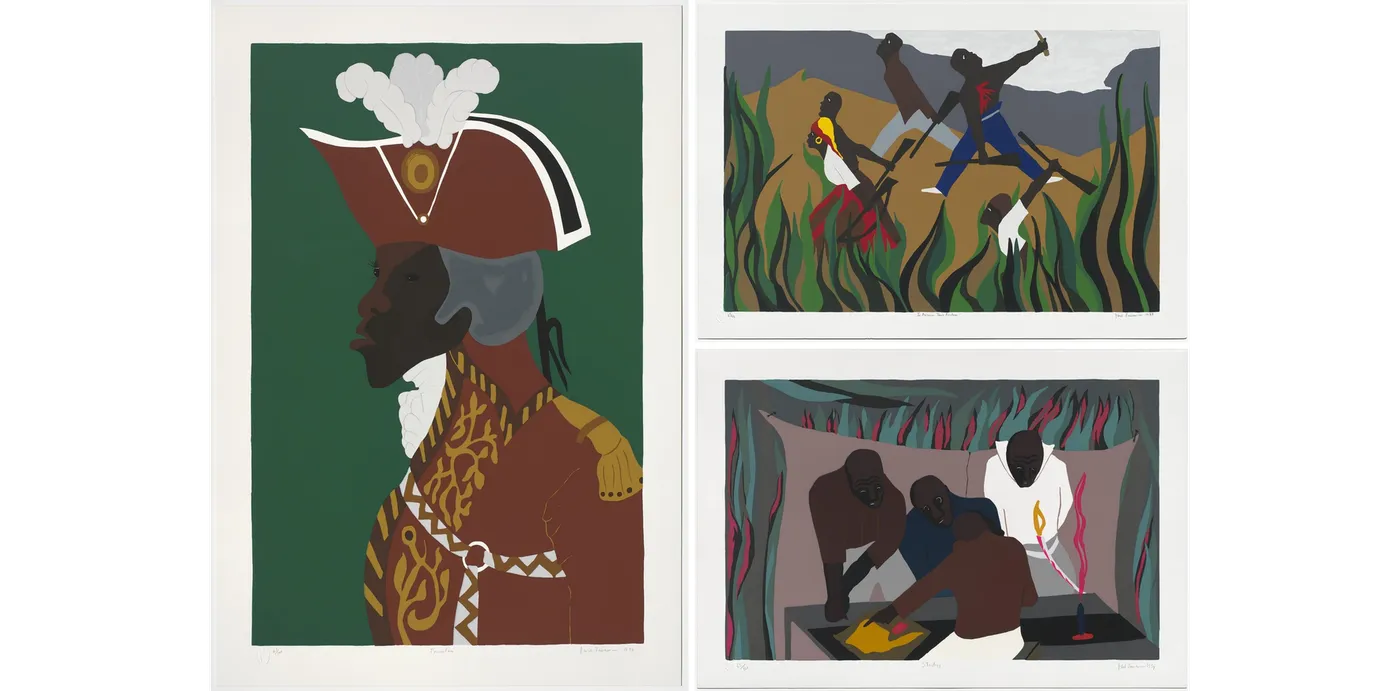
These three prints come from Jacob Lawrence's series on the life of Toussaint L'Ouverture, the revolution's most famous leader. Lawrence first painted the series as 41 small panels in 1938, when he was a young artist in Harlem learning Black history at libraries and community workshops, and decades later he turned some of those images into screenprints (these three date from 1986, 1988, and 1994). Rather than treating the Haitian Revolution as a distant historical event, Lawrence gives it the same serious artistic attention given to other major world revolutions. Each image captures a different side of the struggle (leadership, the fight to preserve hard-won freedom, and military strategy), echoing the themes of organized resistance and maroon involvement described earlier in this topic. Together, they show the revolution as a sustained, strategic struggle carried out over more than a decade, and they show how Black artists kept Haiti alive as a symbol of Black freedom.