

2.8 - The Social Construction of Race and the Reproduction of Status
Partus Sequitur Ventrem and Its Impact on African American Families
Partus sequitur ventrem was a seventeenth-century legal doctrine that determined a child's legal status based entirely on the status of their mother, and it had devastating consequences for enslaved African American families. Under this law, any child born to an enslaved African American woman automatically inherited her status as property, which meant African Americans had no legal claim to their own children, even when biology clearly said otherwise.
This law was actually a significant break from English common law tradition, which normally passed down a father's free status to his children. Partus deliberately overturned that custom specifically to prevent mixed-race children born to Black women from inheriting freedom through their fathers.
The consequences of this law went even further. It gave male enslavers legal cover to deny any responsibility for children they fathered with enslaved women, children who were most often conceived through assault, and it let enslavers treat enslaved women's reproductive capacity itself as a commodity, essentially another resource to be exploited and controlled.
This law didn't emerge in a vacuum either. In 1656, Elizabeth Key, born to a white father and an enslaved Black mother, became the first Black woman in North America to successfully sue for her freedom. Not long after, in 1662, Virginia's General Assembly passed partus sequitur ventrem, and the doctrine quickly spread to the rest of the thirteen colonies. Key's case is a clear example of colonial law shifting specifically in response to enslaved people successfully asserting their legal freedom, and over time, this shift helped cement slavery in North America as a status you inherited through race, not something tied to individual circumstance.
Key's case shows exactly why lawmakers wanted this change. She won her freedom partly by arguing that her father was a free Englishman, and under English common law a child followed the father's status. She also pointed out that she had been baptized as a Christian. Virginia soon closed both paths: the 1662 law tied a child's status to the mother, and a 1667 law declared that baptism did not free an enslaved person.
How Racial Classification Emerged Alongside Legal Status
Within African American Studies, and many other academic fields, race is understood as a social construct rather than a biological reality. There's actually more genetic variation within so-called racial groups than there is between them, and current biological science doesn't support attributing cultural, political, or economic achievement to any "race." Despite that, concepts and classifications of racial types developed hand in hand with systems of enslavement and oppression, race wasn't discovered first and then used to justify slavery, the categories themselves were shaped by the need to justify and maintain that system.
Phenotype, things like skin color and hair texture, has always played a large role in how people perceive racial identity. But during the era of slavery, racial categories weren't just about appearance, they were defined by law, regardless of what someone actually looked like. Laws like partus sequitur ventrem tied racial categories directly to rights and legal status, like being enslaved, free, or a citizen, specifically as a tool to keep slavery going across generations.
Race classification in the U.S. relied on what's called hypodescent, the idea that a person automatically inherits the status of the more socially subordinate group. Before the Civil War, different states actually disagreed on exactly what percentage of African ancestry made someone legally Black versus white. Later, in the late nineteenth and twentieth centuries, this hardened even further into the so-called "one-drop rule," which classified anyone with any African ancestry at all as belonging to a single, socially inferior racial category.
One important consequence of all this: even though many African Americans also had European or Indigenous ancestry, these rigid racial classification systems didn't allow them to fully claim or embrace that multiracial or multiethnic heritage. The law essentially flattened complex ancestry into a single imposed racial category.
Required Sources
Laws of Virginia, Act XII, General Assembly, 1662
WHEREAS some doubts have arrisen whether children got by any Englishman upon a negro woman should be slave or ffree, Be it therefore enacted and declared by this present grand assembly, that all children borne in this country shalbe held bond or free only according to the condition of the mother, And that if any christian shall committ ffornication with a negro man or woman, hee or shee soe offending shall pay double the ffines imposed by the former act. Act XII, "Negro womens children to serve according to the condition of the mother," General Assembly of Virginia, December 1662. William Waller Hening, ed., The Statutes at Large, vol. 2 (New York, 1823), p. 170 (Public Domain)
This is the actual legal text that established partus sequitur ventrem, the law responsible for so much of what's described above. Reading the statute itself, rather than just a summary of it, shows exactly how directly and deliberately colonial lawmakers wrote race and inherited status into law, tying a child's freedom or bondage permanently to their mother's condition.
"Am I Not a Woman and a Sister?", 1837 (the emblem The Liberator also printed in 1849)
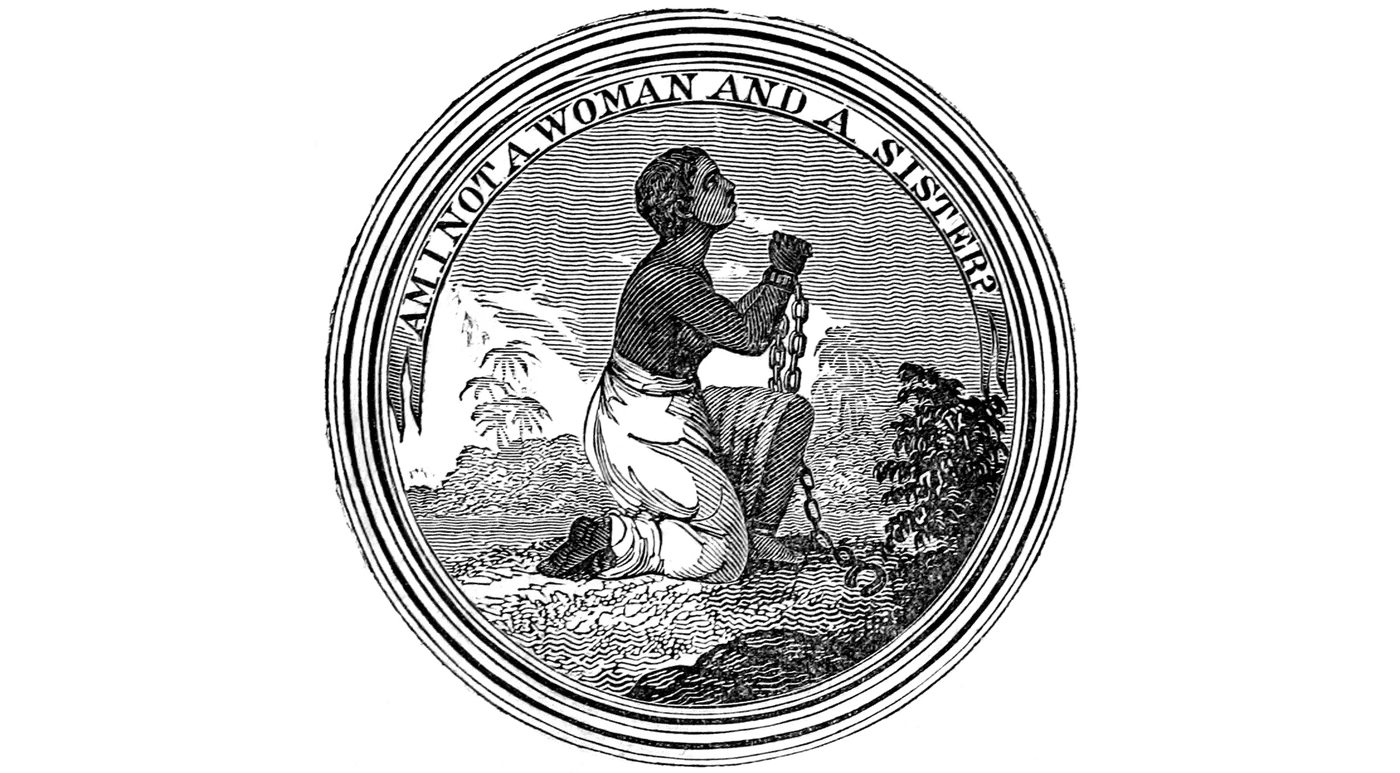
This emblem appeared in abolitionist books like this 1837 one and later in The Liberator, one of the most influential abolitionist publications of its time, and it directly appeals to the shared humanity and womanhood of enslaved Black women, a pointed response to a legal and social system that treated Black women's bodies and reproduction as property rather than personhood. Given everything covered in this topic, how partus sequitur ventrem commodified enslaved women's reproductive lives, this image reads as a direct visual rebuttal, insisting on the recognition of enslaved women as full people and as sisters, not commodities defined by law.