

2.17 - African Americans in Indigenous Territory
Two Very Different Relationships Between Black and Indigenous Communities
As slavery expanded across the American South, the relationship between Black and Indigenous people took two very different, almost opposite forms depending on where you looked.
On one hand, some African American freedom seekers, maroons, found genuine refuge among the Seminoles in Florida, where they were welcomed as actual kin rather than outsiders. This bond was strong enough that they fought side by side with the Seminoles during the Second Seminole War, from 1835 to 1842, resisting the U.S. government's efforts to forcibly relocate them.
These Black Seminoles lived in their own towns near Seminole towns, farmed, carried weapons, and often paid a share of their harvest to Seminole leaders, an arrangement much looser than plantation slavery. Many spoke English, Spanish, and Seminole languages, so they often served as interpreters. General Thomas Sidney Jesup, the U.S. Army commander in Florida, came to see Black Seminoles as a driving force behind the resistance, and the war was partly a fight over whether they would be returned to slavery.
On the other hand, a much harsher reality existed elsewhere. Many African Americans were enslaved by peoples of the five large Indigenous nations. When the federal government forced these Indigenous enslavers off their land during the Trail of Tears, they brought the African Americans they held in bondage along with them on that same brutal journey.
The five large Indigenous nations of the Southeast were the Cherokee, Chickasaw, Choctaw, Creek (Muscogee), and Seminole. Under the Indian Removal Act of 1830, the federal government forced them west to Indian Territory (present-day Oklahoma) in the 1830s, the removals known as the Trail of Tears. Before removal, some of their leaders had taken up plantation farming and racial slavery like their white neighbors.
These same five Indigenous nations went on to adopt formal slave codes of their own, established slave patrols, and actively assisted in recapturing enslaved Black people who tried to escape. This wasn't a minor detail, it meant some Indigenous communities were directly enforcing the same system of racial slavery that dominated the broader American South.
How Racial Slavery Hardened Lines Within Indigenous Communities
Codifying racial slavery within these Indigenous nations had a lasting, damaging effect on their internal social fabric. It severed existing kinship ties between Black and Indigenous people and eliminated recognition for mixed-race members of these communities, people who had once been considered part of the community were instead redefined as permanent outsiders based purely on race. In effect, adopting racial slavery imported the same rigid racial hierarchy found elsewhere in America, and it fractured relationships that had once been rooted in kinship rather than race.
Required Sources
Diary Entry Recounting the Capture of 41 Black Seminoles by Gen. Thomas Sidney Jesup, 1836
General Thomas Sidney Jesup commanded U.S. forces in Florida during the Second Seminole War and kept a diary of the campaign from October 1836 to May 1837. The entry for December 3, 1836, records that U.S. troops surprised a Black Seminole village near the Ocklawaha River, captured 41 of its people, and burned the houses. It's a firsthand military record of the conflict described above, and it shows that the army treated Black Seminoles as a specific target, both because they were fighting alongside the Seminoles and because white enslavers wanted them returned to slavery.
3. Went forward, crossed the Ocklawaha at the lower end of a lake on a temporary bridge constructed by General Eustis: Soon after captured an Indian from whom information was obtained of the situation of a negro village at the head of the lake. Detached Lt. Col. Caulfield with two companies of his battalion, accompanied by Capt. Crossman and Lieut. Chambers, also by an interpreter and the Indian prisoner: Genl. J. moved forward with the remainder of the command about five miles encamped on a beautiful lake: Lieut. Col. Caulfield returned about 9 p.m. with forty one negro prisoners, having surprised the village, captured the greater part of its inhabitants, and burnt the houses and property which they could not bring in.
Thomas Sidney Jesup, campaign diary, entry for December 3, 1836. Source: State Archives of Florida, Collection M86-12, Florida Memory transcript
Abraham, a Black Seminole Leader, 1863
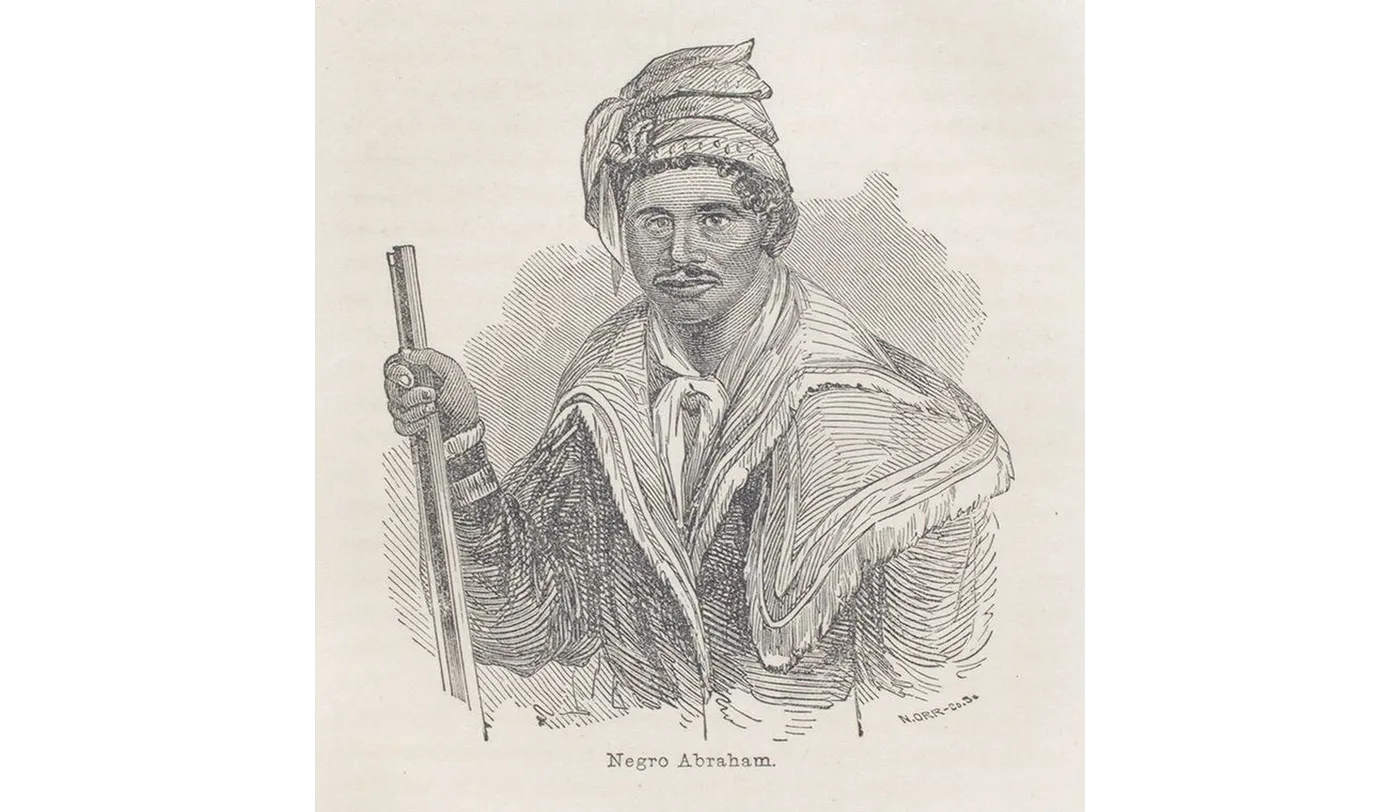
This portrait depicts Abraham, a real Black Seminole leader, giving a face and identity to the alliance between Black freedom seekers and the Seminole nation described above. His leadership role shows that Black Seminoles weren't simply sheltered by the Seminole nation, they held genuine positions of authority and influence within that community.
Abraham had escaped slavery in Pensacola and became an adviser and interpreter for the Seminole leader Micanopy. During the Second Seminole War he helped lead the resistance and later took part in negotiations with the U.S. Army, including talks with General Jesup, before moving west to Indian Territory.
Gopher John, a Black Seminole Leader and Interpreter, 1863
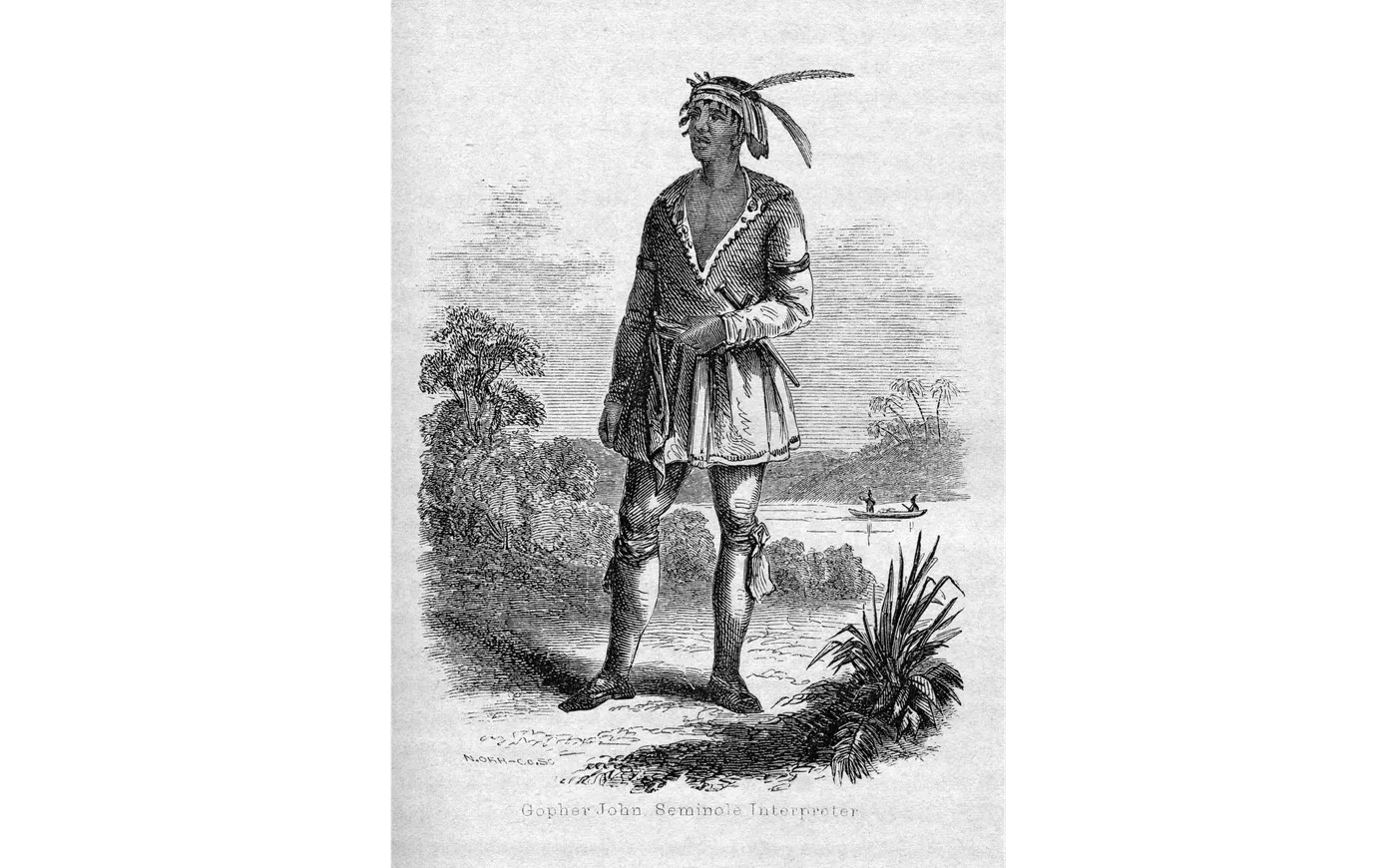
Gopher John served as both a leader and an interpreter for the Black Seminole community, a role that highlights just how deeply integrated Black Seminoles were within Seminole society, serving as a vital bridge between languages and cultures. This portrait reinforces the same point as Abraham's, that Black Seminoles held real, respected positions within their communities rather than existing on the margins.
Gopher John is better known today as John Horse. He fought in the Second Seminole War, served as an interpreter for Micanopy, and later worked as an interpreter for the U.S. Army. After removal to Indian Territory, where Black Seminoles faced raids by slave catchers, he led a group of Black Seminoles and Seminoles to Mexico around 1850, where slavery was illegal.
Arkansas Petition for Freedmen's Rights, 1869
This petition comes from after the Civil War and reflects the ongoing struggle for African American rights within former Indigenous territory. It connects directly to the second half of this topic, the story of African Americans who had been enslaved by Indigenous nations. Even after emancipation, formerly enslaved people connected to these Indigenous nations had to continue fighting formally for recognition and rights, a direct legacy of the racial slave systems those nations had adopted.
For context: after the Civil War, the United States made new treaties with the five nations in 1866 that ended slavery in Indian Territory, but freedpeople's place in those nations, including citizenship and rights to land, stayed disputed for decades (see 2.24). This petition was sent to Congress in 1869 by lawmakers in Arkansas, next door to Indian Territory, on behalf of about 3,000 freedpeople living in the Choctaw and Chickasaw Nations. It asked that they be allowed to stay there, claim 40 acres of land each, and have the same rights as other citizens of those nations, including the right to vote.
[...] So that all persons of African descent may remain in said Nations; select and hold forty (40) acres of Land each and be entitled to all the rights and privileges of any class of Citizens in said Nations including the right of Suffrage.
[...] there are three thousand persons of African descent living and residing in the Choctaw and Chickasaw Nations, who were formerly held in servitude by said Nations, and who are desirous of remaining in said Nations and enjoying all the rights and privileges of Citizens thereof.
Arkansas legislators, Petition to Congress for the rights of Choctaw and Chickasaw freedmen (1869). Source: National Archives, Records of the U.S. Senate, as transcribed in the National Archives exhibit "Records of Rights"