

2.15 - Maroon Societies and Autonomous Black Communities
What Maroon Communities Looked Like
Maroon communities sprang up across the entire African diaspora, usually in remote, hidden environments that kept them out of reach from enslavers. Some of these communities only survived a few years before being discovered or destroyed, while others lasted for a full century, a remarkable feat of sustained, hidden resistance.
These communities were made up of both self-emancipated people who had escaped slavery and people who were simply born free within the community itself. Inside these autonomous spaces, African-based languages and cultural practices were able to blend and genuinely flourish, even while people living there faced constant hardship: illness, starvation, and the ever-present threat of being recaptured.
In North America, African Americans formed maroon communities in places like the Great Dismal Swamp, straddling the border between Virginia and North Carolina, and also within Indigenous communities, who sometimes offered shelter and integration to escaped enslaved people.
This wasn't a uniquely North American phenomenon either. Similar communities existed throughout the diaspora under different names, palenques in Spanish America and quilombos in Brazil. The largest of these, the Quilombo dos Palmares in Brazil, lasted for nearly a full century, standing as one of the most enduring maroon societies anywhere in the Americas. It's worth knowing that the word "quilombo" actually traces back to kilombo, meaning "war camp" in Kimbundu, a Bantu language from West Central Africa. In fact, in seventeenth-century Angola, Queen Njinga herself created a kilombo, a sanctuary community for enslaved runaways where she provided military training to help them defend against the Portuguese, showing that this same concept of a fortified refuge community had roots stretching back to Africa itself.
Maroon Wars
Maroon communities didn't just hide, sometimes their leaders and militias waged organized wars against colonial governments specifically to defend their collective freedom and autonomy, a different kind of resistance than the individual slave revolts covered elsewhere. Not every maroon community chose open conflict though, some instead negotiated treaties with colonial powers, agreements that, notably, sometimes required maroons to help suppress slave rebellions elsewhere in exchange for their own continued freedom.
Two leaders stand out as clear examples of maroon resistance through armed conflict. Bayano led a maroon community in a sustained war against the Spanish in Panama during the sixteenth century. About two centuries later, Queen Nanny led maroon fighters in Jamaica in wars against the English throughout the eighteenth century, becoming one of the most celebrated maroon leaders in Caribbean history.
Bayano was an enslaved African who led a revolt in Panama in the 1550s and built a fortified maroon community in the forest, where his fighters held off Spanish forces for several years before the Spanish captured him. Jamaica shows both paths described above. After years of war, the British signed treaties in 1739 and 1740 with Jamaica's two main maroon groups, the Leeward Maroons led by Cudjoe and the Windward Maroons, the group Nanny led. The treaties recognized the maroons' freedom and gave them land, but they also required the maroons to return future runaways and help British forces put down slave revolts. Queen Nanny is remembered for leading the Windward Maroons from their mountain stronghold, Nanny Town, and Jamaica honors her today as one of its National Heroes.
Required Sources
Leonard Parkinson, a Captain of the Maroons by Abraham Raimbach, 1796
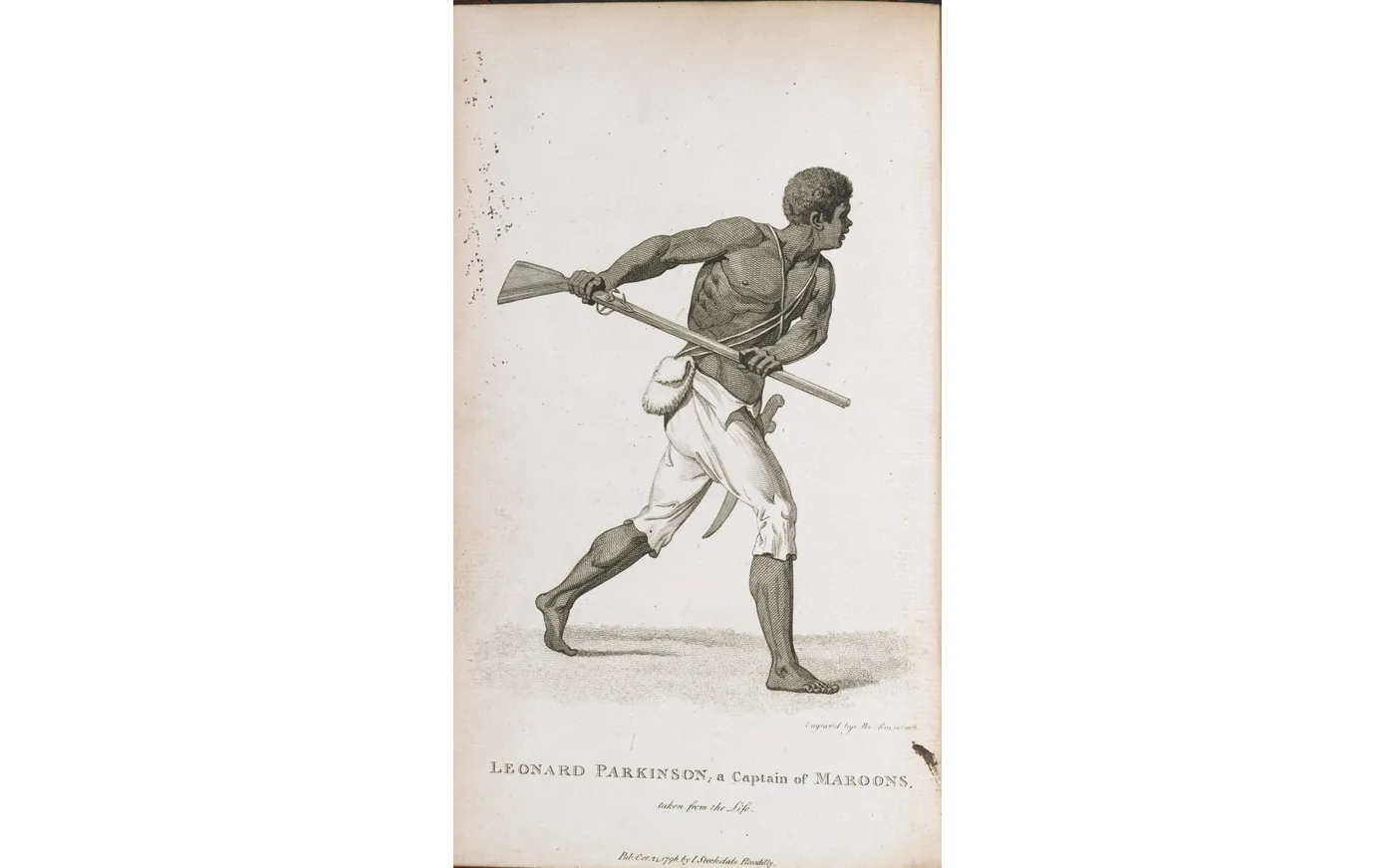
This portrait depicts a real maroon military leader, giving a human face to the organized resistance described above. Showing Parkinson specifically as a captain reinforces the point that maroon communities weren't just loosely organized refuges, they had real military structure and leadership capable of waging sustained conflict against colonial forces.
Parkinson was a captain of the maroons of Trelawny Town in western Jamaica during the Second Maroon War (1795 to 1796), when they fought British forces after disputes with the colonial government. Abraham Raimbach's engraving was published in London in 1796 and presents Parkinson as a fighter. After the war, the British deported hundreds of Trelawny Town maroons to Nova Scotia, and many of them later moved to Sierra Leone.
The Maroons in Ambush on the Dromilly Estate in the Parish of Trelawney, Jamaica by J. Bourgoin and J. Merigot, 1801
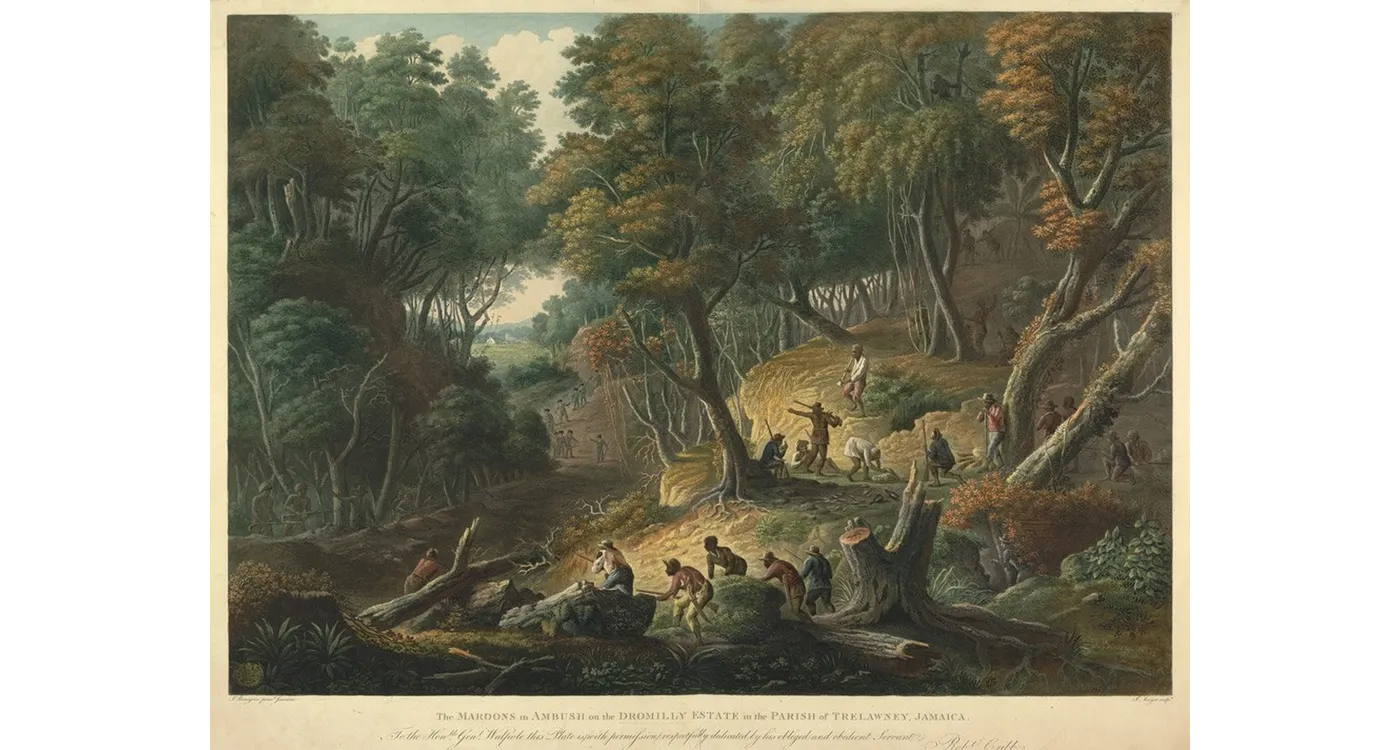
This image captures maroons actively engaged in combat, staging an ambush rather than simply hiding in remote territory. It's a direct visual representation of the maroon wars discussed above, showing how maroon fighters used tactics like ambush to offset the numerical and material advantages held by colonial forces.
The scene is set on an estate in the parish of Trelawny, the western Jamaica region where the Trelawny Town maroons fought British troops during the Second Maroon War. Maroons used their knowledge of the steep, forested Cockpit Country to hide, ambush soldiers, and disappear, which is how small maroon forces held off much larger colonial armies.
The Hunted Slaves by Richard Ansdell, 1862
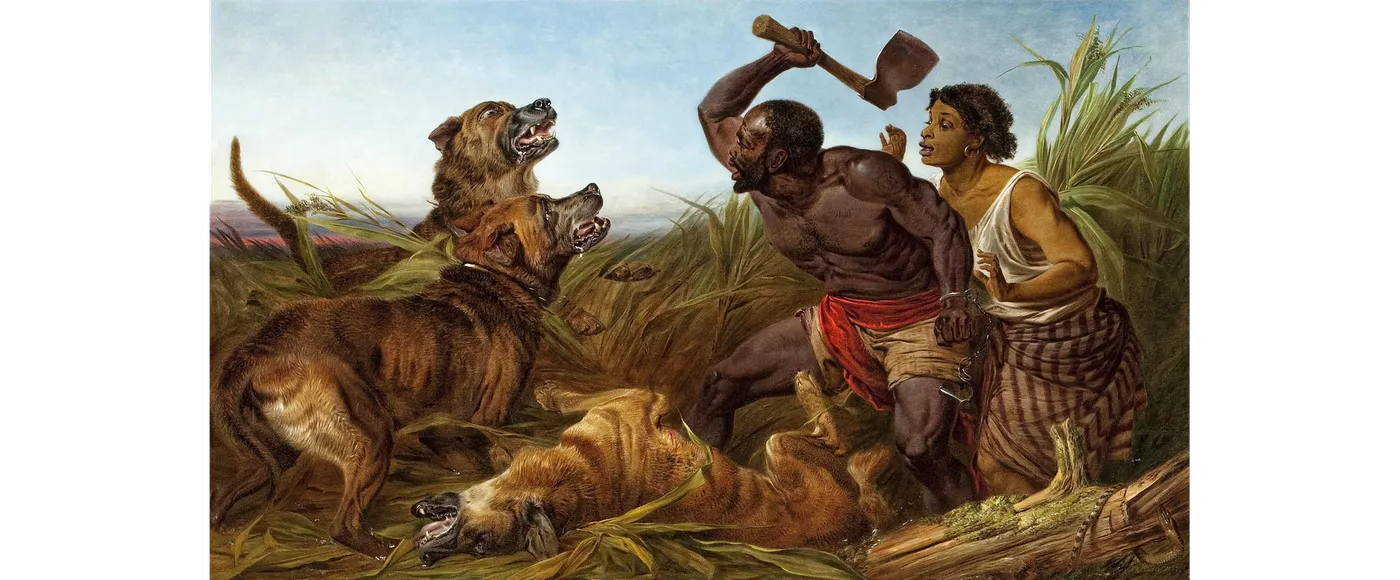
This painting depicts the constant danger maroons and escaped enslaved people lived under, the threat of being hunted down and recaptured. It's a powerful visual reminder that life in a maroon community, even when successful for decades, was never fully free from risk. It reinforces just how significant it was that communities like Palmares managed to survive for as long as nearly a century despite this ongoing threat.
Ansdell, an English painter known for animal scenes, shows a man and a woman who have escaped slavery fighting off a pack of dogs sent to track them down, with one dog already wounded. The painting was linked to Henry Wadsworth Longfellow's poem "The Slave in the Dismal Swamp," about a freedom seeker hiding in the Great Dismal Swamp, one of the North American maroon refuges described above. Slave catchers really did use dogs to hunt freedom seekers, so the scene shows the danger people faced, while the couple's stance shows them fighting back.