

2.2 - Departure Zones in Africa and the Slave Trade to the United States
The Scale and Scope of the Transatlantic Slave Trade
Before the nineteenth century, more people crossed into the Americas from Africa than from any other region on Earth, a scale that's easy to underestimate if you only think of European migration when picturing the Americas' founding population.
The transatlantic slave trade itself lasted more than 350 years, running from the early 1500s all the way to the mid-1800s. Over that period, more than 12.5 million enslaved Africans were forcibly transported to the Americas. Of those who survived the brutal journey, only about 5 percent, roughly 388,000 people, came directly from Africa to what became the United States. That's a relatively small share of the overall trade, but it still represents hundreds of thousands of individual lives.
Within the United States specifically, the trade was heavily concentrated in one place: 48 percent of all Africans brought directly from Africa landed in Charleston, South Carolina, which functioned as the center of the U.S. slave trade.
Five nations dominated this trade overall: Portugal, Great Britain, France, Spain, and the Netherlands. These five were the primary enslaving powers driving the transatlantic system.
Where Enslaved Africans Came From
Enslaved Africans sent directly to mainland North America came primarily from nine regions that correspond to present-day African countries and areas: Senegambia, Sierra Leone, Liberia, Côte d'Ivoire, Ghana, Benin, Nigeria, Angola, and Mozambique.
Two regions stand out above the rest. Captives from Senegambia and Angola together made up nearly half of everyone forcibly transported to mainland North America, roughly a quarter from each region. Senegambia sits in West Africa, while Angola is in West Central Africa, so these two major source regions represent very different parts of the continent, each with its own distinct cultures and languages.
How Ethnic Diversity Shaped African American Communities
Because enslaved Africans came from so many different regions and ethnic groups, the cultural contributions they brought with them varied widely too. As people from different African ethnic groups interacted with one another in the Americas, often out of necessity, they produced new, blended combinations of African-based cultural practices, languages, and belief systems, ones that hadn't existed in quite that form back in Africa.
The ancestors of early African Americans in mainland North America came from numerous West and Central African ethnic groups, including the Wolof, Akan, Igbo, and Yoruba, among many others. It's also worth remembering that nearly half of those who arrived in the United States came from regions of Africa that were already Muslim or Christian, meaning religious identity, not just ethnic identity, was already diverse before people ever reached American shores.
This complex mixing didn't happen evenly either. The specific distribution patterns of different African ethnic groups across the American South meant that Black communities in different areas developed distinctive, localized combinations of African-based traditions, languages, and beliefs, rather than one single, uniform African American culture.
Required Sources
Map Showing an Overview of the Slave Trade Out of Africa
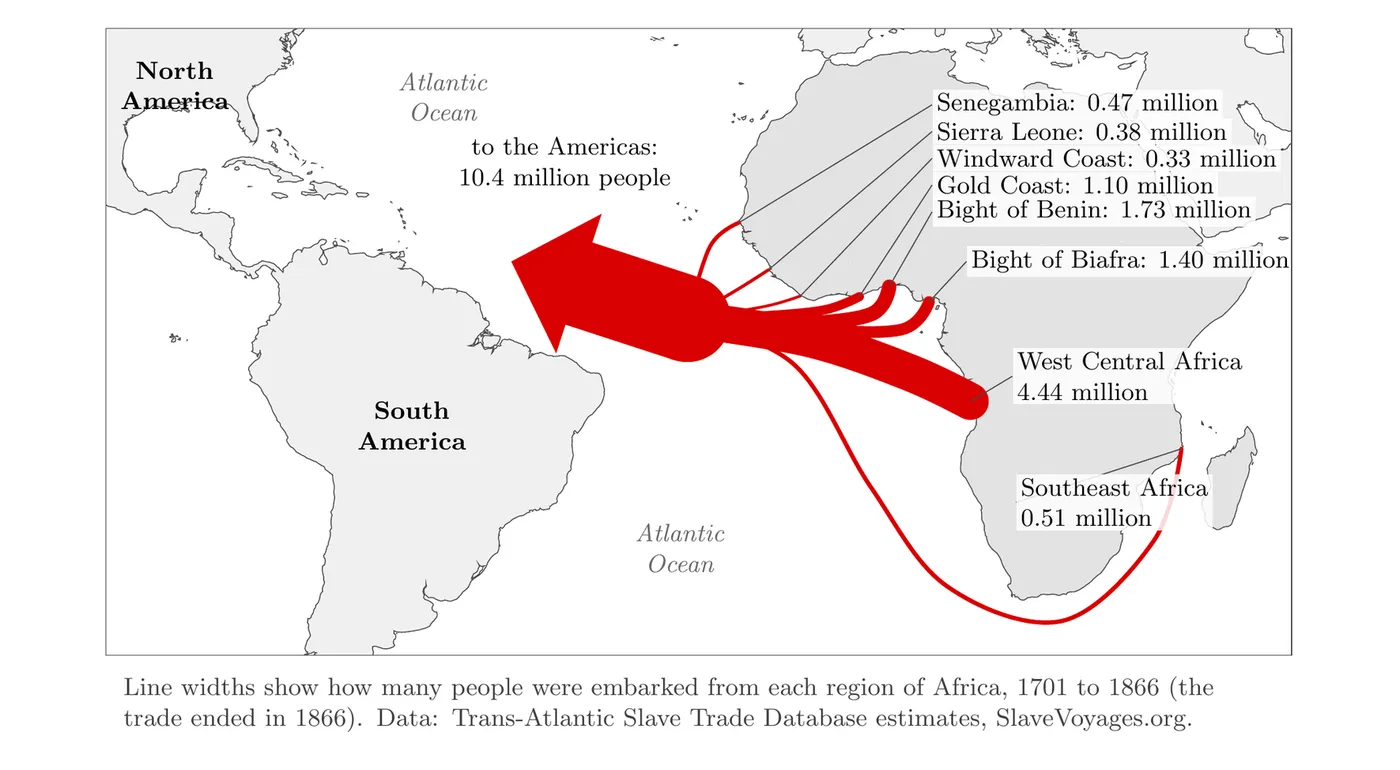
This map turns the raw statistics from this topic into something visual and immediate. Because the width of each route corresponds to how many enslaved people were transported along it, you can see at a glance which departure points and destinations carried the heaviest traffic. It reinforces just how vast and interconnected this forced migration system was, spanning the entire Atlantic and multiple African coastal regions simultaneously.
Map Showing the Regional Origins of Enslaved People Forcibly Transported to North America
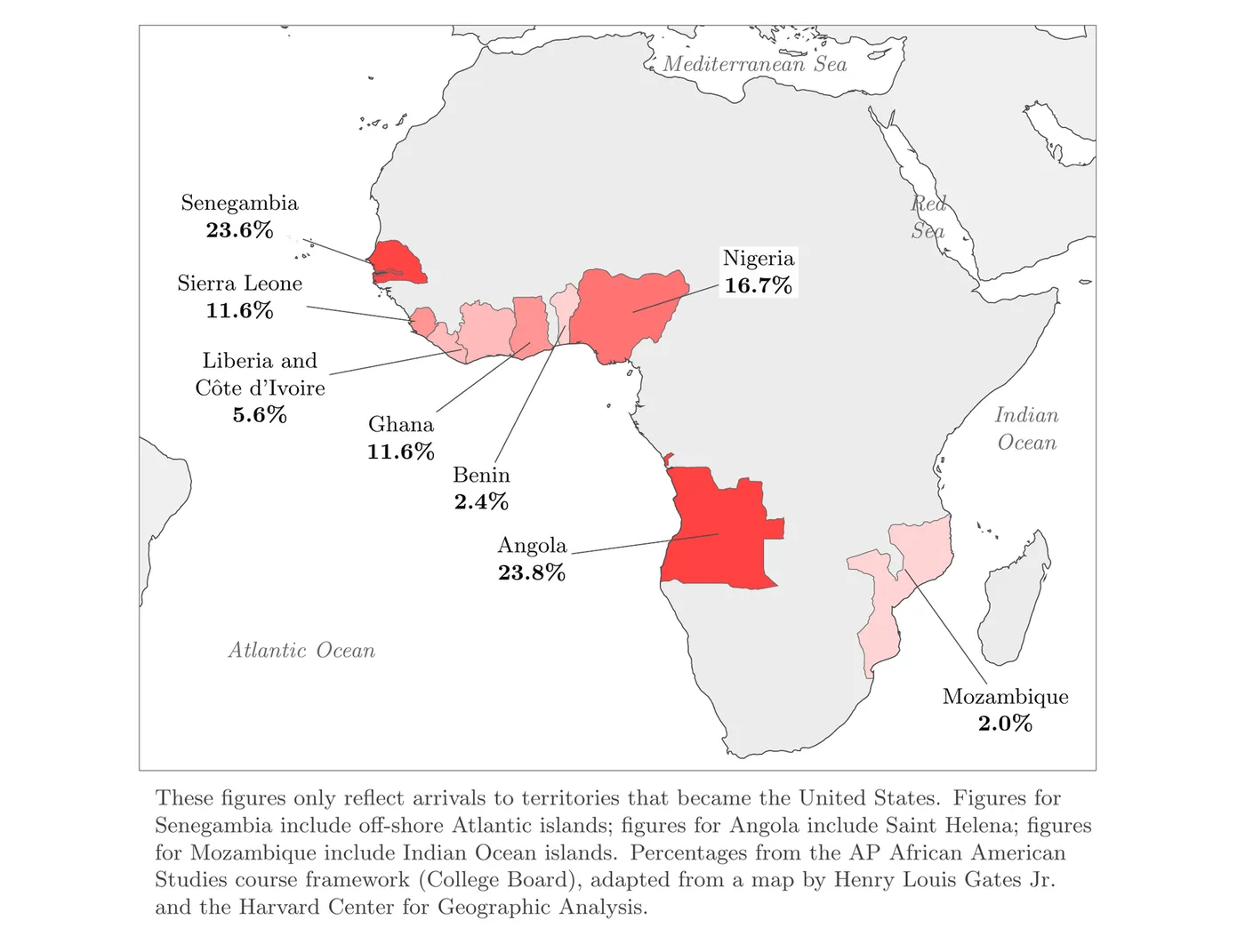
This map breaks down exactly which African regions specific percentages of enslaved people came from, giving concrete numbers to back up the point that Senegambia and Angola together accounted for close to half of all arrivals. A few notes make the data more precise: the Senegambia figures include nearby Atlantic islands, the Angola figures include Saint Helena, and the Mozambique figures include Indian Ocean islands. These details matter because they show the regional categories used here reflect broader cultural and geographic zones, not strict modern national borders.