

2.5 - Slave Auctions and the Domestic Slave Trade
The Nature of Slave Auctions
Slave auctions in the nineteenth-century American South weren't just economic transactions, they were a system of control backed by law and white supremacist ideology, used to assault the bodies, minds, and spirits of enslaved Africans and their descendants. Resistance at these auctions was met with brutal punishment, people who resisted being sold were often whipped severely, sometimes in full view of their own families and friends, a deliberate act of humiliation and control.
African American Writers Confronting the Auction Block
African American writers used their work, including narratives and poetry, to describe the real physical and emotional toll of being sold at auction and shipped off to unfamiliar territory, often separated forever from loved ones. This writing served a clear purpose: enslavers frequently claimed slavery was a mild or even benevolent institution, and African American authors wrote directly against that narrative, using their own experiences to advance the cause of abolition.
Cotton, Displacement, and the Second Middle Passage
After the United States formally banned the transatlantic slave trade in 1808, the enslaved population could no longer be replenished through new importation. Instead, it grew mainly through childbirth, even as demand for enslaved agricultural labor kept rising.
That demand was driven overwhelmingly by cotton. The Lower South, meaning South Carolina, Georgia, Florida, Alabama, Mississippi, Louisiana, and Texas, became dominated by what's often called the slave-cotton system, where enslaved African Americans were treated as especially valuable commodities purely because of how much labor the cotton industry demanded. Part of what fueled this boom was the invention of the cotton gin, which dramatically increased how much cotton the U.S. could produce, deepening the country's economic dependence on it as a cash crop. At the same time, the forced removal of Indigenous communities through the Trail of Tears opened up huge amounts of land specifically for large-scale cotton farming, land that then needed enslaved labor to work it.
During the cotton boom of the early nineteenth century, this demand triggered a massive forced relocation. Enslaved African Americans were moved through the domestic slave trade from the Upper South, states like Virginia, Tennessee, Kentucky, Arkansas, and Missouri, down into the Lower South, often marched hundreds of miles on foot.
This mass displacement is sometimes called the "Second Middle Passage," and the scale of it is staggering: over one million African Americans were forcibly relocated this way, more than two and a half times the number of people who had originally arrived in America from Africa during the actual Middle Passage. It stands as the largest forced migration in American history.
The domestic slave trade worked like a business. Professional traders bought enslaved people in the Upper South, where tobacco farming had worn out much of the soil and enslavers had more workers than they needed, and sold them for higher prices in the cotton and sugar regions. Some people were shipped along the coast to New Orleans, but many were chained together in long lines called coffles and forced to walk south. Because traders and buyers cared about profit, sales routinely tore families apart, separating spouses from each other and children from their parents, often forever. This is how the growth of the cotton industry displaced enslaved African American families.
Required Sources
Excerpt from Twelve Years a Slave: Narrative of Solomon Northup, a Citizen of New York, Kidnapped in Washington City in 1841, and Rescued in 1853, 1853
The very amiable, pious-hearted Mr. Theophilus Freeman, partner or consignee of James H. Burch, and keeper of the slave pen in New-Orleans, was out among his animals early in the morning. With an occasional kick of the older men and women, and many a sharp crack of the whip about the ears of the younger slaves, it was not long before they were all astir, and wide awake. Mr. Theophilus Freeman bustled about in a very industrious manner, getting his property ready for the sales-room, intending, no doubt, to do that day a rousing business. In the first place we were required to wash thoroughly, and those with beards, to shave. We were then furnished with a new suit each, cheap, but clean. The men had hat, coat, shirt, pants and shoes; the women frocks of calico, and handkerchiefs to bind about their heads. We were now conducted into a large room in the front part of the building to which the yard was attached, in order to be properly trained, before the admission of customers. The men were arranged on one side of the room, the women on the other. The tallest was placed at the head of the row, then the next tallest, and so on in the order of their respective heights. Emily was at the foot of the line of women. Freeman charged us to remember our places; exhorted us to appear smart and lively, sometimes threatening, and again, holding out various inducements. During the day he exercised us in the art of "looking smart," and of moving to our places with exact precision. [...] Next day many customers called to examine Freeman's "new lot." The latter gentleman was very loquacious, dwelling at much length upon our several good points and qualities. He would make us hold up our heads, walk briskly back and forth, while customers would feel of our hands and arms and bodies, turn us about, ask us what we could do, make us open our mouths and show our teeth, precisely as a jockey examines a horse which he is about to barter for or purchase. Sometimes a man or woman was taken back to the small house in the yard, stripped, and inspected more minutely. Scars upon a slave's back were considered evidence of a rebellious or unruly spirit, and hurt his sale. Twelve Years a Slave: Narrative of Solomon Northup, Solomon Northup, 1853. Chapter 6, pp. 78 to 80 (Auburn: Derby and Miller, 1853) (Public Domain)
Solomon Northup was a free African American musician who was kidnapped and illegally sold into slavery on a Louisiana cotton plantation. His narrative provides a firsthand, eyewitness account of exactly the kind of exploitation described above, tying his own personal story directly to the broader machinery of the slave-cotton system in the Lower South. Because Northup started out free and was born into a life outside of slavery, his account gives a particularly vivid sense of just how violently that system could seize and consume a person's life.
Broadside for an Auction of Enslaved Persons at the Charleston Courthouse, 1859
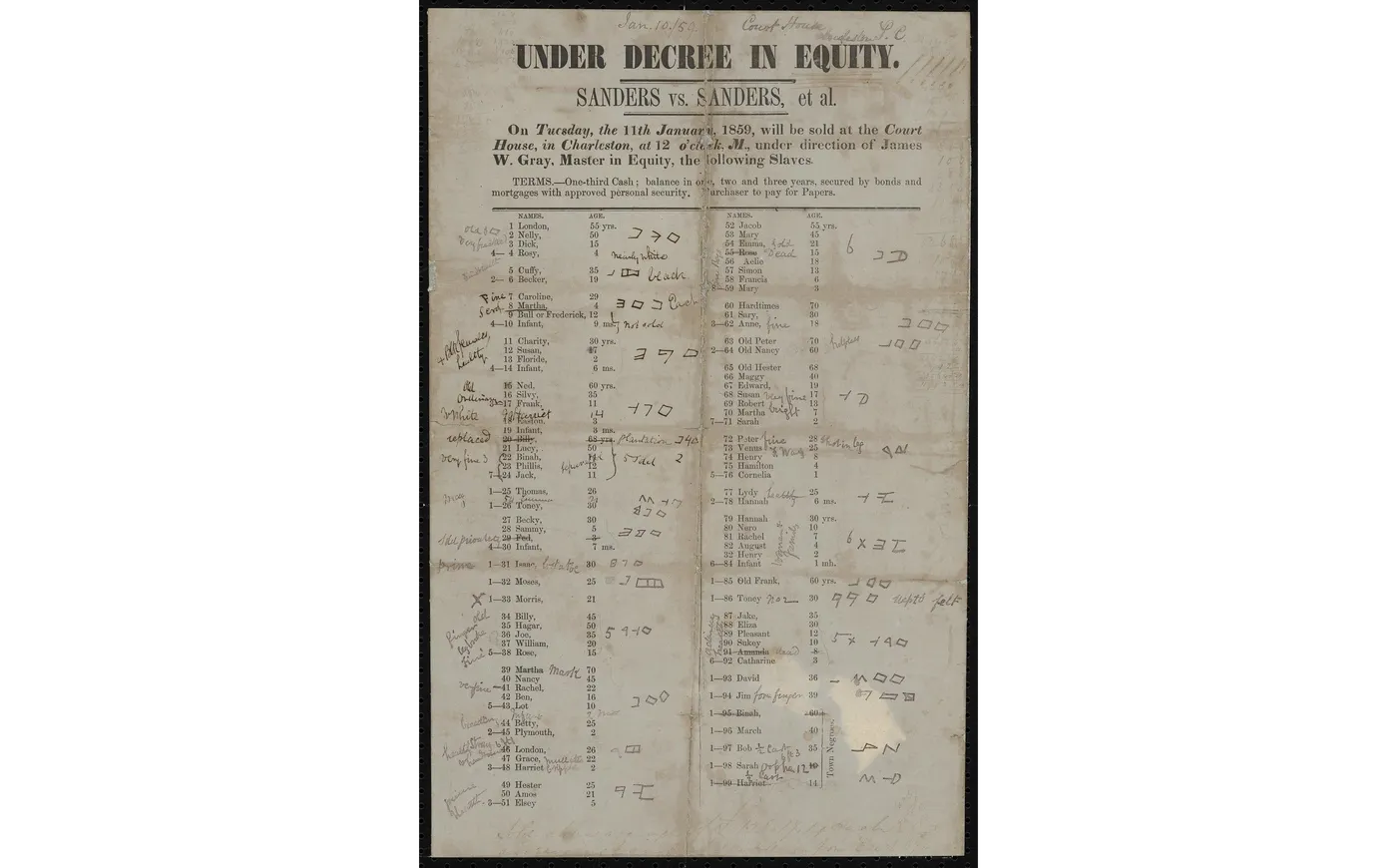
This broadside is an actual advertisement for a real slave auction, and it makes the economic side of this system impossible to ignore. Charleston was a major hub in the domestic slave trade, and documents like this one show how casually and publicly human beings were listed, marketed, and sold as commodities. Seeing a genuine period advertisement like this drives home the point made earlier: these auctions weren't hidden or ashamed of what they were, they were treated as ordinary business, which is exactly what African American writers like Northup were fighting to expose and condemn.