

2.16 - Diasporic Connections: Slavery and Freedom in Brazil
The Scale and Nature of Slavery in Brazil
More enslaved Africans were brought to Brazil than to any other place in the Americas. Of the roughly 10 million Africans who survived the Middle Passage, about half landed in Brazil, making it home to the largest African diasporic population anywhere in the Americas. Once there, enslaved people were forced to labor across a wide range of industries that rose and fell over the centuries, sugar plantations, gold mines, coffee plantations, cattle ranching, and the production of food and textiles for local use.
Because so many African-born people arrived in Brazil, they were able to build communities that kept real cultural practices alive, practices that in many cases still exist in Brazil today. Two clear examples are capoeira, a martial art developed by enslaved Africans that blends movement with music and call-and-response singing, and the congada, a celebration honoring both the king of Kongo and Our Lady of the Rosary. Both traditions show how enslaved communities in Brazil didn't just survive, they actively preserved and reshaped African cultural and religious life under entirely new conditions.
Comparing Nineteenth-Century Trends in Brazil and the United States
Brazil and the United States actually moved in noticeably different directions during the nineteenth century when it came to slavery's scale. In Brazil, the number of enslaved Africans steadily declined over the century as the country's free Black population grew significantly, driven by an increasing rate of manumission, formal release from slavery, influenced heavily by Iberian legal tradition and the Catholic Church. By 1888, when Brazil became the very last country in the Americas to abolish slavery, roughly 4 million people of African descent in Brazil were already free. That year, the Golden Law (Lei Áurea) freed everyone who was still enslaved. About 1.5 million people had been enslaved in Brazil in the 1870s, and by 1888 that number had fallen to roughly 700,000.
Brazil also moved toward abolition through a series of gradual laws. It banned the slave trade from Africa in 1850, passed the Law of the Free Womb in 1871 (children born to enslaved mothers would no longer be born enslaved), and freed older enslaved people in 1885.
The United States followed a very different pattern. Even after the international slave trade was banned in 1808, the number of enslaved people in the U.S. kept rising steadily throughout the century, not through new importation, but because children born to enslaved parents were themselves born into slavery. By the time of the Emancipation Proclamation, about 4 million people remained enslaved in the United States, representing roughly 50 percent of all enslaved people across the entire Americas at that point. So while Brazil's enslaved population was shrinking through manumission, the U.S. enslaved population kept growing through birth, a striking contrast between the two largest slaveholding societies in the hemisphere.
Required Sources
Festival of Our Lady of the Rosary, Rio de Janeiro, Brazil by Carlos Julião, Circa 1770s
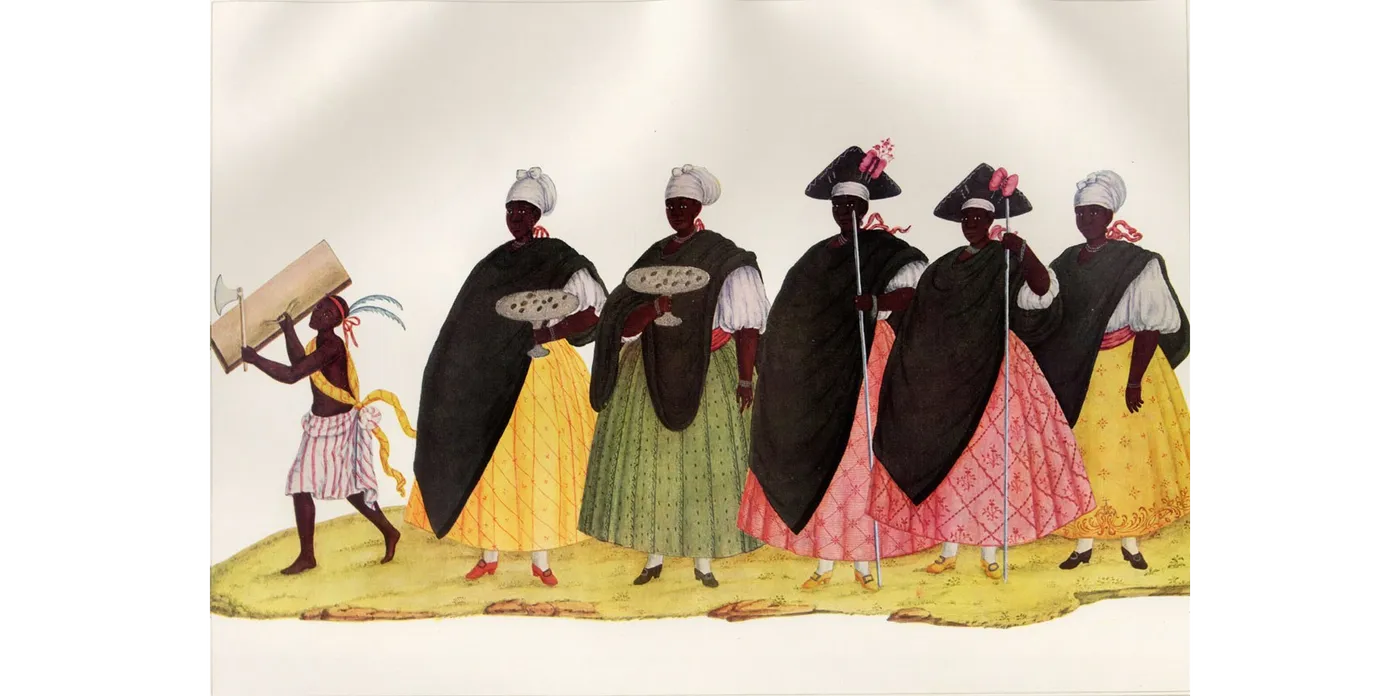
This drawing depicts a festival held by the brotherhood of Our Lady of the Rosary, and it connects directly to the congada tradition described above. It shows enslaved people in Brazil actively recreating Afro-Catholic customs rooted in West Central Africa, blending African religious and cultural practice with Catholic tradition rather than simply abandoning one for the other.
Julião, an Italian-born officer in the Portuguese army, painted a series of watercolor figures of people in Rio de Janeiro and the diamond district of Serro do Frio. Besides this festival, his drawings show enslaved and free Black people doing many kinds of work, from selling goods in the streets and markets to medical work, which shows how varied enslaved labor in Brazil was.
Escravo Mina and Escrava Mina by José Christiano de Freitas Henriques Junior, 1864
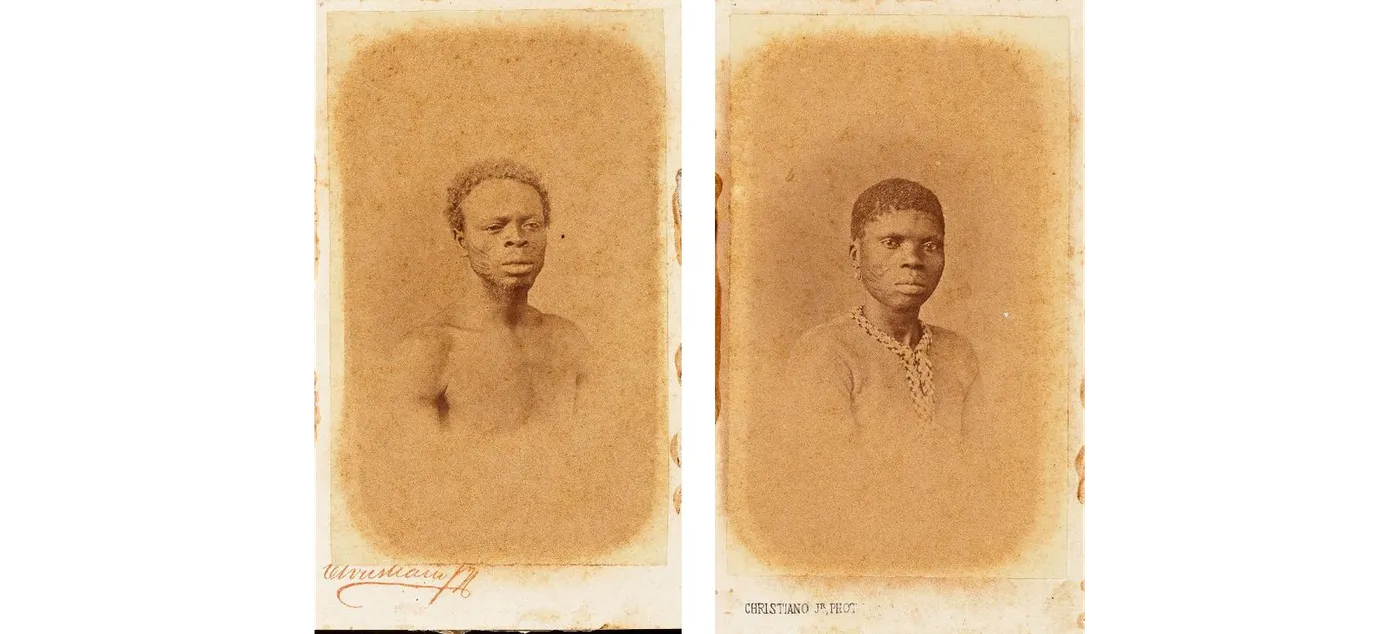
These photographs portray enslaved people who arrived in Brazil as children, likely during the collapse of the Oyo Empire in Nigeria in the early 1830s. Their individual portraits give a personal, human face to the broader statistic mentioned earlier, that roughly half of all Africans who survived the Middle Passage ended up in Brazil, reminding us that behind that huge number were real individual children whose lives were upended by political collapse and forced displacement thousands of miles from home.
In Brazil, Mina was a label for Africans shipped from the "Mina Coast," the stretch of West Africa around the Bight of Benin. José Christiano de Freitas Henriques Junior, a Portuguese-born photographer working in Rio de Janeiro, made these portraits as small photographic cards (cartes de visite) that he sold as souvenirs of Brazilian "types," especially to Europeans. They were made for a white audience, but they still preserve the faces of real individuals.
Capoeira Players and Musicians in Salvador da Bahia
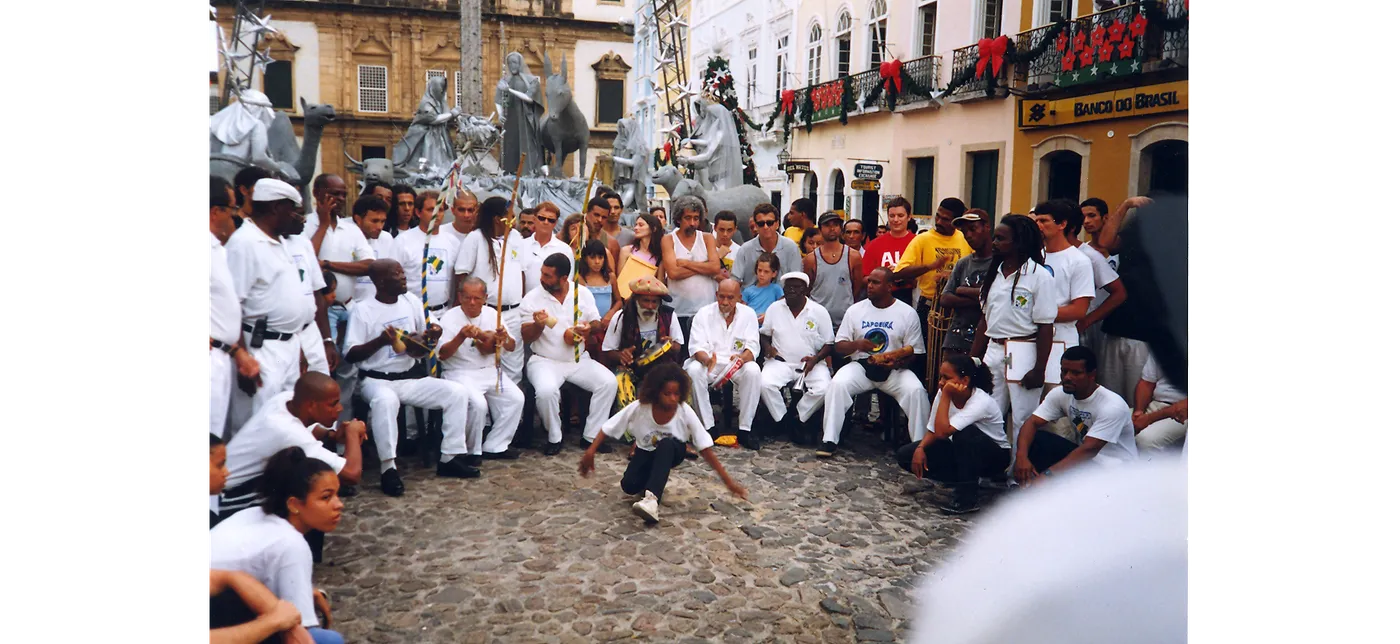
This photograph shows capoeira being practiced today, exactly as described above, a living tradition that combines martial arts, music, and call-and-response singing, all traceable back to enslaved Africans in Brazil. Seeing it practiced in the streets of Salvador da Bahia, a city deeply tied to Afro-Brazilian history and culture, drives home just how thoroughly these cultural practices survived slavery and remain a vibrant part of Brazilian life today.