

2.9 - Creating African American Culture
Blended Roots: Art, Craft, and Instruments
African American creative expression didn't come from one single source, it grew out of a genuine blend of African ancestral traditions, community innovation, and local European and Indigenous influences.
You can see this clearly in crafts like pottery and quilting. African Americans brought African aesthetic sensibilities into their pottery, and they also built a rich tradition of quilt-making that functioned as more than decoration, it became a medium for storytelling and preserving memory.
The same blending shows up in instrument-making. African Americans built instruments like gourd rattles, the banjo, and various drums, drawing on both African and local materials to recreate instruments similar to what existed in West Africa. These weren't just replicas either, they represented an active effort to keep musical traditions alive under entirely new circumstances.
Language and the Birth of Creole Speech
Enslaved Africans didn't arrive in America linguistically isolated, many already had experience with both African and European languages. In particular, Africans who had taken part in long-distance trade back home were already used to developing a lingua franca, a shared common language used to communicate across different linguistic groups.
Enslaved African Americans carried this same practice forward once in the United States, developing creole languages like Gullah, which blends elements of West African languages with European ones. This wasn't a loss of language so much as an adaptation, using the same cross-linguistic skill that had existed in Africa to build something new under drastically different conditions.
From Christian Hymns to American Music
Enslaved people took the Christian hymns they learned and reshaped them using African rhythmic and performative techniques, things like call and response, clapping, improvisation, and syncopation, blending these with biblical themes to create an entirely new, distinctly American musical genre. This fusion became the direct foundation for later genres like gospel and the blues.
The influence wasn't uniform across the country either. Large numbers of Senegambians and West Central Africans arrived specifically in Louisiana, and that concentration directly shaped the development of American blues. In fact, American blues shares the same underlying musical system as the fodet, a musical form from the Senegambia region, a direct thread connecting a specific African musical tradition to a genre now considered quintessentially American.
Spirituals: Music, Faith, and Resistance All at Once
Musical tradition and religious faith combined in the form of spirituals, sometimes called sorrow songs or jubilee songs. These were the songs enslaved people sang to express both their suffering and their hope, functioning as art and testimony at the same time.
Religious practice among enslaved people served social, spiritual, and political purposes all together. Spirituals weren't just about coping with hardship, they were tools of active resistance, enslaved people used them to push back against the dehumanization of slavery, to express genuine creativity, and to communicate practical, strategic information, like warnings, escape plans, and specific methods for running away.
This often worked through deliberate double meanings. Spirituals frequently used biblical language about redemption and deliverance as coded messages, alerting enslaved people to real opportunities to escape via the Underground Railroad. So a song that sounded, on its surface, like ordinary religious expression could simultaneously be carrying very specific, practical instructions.
Ultimately, spirituals reflect a dual identity: they preserve rhythms and performance styles rooted in West Africa, while also giving voice to the lived, contemporary experience of being Black in America. It's worth noting, too, that enslaved people held a range of spiritual beliefs beyond just Christianity, including African-derived beliefs and Islam, and for many enslaved African Americans specifically, Christian belief became a driving force behind political action and the pursuit of liberation. You can also see African performative elements surviving directly in traditions like the ring shout, still practiced among the Gullah Geechee community across the sea islands of Georgia, Florida, and the Carolinas.
Required Sources
Cream and Red Appliqued Quilted Bedcover, Circa 1850
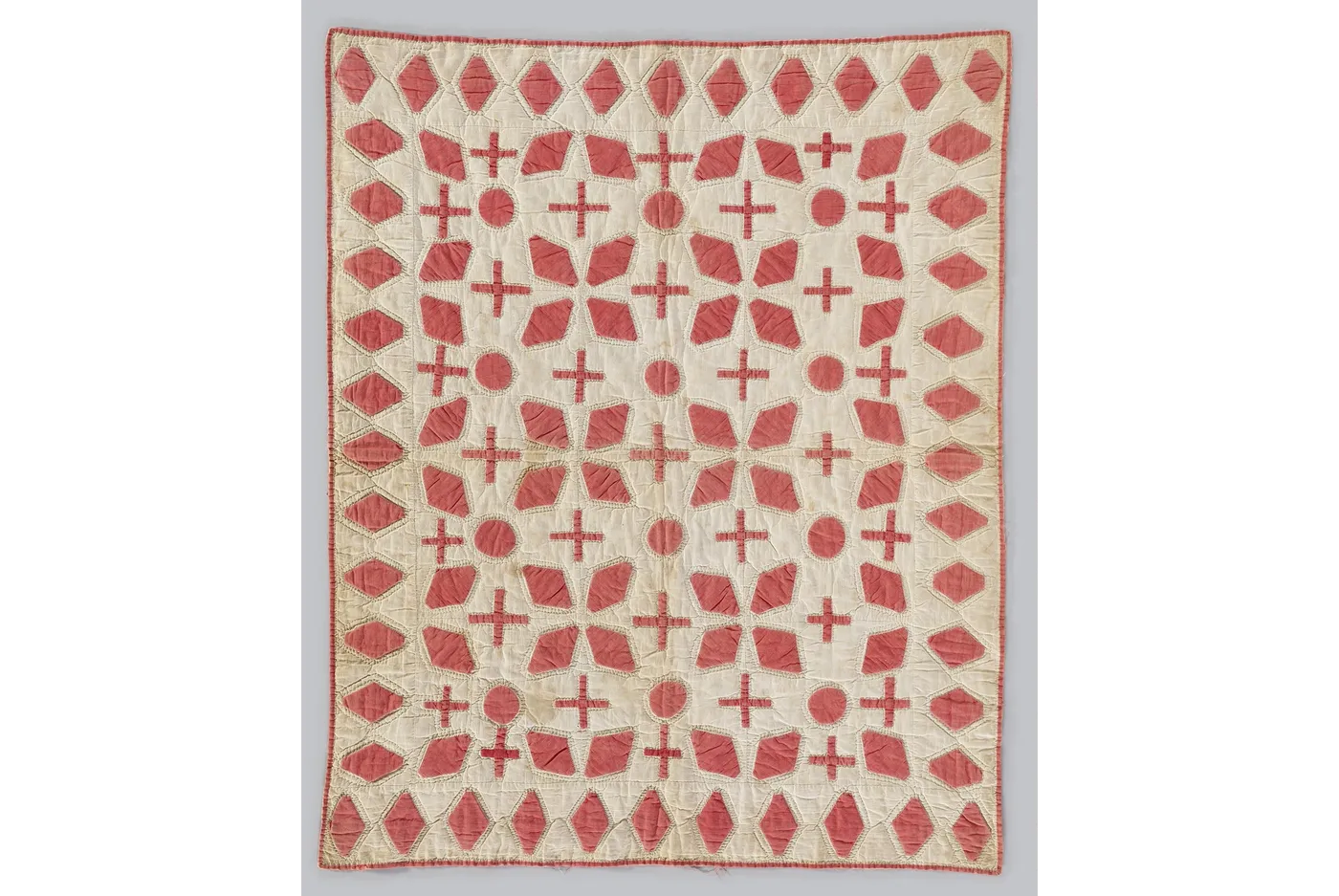
This quilt is a direct physical example of the storytelling and memory-keeping tradition described above. Quilting gave enslaved women a creative outlet that also functioned as a form of documentation, preserving personal and communal history through pattern and design at a time when so many other forms of expression and record-keeping were denied to them.
Excerpt from Chapter 6 of My Bondage and My Freedom by Frederick Douglass, 1855
Slaves are generally expected to sing as well as to work. A silent slave is not liked by masters or overseers. "Make a noise," "make a noise," and "bear a hand," are the words usually addressed to the slaves when there is silence amongst them. This may account for the almost constant singing heard in the southern states. There was, generally, more or less singing among the teamsters, as it was one means of letting the overseer know where they were, and that they were moving on with the work. But, on allowance day, those who visited the great house farm were peculiarly excited and noisy. While on their way, they would make the dense old woods, for miles around, reverberate with their wild notes. These were not always merry because they were wild. On the contrary, they were mostly of a plaintive cast, and told a tale of grief and sorrow. In the most boisterous outbursts of rapturous sentiment, there was ever a tinge of deep melancholy. [...] The remark is not unfrequently made, that slaves are the most contented and happy laborers in the world. They dance and sing, and make all manner of joyful noises, so they do; but it is a great mistake to suppose them happy because they sing. The songs of the slave represent the sorrows, rather than the joys, of his heart; and he is relieved by them, only as an aching heart is relieved by its tears. [...] Sorrow and desolation have their songs, as well as joy and peace. Slaves sing more to make themselves happy, than to express their happiness. My Bondage and My Freedom, Frederick Douglass, 1855. Chapter 6, pp. 97 to 100 (New York and Auburn: Miller, Orton & Mulligan, 1855) (Public Domain)
In this chapter, Douglass describes the songs enslaved people sang on their way to the Great House Farm to collect their monthly food allowance. He makes two points that connect to spirituals. First, enslavers demanded singing ("make a noise") as a way to keep track of workers and control them. Second, the songs were not proof that enslaved people were happy, as defenders of slavery claimed. They expressed grief and longing, which matches how spirituals, also called sorrow songs, put enslaved people's hardships and hopes into words. Douglass, who escaped slavery in 1838 and became the best-known Black abolitionist of his time, uses his own memory to turn a proslavery argument ("they sing, so they must be content") into evidence against slavery.
Storage Jar by David Drake, 1858
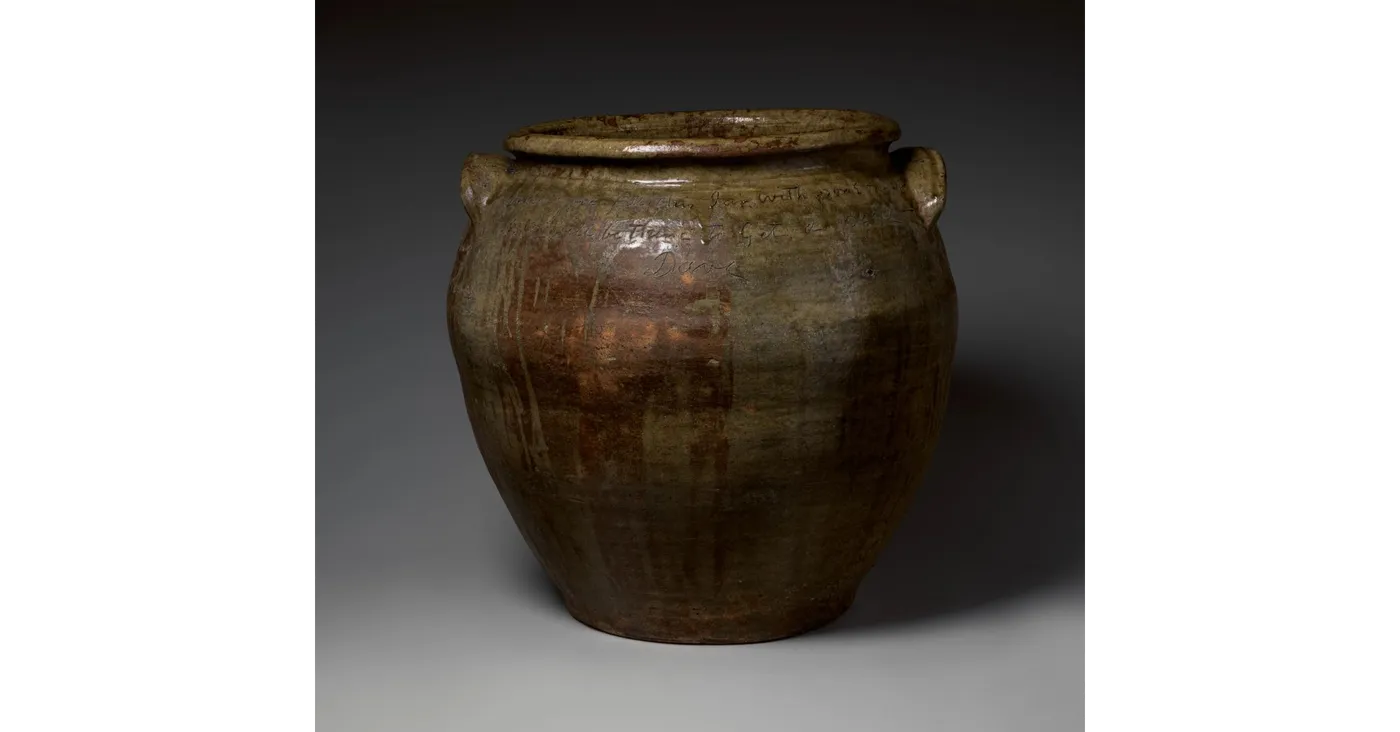
David Drake was an enslaved potter in South Carolina who, despite living under laws that banned literacy for African Americans, found a way to express himself creatively anyway. He inscribed short poems directly onto the jars he made, touching on subjects like love, family, spirituality, and slavery itself. His work is a striking example of resistance and self-expression operating simultaneously, using a functional craft object as a vehicle for literacy and voice in defiance of the very laws meant to suppress both.
Gospel Performance of "Steal Away to Jesus" by Shirley Caesar and Michelle Williams (video, 0:00 to 2:00), 2001

This modern gospel performance shows how a song rooted in the era of slavery continues to be performed and reinterpreted today. Watching a contemporary rendition alongside the historical lyrics helps highlight just how much of the original rhythmic and performative style, the call and response, the emotional delivery, has been carried forward into modern gospel music.
Lyrics to "Steal Away to Jesus," Mid-Nineteenth Century
Chorus: Steal away, steal away, steal away to Jesus! Steal away, steal away home, I haint got long to stay here. 1. My Lord calls me, He calls me by the thunder; The trumpet sounds it in my soul, I hain't got long to stay here. [Chorus] 2. Green trees are bending, poor sinners stand trembling; The trumpet sounds it in my soul, I hain't got long to stay here. [Chorus] 3. My Lord calls me, He calls me by the lightning; The trumpet sounds it in my soul: I hain't got long to stay here. [Chorus] 4. Tombstones are bursting, poor sinners stand trembling; The trumpet sounds it in my soul: I hain't got long to stay here. [Chorus] "Steal Away," spiritual, as sung by the Jubilee Singers of Fisk University. Jubilee Songs (New York: Biglow & Main, 1872), p. 28 (Public Domain)
This song was documented and composed by Wallace Willis, a formerly enslaved Black man living in Choctaw territory in Mississippi who was later displaced to Indian Territory (present-day Oklahoma) during the Trail of Tears. Its lyrics fit perfectly into the pattern described above, of spirituals carrying coded, double meanings tied to escape and deliverance. Knowing Willis's own displacement history adds another layer to the song, it comes from someone who experienced forced removal firsthand, someone for whom themes of escape and deliverance weren't abstract, but deeply personal.