

2.4 - African Resistance on Slave Ships and the Antislavery Movement
How Africans Resisted Aboard Slave Ships
Even in the middle of the Atlantic, stripped of nearly everything, African captives found ways to resist the trauma of being torn from their homes, treated as commodities, and forced into lifelong enslavement. Resistance took both individual and collective forms: people staged hunger strikes, attempted to jump overboard rather than live enslaved, and worked across language barriers to organize revolts.
Two terms are worth knowing here. Deracination means being violently uprooted from your homeland, family, and culture. Commodification means being treated as a product to be bought and sold rather than as a person.
This resistance came at enormous risk. Even though captives often outnumbered the crew, they faced overwhelming odds and near-certain death if they tried to fight back or escape. But their resistance wasn't without effect, it actually made the slave trade more expensive and more dangerous to carry out, and it forced changes in how slave ships were designed, including the addition of barricades, nets, and guns specifically meant to prevent uprisings and escape attempts.
The most famous act of resistance came in 1839, more than 30 years after the slave trade itself had been formally abolished. Sengbe Pieh, a Mende captive from Sierra Leone also known by the name Joseph Cinque, led a revolt aboard the schooner La Amistad, and the captives succeeded in taking control of the ship. What followed was a two-year legal battle, and ultimately the Supreme Court ruled in favor of the Mende captives, granting them their freedom. The trial didn't just resolve one case, it generated real public sympathy for the broader abolitionist cause.
The revolt took place off the coast of Cuba, where the captives had been illegally brought from West Africa and sold. After they took the ship, the Africans ordered the surviving crew to sail toward Africa, but the crew steered north instead, and a U.S. Navy ship took the Amistad into custody off Long Island, New York. Spanish officials and the men who claimed to own the captives demanded them back as property, and the case moved through the federal courts. In 1841 the Supreme Court, after hearing former president John Quincy Adams argue for the Africans, ruled that they had been illegally kidnapped and were free. The 35 surviving Africans later sailed home to Sierra Leone with money raised by American abolitionists.
What Slave Ship Diagrams Reveal, and What They Leave Out
Diagrams of slave ships from this era show a chillingly systematic arrangement of human beings, designed purely to maximize how many people could be transported and sold for profit. Even so, these diagrams typically only show about half the actual number of people who were really packed onto any given ship, meaning even these disturbing images understate the true horror.
The diagrams do make clear how unsanitary and cramped conditions were, conditions that drove up rates of disease, disability, and death across voyages that could last as long as 90 days. What they usually leave out, though, are the tools enslavers used to suppress resistance: guns, nets to stop people from jumping overboard, and iron instruments used to force-feed captives who refused to eat. In other words, these diagrams created a visual record of people reduced to interchangeable, anonymous cargo, while conveniently omitting the machinery of control and violence that made that system function. Taken together with documents like the Amistad plea, slave ships were an early example of economic profit converging with the mass incarceration and surveillance of people of African descent: captives were confined, watched, and controlled so that others could profit from them.
From Slave Ships to Art and Activism
The horror captured in these diagrams didn't stay confined to history, it became a tool for change and later, a subject for art. In the eighteenth and nineteenth centuries, both Black and white antislavery activists circulated slave ship diagrams specifically to expose the dehumanizing reality of the Middle Passage to a wider public, using the images as evidence in the fight against slavery.
That legacy didn't end with abolition either. Since then, Black visual and performance artists have continued to reinterpret the imagery of the slave ship as a way to process this historical trauma and honor the memory of their ancestors, more than 12.5 million Africans forced onto over 36,000 known voyages across more than 350 years. Today, the slave ship has become something more than a symbol of horror alone, it also represents a pivotal moment in the shared history of African-descended communities worldwide: the birth of a truly global African diaspora.
Required Sources
Stowage of the British Slave Ship Brookes, Early Nineteenth Century (this print dates to about 1788)
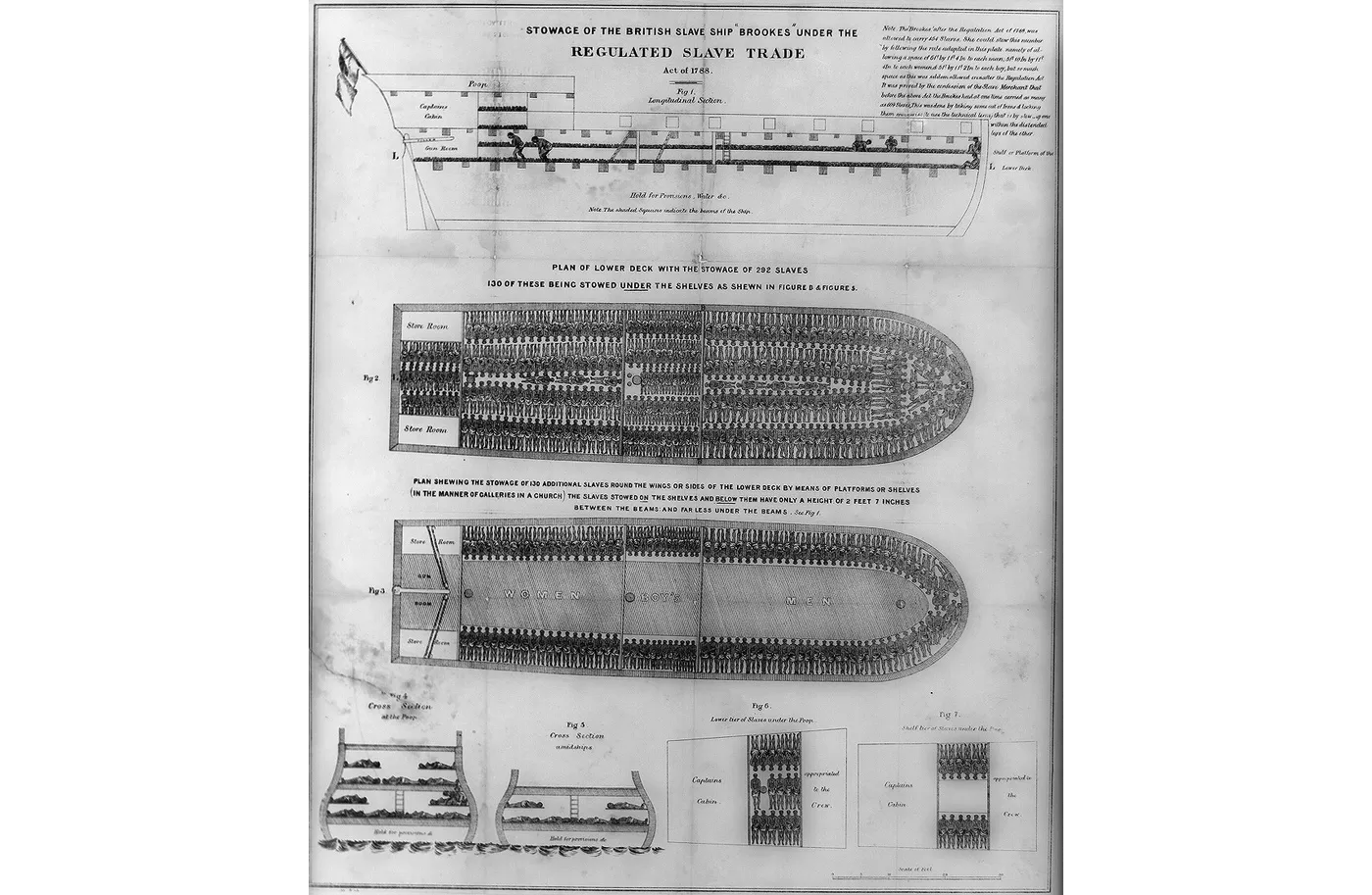
This diagram is probably the most well known visual document of the transatlantic slave trade, and it captures exactly the disturbing arithmetic described above. It shows enslaved people arranged with mechanical precision to fit as many bodies as possible into the ship's lower deck. Because it depicts people as an anonymous, uniform mass rather than individuals, it visually reinforces how the trade reduced human beings to fungible goods for sale, while also leaving out the guns, nets, and restraints that were really used to keep control over the people onboard.
The diagram was first published in 1788 by British abolitionists in the Society for Effecting the Abolition of the Slave Trade, who were campaigning in Parliament to end the trade. It was reprinted as posters, pamphlets, and book illustrations in Britain and the United States, which made it one of the most widely circulated antislavery images of the era. Even so, the number of people it shows is smaller than the number the Brookes had actually carried on some of its voyages.
Plea to the Jurisdiction of Cinque and Others, 1839
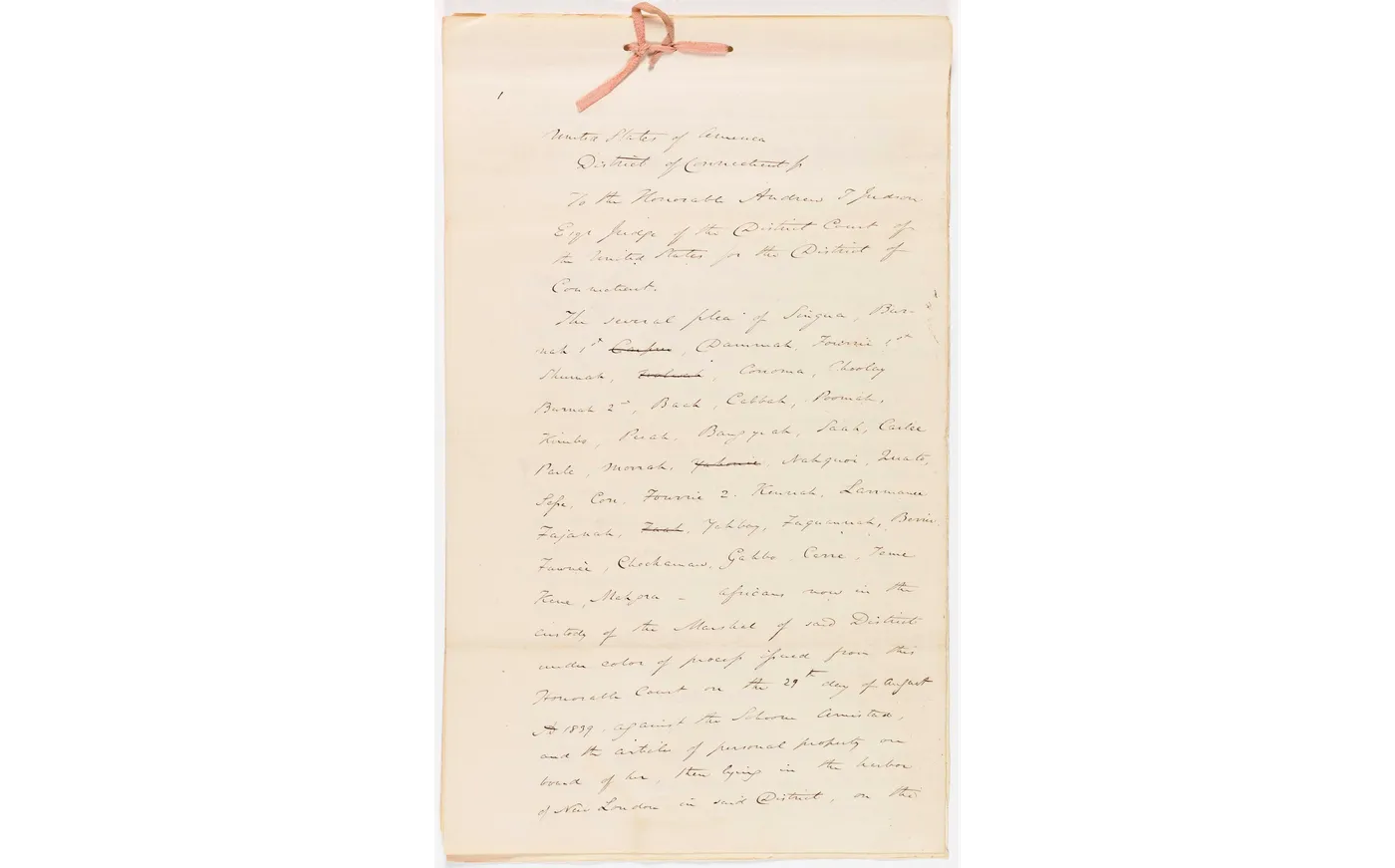
This legal document comes directly from the Amistad case, the same revolt led by Sengbe Pieh described above. It's a firsthand piece of the actual legal fight that determined the captives' fate, showing how their act of resistance aboard the ship extended into a formal, prolonged battle for freedom in the American court system.
In the plea, filed in the U.S. District Court in Connecticut in August 1839, Cinque and the others stated that they were natives of Africa who had been born free and had been illegally kidnapped, so they could not be treated as anyone's property. It is a rare legal document in which the captives' own claim to freedom is put on the record.
Sketches of the Captive Survivors from the Amistad Trial, 1839
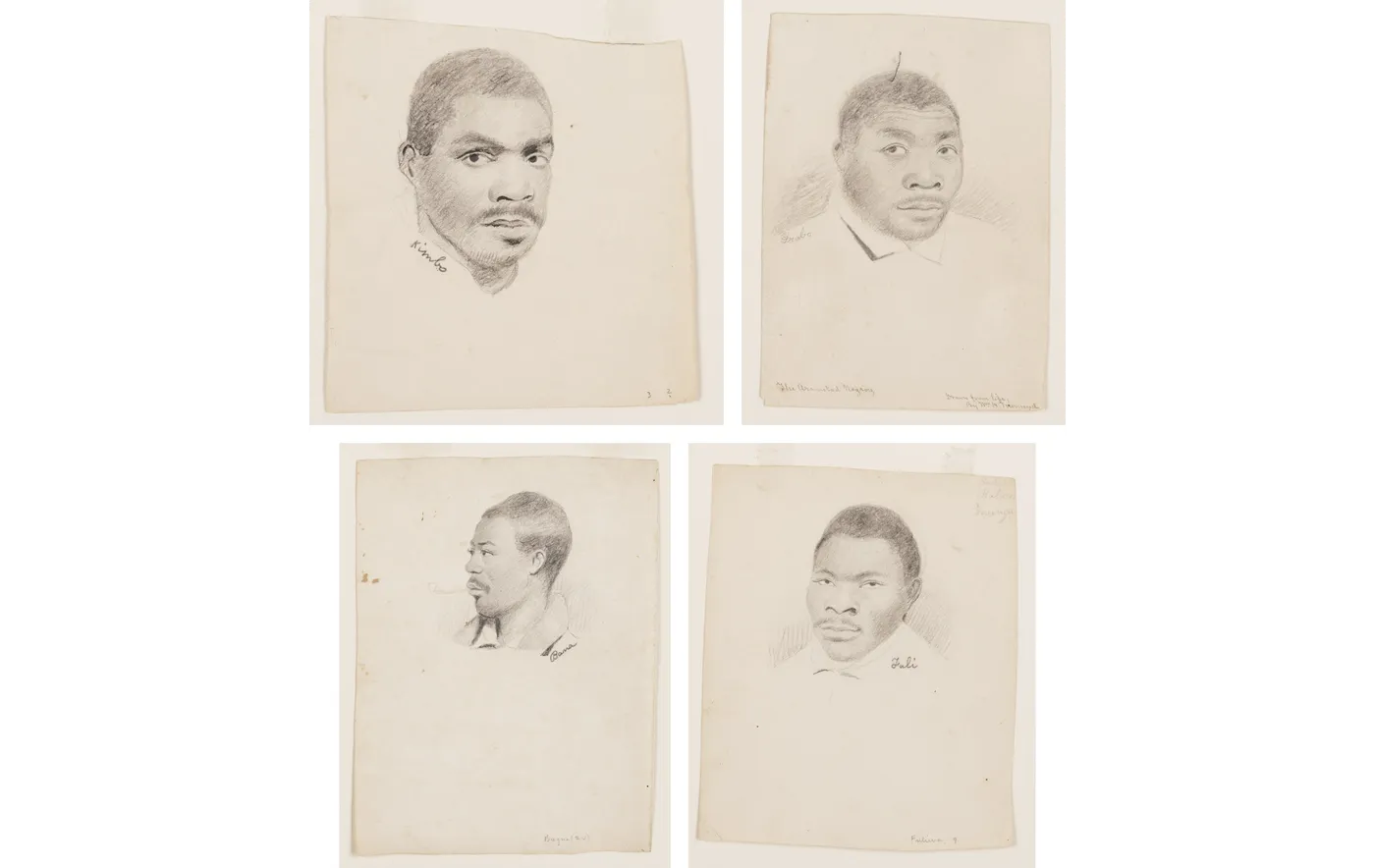
These sketches, drawn during the actual trial, show the Amistad captives as real individuals rather than the anonymous masses depicted in ship diagrams like the Brookes. That distinction matters: after the very dehumanization documented in those earlier diagrams, these portraits helped the public see the captives as specific people with names and faces, which fed directly into the wave of public sympathy the trial generated for abolition.
Stowage by Willie Cole, 1997
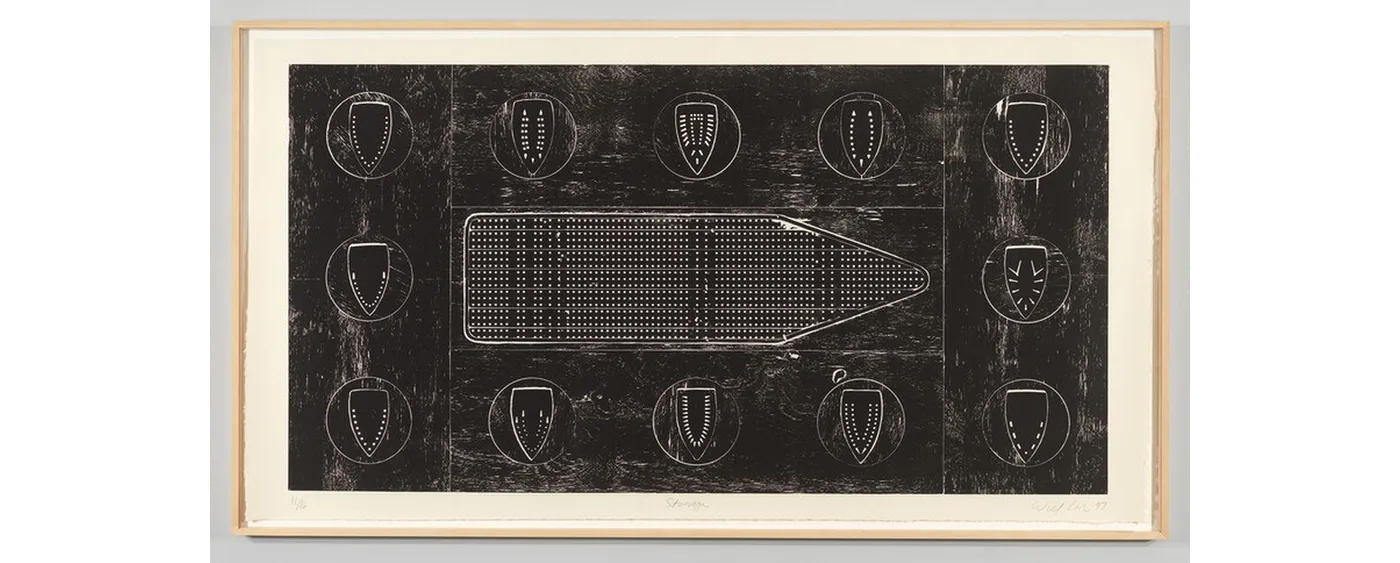
Willie Cole's Stowage is a striking example of contemporary Black artists reworking slave ship imagery to process this history. Cole uses the shape of an everyday household iron, an object tied to domestic labor, to symbolize his ancestors who were forced through the Middle Passage and into forced labor in enslavers' homes. The detailed vertical faces on the iron stand in for the many different African communities who would have been packed onto a single ship, while the horizontal image evokes the shape of the ship itself. It's a piece that takes the same visual logic as the Brookes diagram, systematic, ship-shaped, densely packed, and repurposes it to memorialize rather than dehumanize.