

4.10 - The Black Arts Movement
Art as a Political Tool
The Black Arts Movement, running from 1965 to 1975, brought together Black artists, writers, musicians, and dramatists who saw art as a genuine political tool for achieving Black liberation, not just a means of personal or aesthetic expression. Importantly, these artists didn't share a single, uniform vision of what Black art should look like. What united them instead was a shared conviction that Black art was fundamentally distinct in its inspiration, its characteristics, and its purpose, different from and not defined by the mainstream art world around it.
The movement is usually dated from 1965, when poet and playwright Amiri Baraka (then named LeRoi Jones) moved to Harlem after Malcolm X's assassination and founded the Black Arts Repertory Theatre/School. Writer Larry Neal called the Black Arts movement the "aesthetic and spiritual sister" of Black Power: Black Power focused on political self-determination, and Black Arts tried to do the same for culture, making art by Black artists, for Black audiences, about Black life. Poets like Sonia Sanchez, Nikki Giovanni, and Haki Madhubuti read their work in community centers and on the street, often in the rhythms of Black speech and jazz.
In many ways, the Black Arts Movement echoed the Harlem Renaissance of the 1920s, which had proclaimed a new mentality for the "New Negro" decades earlier. Where the Harlem Renaissance had introduced that new cultural mentality, the Black Arts Movement built an explicitly political foundation for Black art, emphasizing the long, continuous tradition of Black cultural production by deliberately connecting contemporary writers and artists to the forerunners who had come before them.
Building the Foundation for African American Studies
The Black Arts Movement's impact reached well beyond the art world itself. It inspired the creation of Black magazines, publishing houses, art houses, and scholarly journals, and it directly contributed to the founding of some of the earliest African American Studies programs at universities. In many ways, the sheer creative flourishing of Black cultural forms during this movement helped establish African American Studies as a legitimate interdisciplinary academic field, one grounded in the same conviction driving the artists themselves, that Black history, culture, and experience deserved serious, dedicated study on their own terms.
Some of the institutions it created are still known today. Dudley Randall founded Broadside Press in Detroit in 1965, Haki Madhubuti founded Third World Press in Chicago in 1967, and the magazine Negro Digest (renamed Black World in 1970) became a major outlet for Black Arts writers. On campuses, Black students pushed for programs that studied the history and culture these artists celebrated. After protests by Black students at San Francisco State College, the first Black Studies department in the country opened there in 1968, and a long student strike in 1968 and 1969 led to the creation of its College of Ethnic Studies.
Required Sources
Negro es Bello II by Elizabeth Catlett, 1969
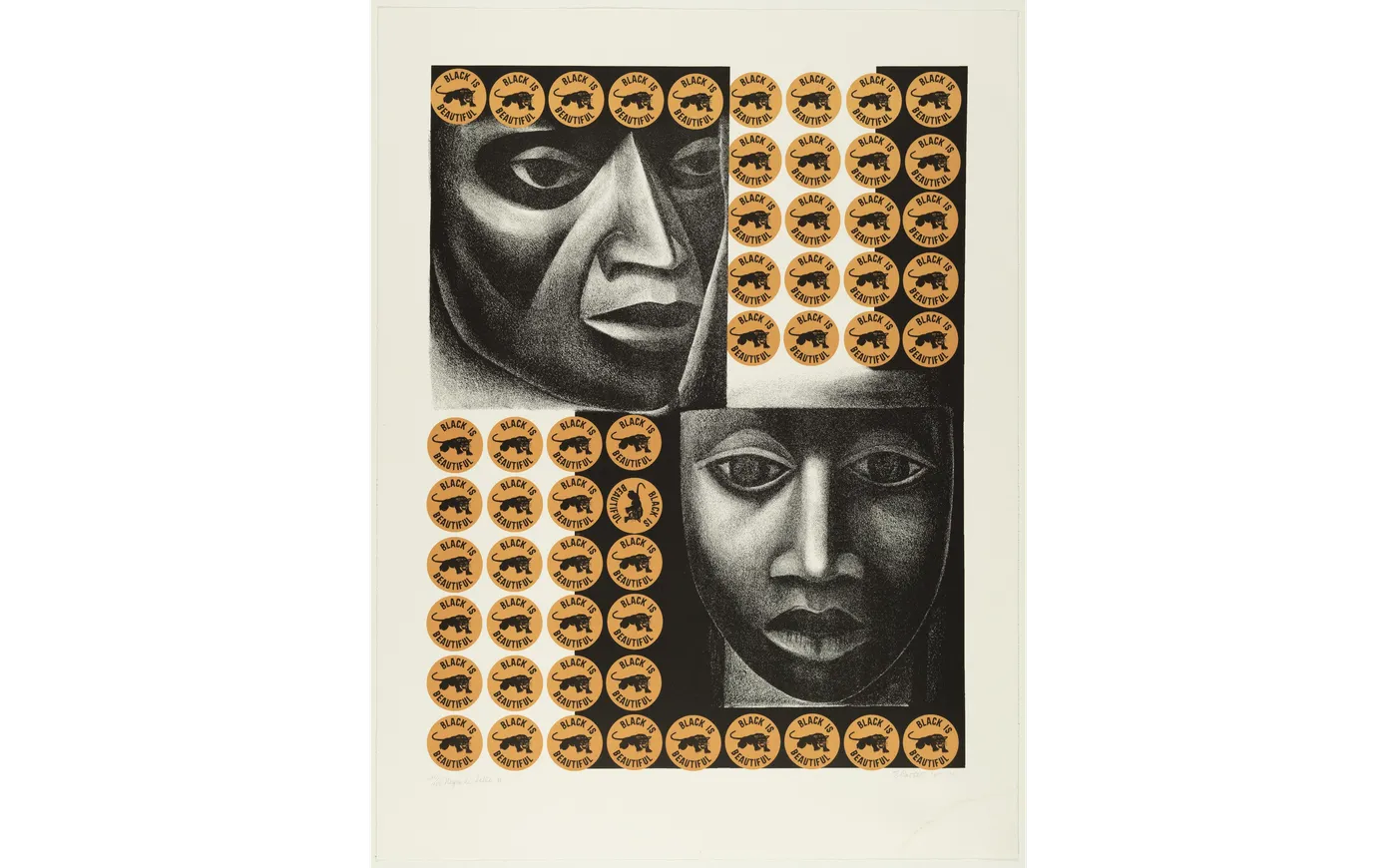
Elizabeth Catlett, the granddaughter of formerly enslaved people, created paintings, sculptures, and prints exploring themes of race, gender, class, and history throughout her career. In the 1940s, she relocated to Mexico and eventually became a Mexican citizen, and her work reflects a genuine blend of African, African American, and Mexican modernist artistic traditions, a fitting embodiment of the diasporic reach this topic emphasizes.
Negro es Bello II specifically highlights the transnational and diasporic reach of the Black is Beautiful and Black Power movements, actively participating in their global circulation rather than simply depicting them from a distance. The piece features two faces rendered in the style of African masks, alongside images of black panthers encircled by the phrase "Black Is Beautiful." Given Catlett's own life spanning African American and Mexican artistic traditions, this piece serves as a striking visual example of exactly how far the ideas and aesthetics of the Black Arts Movement traveled beyond U.S. borders, carried by artists like Catlett who were themselves living between cultures.