

4.2 - Anticolonialism and Black Political Thought
The Black Freedom Movement
The Black Freedom movement refers to a broad period of transnational activism stretching from the mid-1940s to the 1970s. It's typically defined by two overlapping but distinct threads: the Civil Rights movement, which worked to dismantle Jim Crow laws and practices, and the Black Power movement, which pushed to heighten Black consciousness and racial pride, both within the United States and across the wider world.
Diasporic Solidarity in Action
Throughout the 1950s and 1960s, African American writers, leaders, and activists traveled to Africa specifically to express solidarity with the continent's decolonization movements. Some of these figures embraced pan-Africanism outright, advocating for the political and cultural unity of all people of African descent, wherever they lived.
W.E.B. Du Bois is often called the father of modern pan-Africanism, though the idea itself had roots even earlier, nineteenth-century African American and Caribbean writers like Martin Delany, Alexander Crummell, and Edward Blyden were already articulating early versions of pan-African thought decades before Du Bois helped formalize it into a modern movement.
Ghana's independence from British colonial rule in 1957 became a defining moment for this diasporic connection. It drew visits from a remarkable range of African American figures, including Martin Luther King Jr., Malcolm X, writer Maya Angelou, lawyer Pauli Murray, and historian and sociologist W.E.B. Du Bois himself. It's worth knowing that Ghana's own leader, Prime Minister and later President Kwame Nkrumah, had actually studied at Lincoln University and the University of Pennsylvania in the late 1930s and early 1940s, where he built personal connections with African American intellectuals, relationships that helped lay the groundwork for this later wave of diasporic solidarity. At the reception celebrating Ghana's independence, Martin Luther King Jr. famously turned to then-Vice President Richard Nixon and said, "I want you to come visit us down in Alabama, where we are seeking the same kind of freedom the Gold Coast is celebrating," directly linking Ghana's liberation to the ongoing fight for civil rights back home.
Some African Americans went further and moved to Ghana. W.E.B. Du Bois settled there in 1961 at Nkrumah's invitation to work on an Encyclopedia Africana, became a Ghanaian citizen, and died in Accra on August 27, 1963, the day before the March on Washington. Writers and activists such as Maya Angelou and Julian Mayfield also lived and worked in Accra in the early 1960s, which is why they appear in the 1963 embassy photograph below.
This diasporic connection wasn't limited to Africa either. In 1960, the renowned boxer Joe Louis traveled with a predominantly African American delegation to Cuba, exploring plans to promote the island as a tourist destination where African Americans could escape the constant discrimination and segregation of Jim Crow America, a striking example of Black Americans looking for freedom and dignity beyond U.S. borders in more than one direction.
The Global Impact of Diasporic Solidarity
As African Americans and Africans came to recognize their shared struggles against anti-Black racism and oppression, this growing solidarity helped extend the reach of the Black Freedom movement to audiences well beyond the United States, transforming what might have been a purely domestic civil rights struggle into something with genuine international resonance.
This same solidarity helped bring international attention to Africa's decolonization movement more broadly. In fact, 1960 became known as the "Year of Africa," a year in which 17 African nations declared their independence from European colonial rule, a wave of liberation that unfolded alongside, and was reinforced by, the growing diasporic connections between African Americans and Africans. This spirit of solidarity has continued into the present day, reflected in initiatives like Ghana's 2019 "Year of Return," a program specifically designed to reunite people of African descent with the continent.
Required Sources
Martin Luther King Jr. Interview During Visit to Newly Independent Ghana on Invitation from Kwame Nkrumah, 1957
In March 1957, King and Coretta Scott King traveled to Accra for Ghana's independence ceremonies at Kwame Nkrumah's invitation. Right after the midnight ceremony where Ghana's new flag was raised, King recorded a radio interview with Etta Moten Barnett, an African American singer and actress, for a Chicago radio program. In it, King says Ghana's birth shows an old order of colonialism giving way to a new one, predicts it will inspire oppressed people across Africa and Asia, and says it renewed his hope for the freedom struggle in the American South. Asked whether Ghanaians were ready to govern themselves, he answers that people only learn self-government by getting the chance to practice it. The interview is a clear example of diasporic solidarity: King treats African decolonization and the Civil Rights movement as parts of the same fight against racial oppression.
Where to hear it: the original audio recording of this interview is held by the Schomburg Center for Research in Black Culture (The New York Public Library) in its Etta Moten Barnett collection. The Martin Luther King, Jr. Research and Education Institute at Stanford publishes the full transcript in the King Papers as "Interview by Etta Moten Barnett" (Accra, March 6, 1957).
Martin Luther King Jr., radio interview with Etta Moten Barnett, Accra, Ghana, March 6, 1957
Right after the midnight ceremony that made Ghana independent, King told Barnett that the birth of the new nation showed an old order passing away and a new one coming into being. He predicted Ghana would become "a sort of symbol for oppressed people all over the world," in Africa, Asia, and the American South, and said it renewed his faith that justice would win. The interview shows how African independence and the Black freedom struggle in the United States inspired each other.
Joe Louis During Visit of Black Business and Media Leaders to Havana, Cuba, 1960
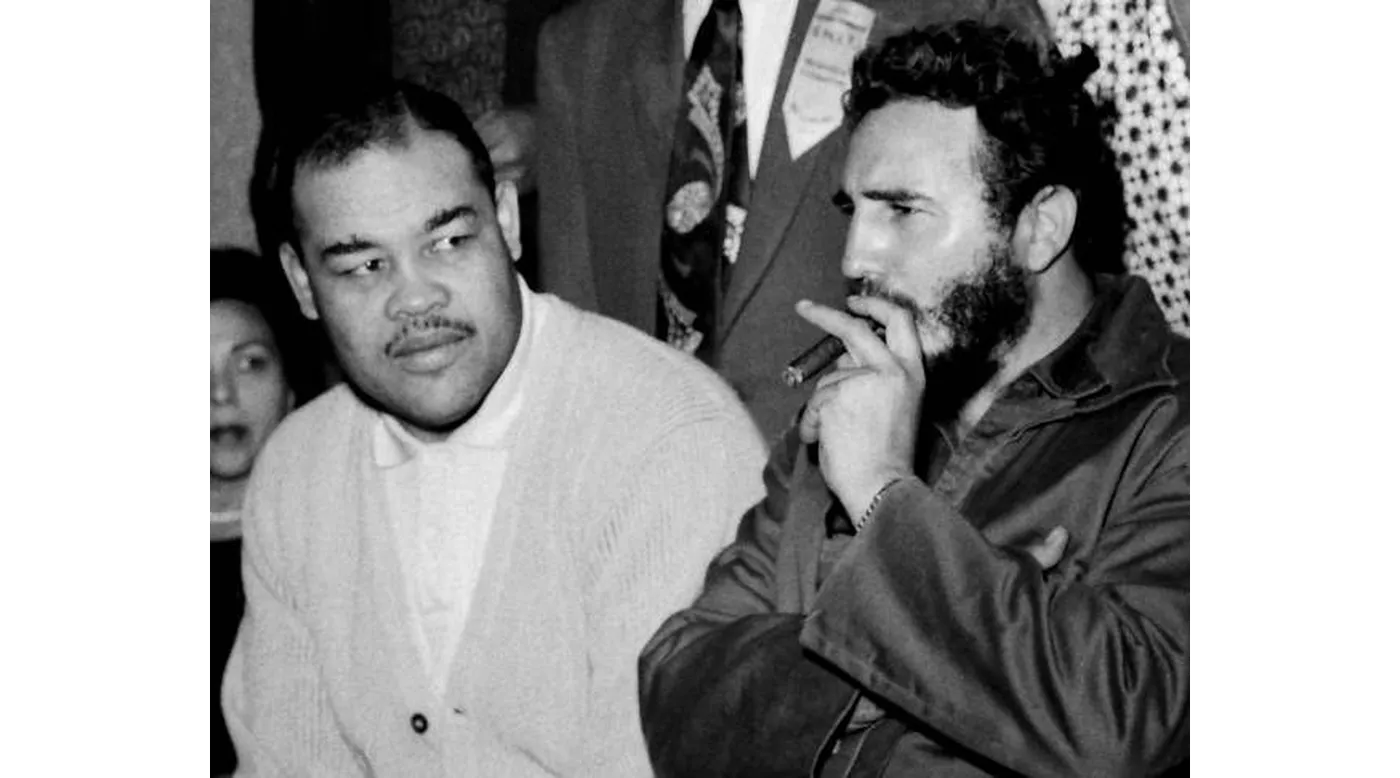
This photograph documents Louis's delegation exploring Cuba as a potential haven from Jim Crow segregation, giving visual evidence of the practical, business-minded side of diasporic solidarity, one focused not just on political ideology, but on tangible economic and social alternatives to American racism.
Maya Angelou, Julian Mayfield, and Others Petition Outside the United States Embassy in Accra, Ghana, 1963
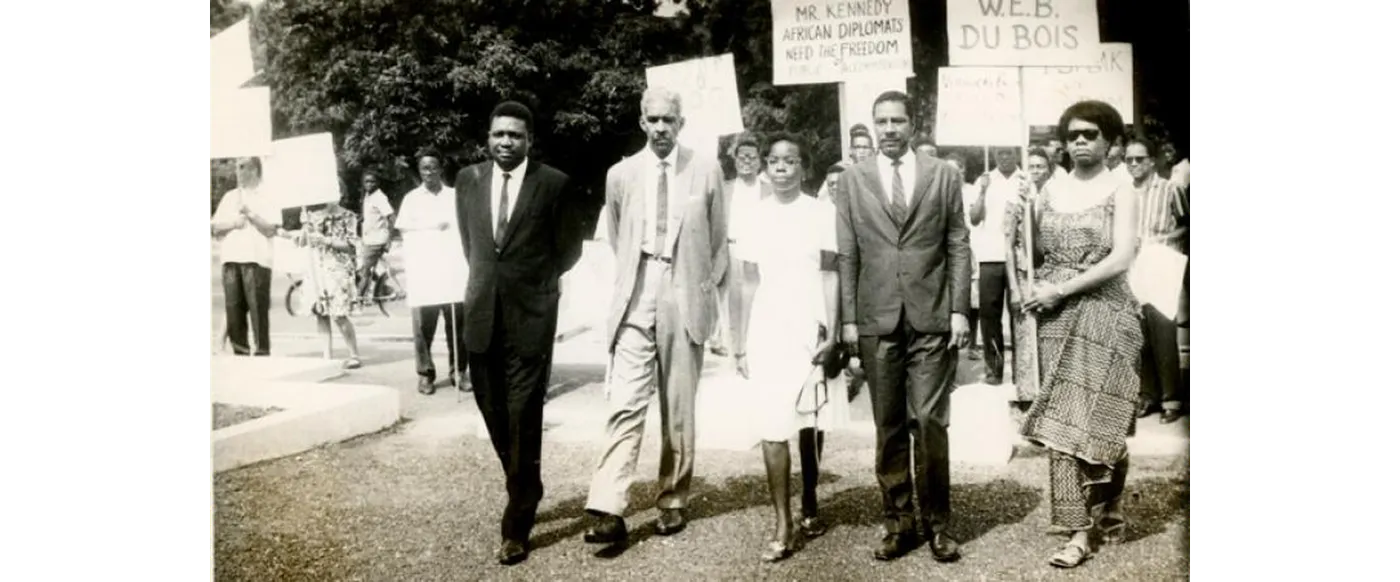
This photograph shows prominent African American activists presenting a petition in support of the March on Washington and in support of ending apartheid in South Africa. Taken together, this single image captures the essence of diasporic solidarity described throughout this topic, activists physically located in Africa, publicly linking the fight against Jim Crow in America to the fight against apartheid in South Africa, treating both as parts of the same global struggle.