

4.21 - Black Studies, Black Futures, and Afrofuturism
African American Studies as an Interdisciplinary Field
African American Studies remains one of the primary lenses through which scholars examine the global influence of Black expression and the persistence of racial inequity. The field analyzes Black history, literature, politics, and many other subjects that traditional academic disciplines have often overlooked, using approaches specifically centered on both past and present Black experience. Importantly, this isn't a static field, these approaches continue to evolve and develop as the discipline itself grows and responds to new questions and new generations of scholarship.
Afrofuturism: Reimagining Black Pasts and Futures
Afrofuturism is a movement that does two things at once: it reimagines Black pasts, envisioning, for instance, a past without oppression, and it envisions Afrocentric futures shaped by technology and science. This boundless exploration of new possibilities for Black life and identity comes alive across a wide range of creative forms, art, music, film, fashion, literature, and architecture, making Afrofuturism less a single genre than a broad creative sensibility spanning many mediums at once.
The word Afrofuturism itself was coined by cultural critic Mark Dery in a 1993 essay titled "Black to the Future," where he asked whether a community whose past had been deliberately erased could imagine its own future.
Afrofuturism's roots actually stretch back much further than many people realize. Early examples include the poet Phillis Wheatley's visions of future freedom and mobility after abolition, envisioning a world beyond the constraints of her own time, and mathematician and astronomer Benjamin Banneker's detailed study of the stars in his own Almanac and Ephemeris, blending scientific observation with a Black intellectual tradition that predated the term "Afrofuturism" by well over a century. Edward Johnson's 1904 novel Light Ahead for the Negro is also considered one of the earliest true Afrofuturist works, imagining a transformed future for Black life through fiction.
Afrofuturism's more widely recognized characteristic works emerged from the 1970s onward, including the pioneering music of Sun Ra and, much later, major films like Black Panther. Its influence can also be traced through the performances of artists including Jimi Hendrix, Herbie Hancock, Patti LaBelle, Janelle Monáe, Missy Elliott, and Outkast, showing just how deeply this sensibility has shaped Black music across multiple generations and genres.
Black Panther (2018), directed by Ryan Coogler, is set in Wakanda, a fictional African nation that was never colonized and became the most technologically advanced country on Earth. It shows both sides of Afrofuturism: it reimagines an African past without colonial oppression, and it pictures an Afrocentric future built on science and technology, with costumes and design drawn from many African cultures.
Required Sources
"How 'Black Panther' Is Bringing Afrofuturism Into the Mainstream," VICE News (video, 5:39)

This video connects one of Afrofuturism's most widely recognized modern touchstones, Black Panther, to the broader movement's history and themes, helping situate a contemporary blockbuster within a much longer creative and intellectual tradition stretching back to figures like Wheatley and Banneker.
Photograph of Nichelle Nichols as Uhura in the Star Trek Episode "A Piece of the Action," 1968
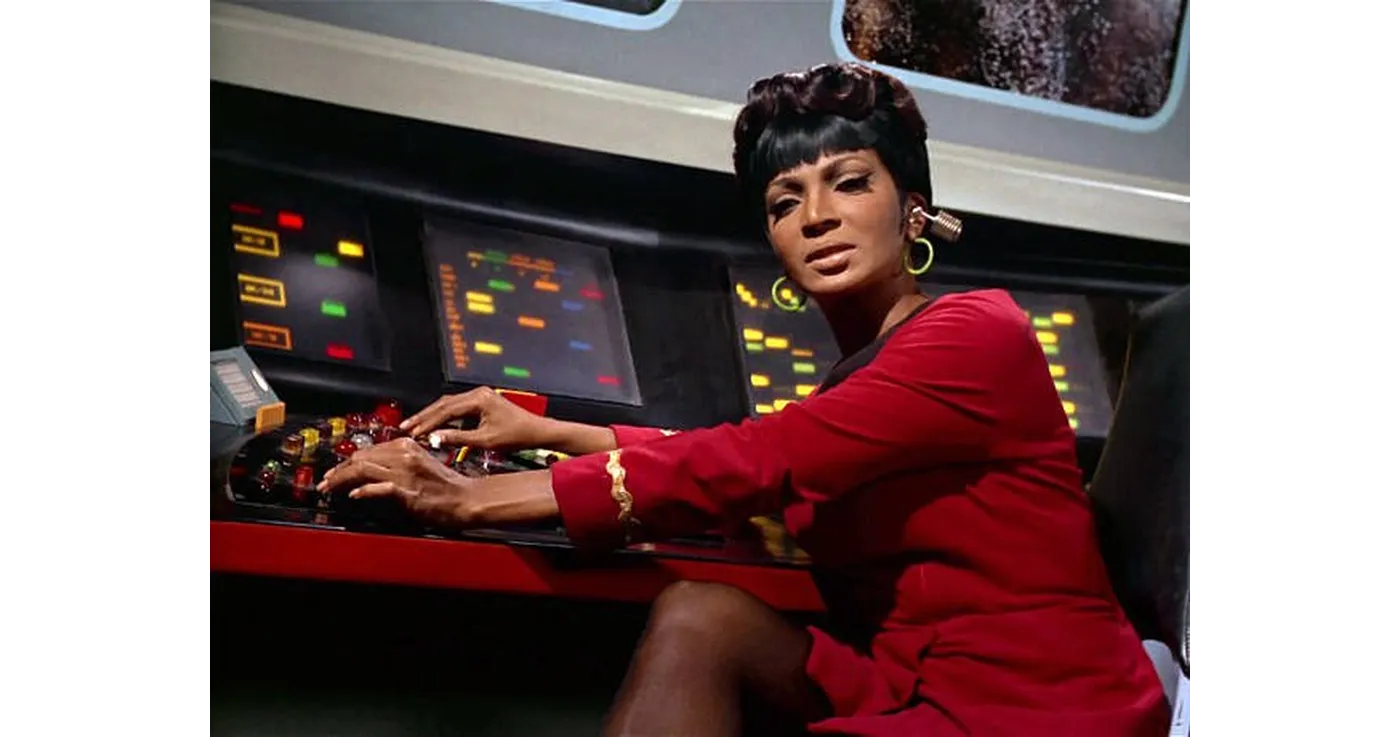
Nichelle Nichols played a genuinely pivotal role in the history of Afrofuturism and space exploration alike through her portrayal of Lieutenant Uhura. Nichols faced real racism as an actress and had actually planned to resign from the role, until Martin Luther King Jr., himself a devoted fan of the show, personally urged her to stay, recognizing the importance of representing equality and Black presence within visions of the future. Nichols's impact didn't end with the show either, she went on to personally recruit African American, Asian American, and women astronaut applicants, directly helping diversify the real U.S. space program. Astronaut Dr. Mae Jemison has spoken about how deeply she was influenced by Nichols, creating a direct, real-world link between a fictional vision of the future and an actual achievement in space exploration decades later.
Poster for the Film Space Is the Place, Circa 1974
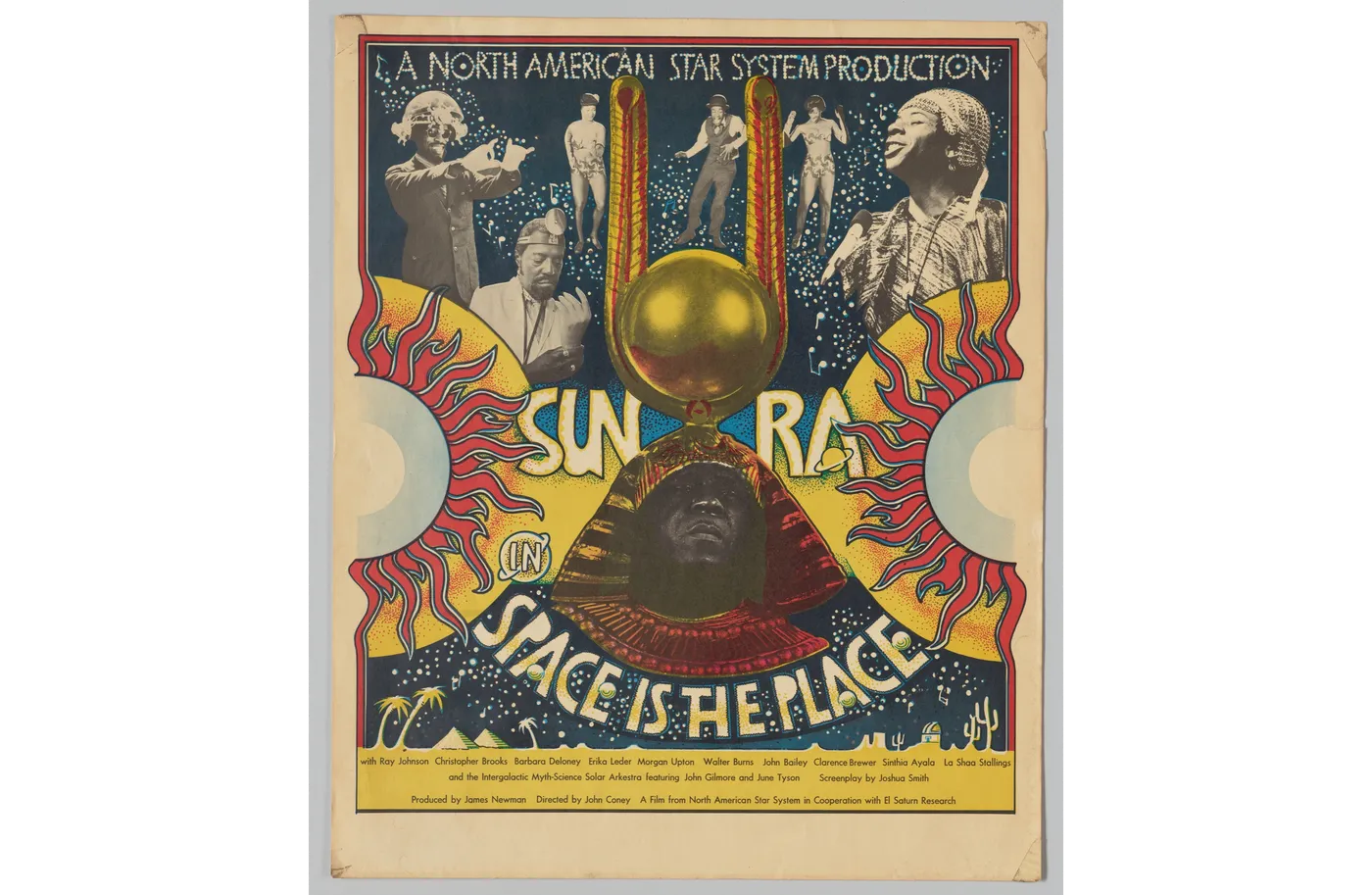
Space Is the Place (1974) stars jazz bandleader Sun Ra, who claimed to come from Saturn and dressed in costumes inspired by ancient Egypt and outer space. In the film he lands his spaceship in Oakland, California, and offers to take Black people to a new planet where they can live free of racism, with music as the force that carries them there. This poster advertised the film. It mixes science fiction, jazz, and 1970s Black nationalist ideas, which makes it one of the characteristic early works of Afrofuturism.
"Culture Zone; Black to the Future" by Walter Mosley, The New York Times, 1998
Walter Mosley, best known for his Easy Rawlins detective novels, wrote this essay for The New York Times Magazine in November 1998, the same year he published his own science fiction novel, Blue Light. He argues that Black writers and readers need science fiction because it lets history be rewritten or ignored and lets people imagine a world different from the one they live in. For young Black readers, he says, the realism of most fiction can feel like a wall that traps them in a culture that shuts them out, while science fiction offers a different vision. Imagination, in his view, is the first step toward changing the world. The essay connects to Afrofuturism's central idea: envisioning Black futures (and pasts) beyond oppression.
Walter Mosley, "Black to the Future," Culture Zone column, The New York Times Magazine, November 1, 1998
Mosley, best known for his Easy Rawlins mysteries, argues that science fiction matters especially for Black writers and readers, because it lets people rewrite or set aside the history that has held them back and imagine a different world. He predicts a wave of science fiction from Black writers. The CED includes it as an early statement of Afrofuturism's central idea: imagining Black futures beyond oppression.
Walter Mosley, "Black to the Future" (1998). Source: The New York Times archive
BackNext