

4.12 - Black Is Beautiful and Afrocentricity
The Emergence of Black Is Beautiful and Afrocentricity
The Black is Beautiful movement and Afrocentricity emerged in the 1960s and 1970s, respectively, both born from African Americans actively embracing Black beauty and well-being while working to strengthen their connections to Africa. Both movements shared a common thread: rejecting the notion that Blackness was somehow inferior, and refusing to conform to mainstream, often white-centered, standards of beauty.
Kathleen Cleaver, a legal scholar and activist with both the Black Panther Party and the broader Black Power movement, was one of the voices who encouraged Black people to embrace their natural beauty and feel genuinely comfortable in their own skin, work that helped anchor this cultural shift in real political activism.
How Black Is Beautiful Reshaped Culture
The Black is Beautiful movement celebrated Afrocentric aesthetics across many dimensions of daily life: natural hairstyles like the afro and cornrows, fashion choices like dashikis and African head wraps, African and Islamic naming practices, celebrations like Kwanzaa (established in 1966), and the embrace of Akan adinkra symbols, including the Sankofa bird.
Kwanzaa was created in 1966 by Maulana Karenga, a Black nationalist activist and scholar, as a week-long celebration of African heritage held from December 26 to January 1. Each day honors one of seven principles (the Nguzo Saba), such as umoja (unity) and kujichagulia (self-determination), using Swahili names. The Sankofa bird, an adinkra symbol of the Akan people of Ghana, is drawn looking backward while moving forward, and it stands for going back to the past to learn what you need for the future.
These naming practices in particular carried deep significance. Since slavery and continuing well beyond it, African Americans have renamed themselves in response to shifting social and political contexts. Far from a superficial choice, these acts of renaming functioned as genuine acts of freedom, powerful assertions of self-identity, Black pride, and community unity.
Community organizing played a real role in spreading these ideals too. The African Jazz-Art Society & Studios, known as AJASS, was founded by a group of artists and jazz musicians inspired by Marcus Garvey and Black nationalism, who wove Afrocentric themes directly into their performances. AJASS produced annual "Naturally" fashion shows to celebrate Black beauty, featuring the Grandassa models, a group of African American women who showcased natural hairstyles and Afrocentric fashion at a time when neither was widely embraced in mainstream culture.
This movement's legacy continues into the present day. In 2019, the California legislature passed the CROWN Act, which stands for Create a Respectful and Open Workplace for Natural Hair, prohibiting discrimination based on hairstyle and hair texture, a modern legal recognition of the same principles the Black is Beautiful movement championed decades earlier.
Afrocentricity as an Intellectual Framework
Afrocentricity, a term coined by scholar Molefi Asante in the 1970s, is an approach that centers the experiences, perspectives, and aesthetics of Black people by placing Africa and the achievements of people of African descent at the very center of historical narrative, rather than treating Africa as peripheral to world history. This approach developed alongside the broader movements of the 1960s that worked to establish African American Studies as a legitimate academic field and to instill genuine pride in African heritage.
Lasting Impact and Critiques
The Black is Beautiful movement's rejection of cultural assimilation helped lay real groundwork for the multicultural and ethnic studies movements that would follow in later decades, extending its influence well beyond questions of beauty and fashion alone.
That said, Afrocentricity as an intellectual framework hasn't been without criticism. While it celebrates Africa and elevates it to a central position in the identities and histories of people of African descent, it can also blur meaningful distinctions across the many different ethnicities that make up the African diaspora, treating "Africa" as a single, unified category rather than the vastly diverse continent it actually is. Critics have also pointed out that Afrocentricity risks becoming a substitute for Eurocentrism rather than a genuine challenge to it, simply replacing one centered historical narrative with another rather than moving toward a more balanced, multi-centered understanding of history.
Required Sources
Kathleen Cleaver on Natural Hair, 1968 (video, 0:57)
This clip captures Cleaver directly articulating the philosophy behind embracing natural Black beauty, connecting this seemingly personal choice to the broader political project of Black pride and self-determination that defined the Black Power movement she was part of.
Naturally '68 Photo Shoot in the Apollo Theater Featuring Grandassa Models and AJASS Members in Dashikis, 1968
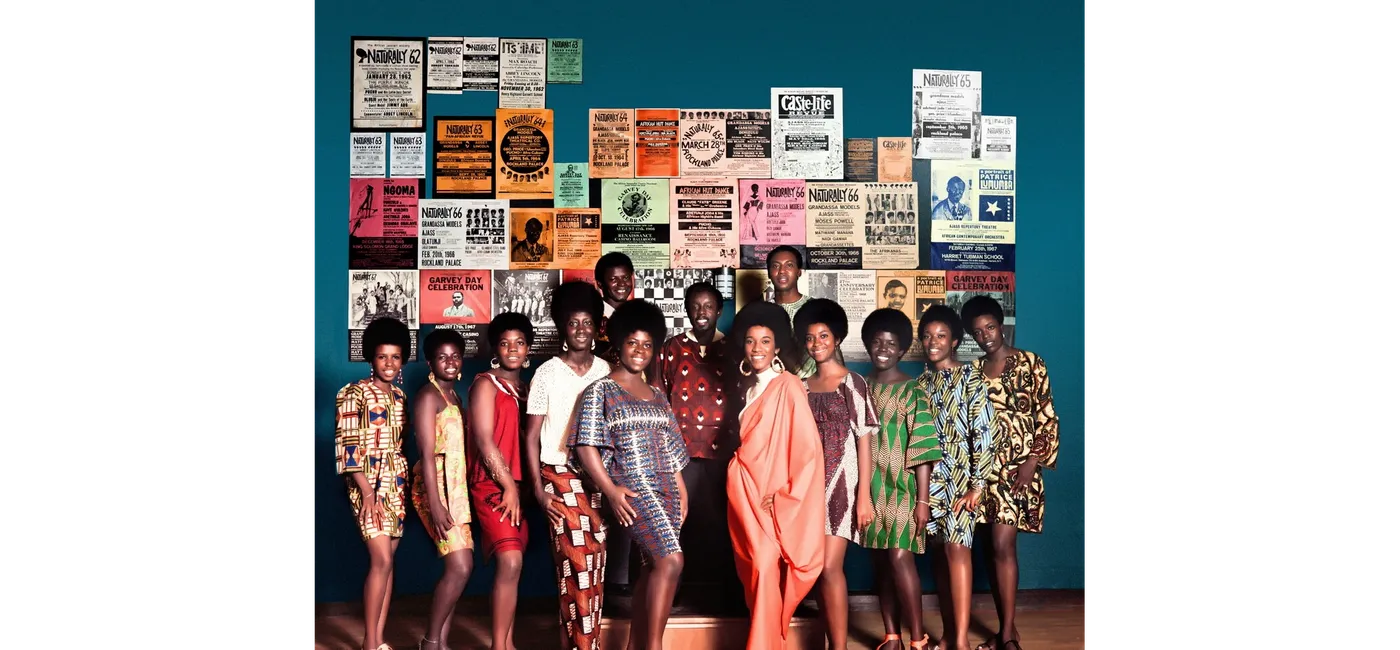
Kwame Brathwaite took this photograph in 1968. Brathwaite, with his brother Elombe Brath, helped found AJASS in the 1950s and the Grandassa Models in the early 1960s, and he helped popularize the slogan "Black Is Beautiful." The photo shows Grandassa models and AJASS members at Harlem's Apollo Theater wearing natural hairstyles and African-inspired clothing such as dashikis. At a time when most magazines and ads showed straightened hair and white beauty standards, the Naturally shows presented dark skin, natural hair, and African fashion as beautiful, which is the central idea of the Black is Beautiful movement.
"Still I Rise" by Maya Angelou, 1978
Maya Angelou published "Still I Rise" in her 1978 poetry collection And Still I Rise. The speaker talks directly to someone who has tried to put her down, who has written her into history with lies, treated her with hatred, and wanted to see her broken. Again and again she answers that she will rise anyway, like dust, like air, like the tides, and she openly celebrates her confidence and her body instead of apologizing for them. By the end she connects herself to the history of slavery, calling herself "the dream and the hope of the slave." The poem reflects the Black is Beautiful movement's rejection of inferiority and its pride in Black identity.
Maya Angelou, "Still I Rise," in And Still I Rise (New York: Random House, 1978)
I am the dream and the hope of the slave.
The speaker answers everyone who has tried to put her down, from people who told lies about her in history to people who want to see her broken, and again and again says she will rise anyway. She celebrates her confidence and her body instead of apologizing for them, and ends by tying her strength to the history of slavery. The CED includes it as an example of the Black is Beautiful movement's pride in Black identity and its rejection of the idea of inferiority.
Maya Angelou, "Still I Rise" (1978). Source: Poetry Foundation