

4.3 - African Americans and the Second World War: The Double V Campaign and the G.I. Bill
African American Service in a Segregated Military
At the start of the Second World War, the United States Armed Forces remained fully segregated. Despite that glaring contradiction, over two million African Americans registered for the draft or voluntarily enlisted, going on to serve in every branch of the U.S. military.
The Tuskegee Airmen hold a landmark place in this history as the first African American pilots in the United States military. Serving in the Army Air Corps, the precursor to today's Air Force, these pilots played a real role in the fight against fascism through their service in Europe and North Africa. They became known as the "Red Tails," a nickname earned from the distinctive red markings painted on their aircraft.
The airmen trained at a segregated airfield near Tuskegee Institute in Alabama starting in 1941, and close to 1,000 pilots completed the program. The first unit, the 99th Fighter Squadron, entered combat from bases in North Africa in 1943, and the 332nd Fighter Group later escorted American bombers over Europe. Their record helped disprove the military's racist claims that Black men couldn't handle combat flying.
Black women also played a vital and often overlooked role in military service. Educator Mary McLeod Bethune and First Lady Eleanor Roosevelt advocated together for Black women to be incorporated into the Women's Army Corps. This effort led to the formation of the 6888th Central Postal Directory Battalion, a unit of more than 800 women that notably included women of Caribbean and Mexican descent as well, reflecting a genuinely diverse group of Black and Afro-diasporic women serving together.
The Double V Campaign
Even as the country rallied to fight fascism abroad, African Americans were acutely aware of the unequal treatment they continued to face as citizens at home. In 1942, James G. Thompson, a young Black worker from Wichita, Kansas, channeled this tension into a letter published in the Pittsburgh Courier, an African American newspaper, and that letter sparked what became known as the "Double Victory" Campaign. Thompson urged readers to fight for two victories simultaneously: one against fascism overseas, and another against Jim Crow segregation right at home, refusing to accept that Black Americans should have to choose between patriotism abroad and justice domestically.
This wasn't just rhetorical either. African American veterans who continued pushing against racism after returning home were often targeted for violent attacks, a brutal reminder that fighting fascism abroad didn't guarantee any safety or justice once they were back on American soil.
One well-known case was Isaac Woodard, a Black Army sergeant who was beaten and blinded by a South Carolina police chief in February 1946, only hours after his discharge and while still in uniform. Outrage over attacks like this pushed President Harry Truman to create a committee on civil rights, and in 1948 Truman issued Executive Order 9981, which ordered the desegregation of the armed forces.
Unequal Access to the G.I. Bill
The G.I. Bill of 1944 was designed, at least on paper, as a race-neutral gesture of gratitude toward returning American veterans, including the 1.2 million Black veterans who had served. It offered major pillars of economic stability, funding for college tuition, low-cost home mortgages, and low-interest business startup loans, benefits that could genuinely transform a family's economic trajectory.
In practice, though, the bill's promise didn't hold up equally for everyone. While it was a federal program, its funds were administered at the local level, which meant it remained subject to the same Jim Crow discriminatory practices found throughout the rest of Southern life. As a result, these benefits were disproportionately disbursed to white veterans. Many Black veterans ended up receiving reduced benefits or none at all, due to a combination of factors: outright denials from state and federal agencies, direct intimidation, and disproportionately higher rates of dishonorable discharge compared to their white counterparts, discharges that could disqualify veterans from receiving benefits altogether.
The numbers show how big the gap was. In Mississippi in 1947, only 2 of the more than 3,000 home, farm, and business loans backed by the Veterans Administration went to Black veterans. Black veterans who wanted to use the bill for college were limited too, because most white colleges in the South (and many outside it) would not admit them, and the HBCUs that would were overcrowded.
Required Sources
James G. Thompson, "Should I Sacrifice to Live 'Half-American'?," Pittsburgh Courier, 1942
James G. Thompson was a 26-year-old Black man from Wichita, Kansas, who worked in the cafeteria of an aircraft plant that would not hire Black workers for its factory floor (he later served in the Army). His letter to the Pittsburgh Courier, published on January 31, 1942, weeks after Pearl Harbor, asks whether he should sacrifice his life to live as a "half-American" and whether the America he knew was worth defending. He proposed that Black Americans adopt a "double VV": one V for victory over enemies abroad and one for victory over enemies at home, meaning racism and Jim Crow. The Courier quickly turned his idea into its Double V Campaign. The letter shows how African Americans tied their wartime service to demands for full citizenship, the main idea of this topic.
James G. Thompson, "Should I Sacrifice to Live 'Half-American'?," letter to the editor, The Pittsburgh Courier, January 31, 1942, p. 3
Should I sacrifice my life to live half American?
Thompson, a 26-year-old cafeteria worker in Wichita, Kansas, wrote this letter weeks after Pearl Harbor. He asks whether Black Americans should give their lives for a country that treated them as half citizens, and he proposes a double V: victory over enemies abroad and over racism at home. The Courier turned his idea into the Double V Campaign, which is why the CED includes the letter.
James G. Thompson, "Should I Sacrifice to Live 'Half-American'?" (1942). Source: Experiencing History, United States Holocaust Memorial Museum (full letter)
Major Charity E. Adams and Captain Mary Kearney Inspect Members of the 6888th Central Postal Directory Battalion in England, 1945
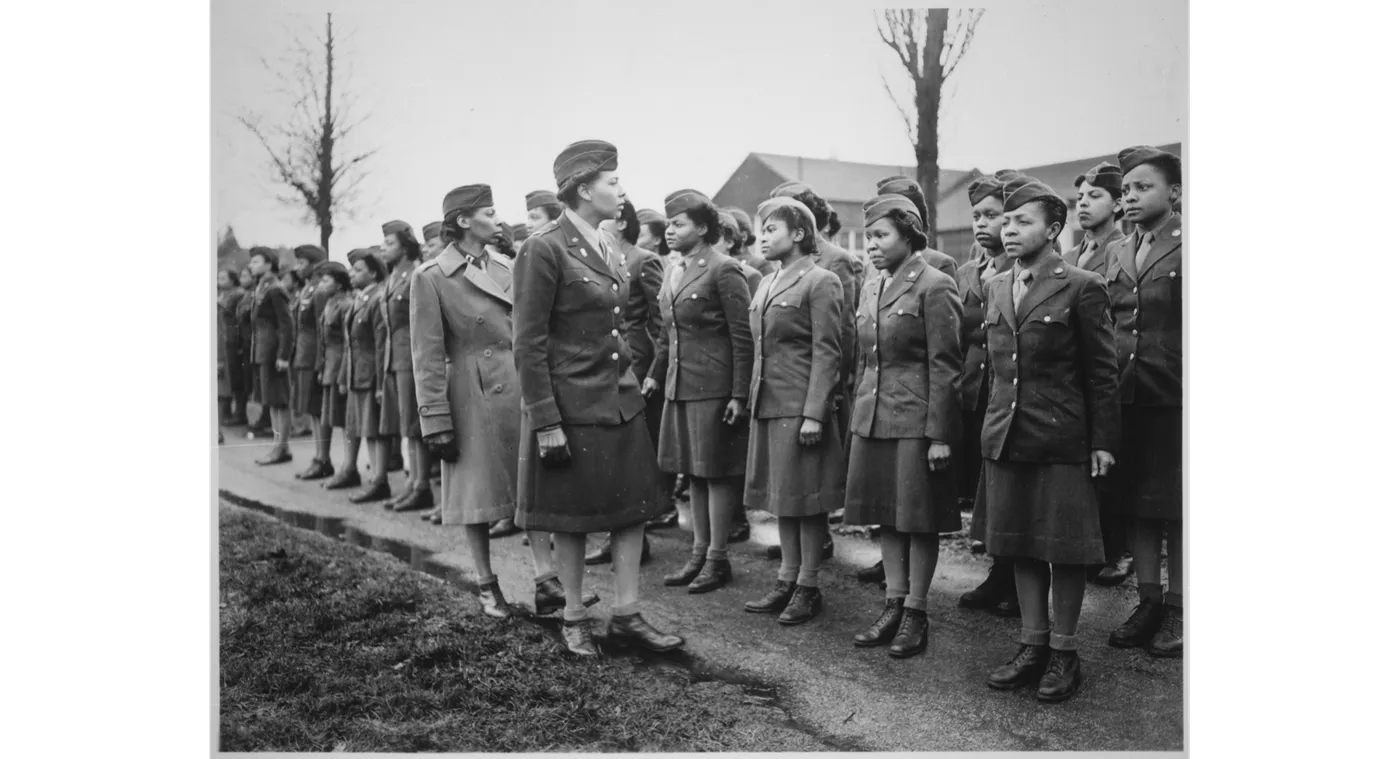
This U.S. Army photograph, taken in England on February 15, 1945, shows Major Charity E. Adams, the battalion's commander, inspecting the 6888th, the very unit whose formation Mary McLeod Bethune and Eleanor Roosevelt championed. The 6888th's job was to clear a huge backlog of undelivered mail for American troops in Europe. Working in cold, poorly lit warehouses in Birmingham, England, they sorted millions of letters and packages in about three months, far faster than the Army expected, under the motto "No mail, low morale." The photo highlights a side of Black wartime service often overshadowed by combat stories: skilled work done by Black women, under Black women's leadership, who had to fight for the chance to serve at all.
The Flight Instructor Staff of Tuskegee Army Airfield, Late in the Second World War, 1945
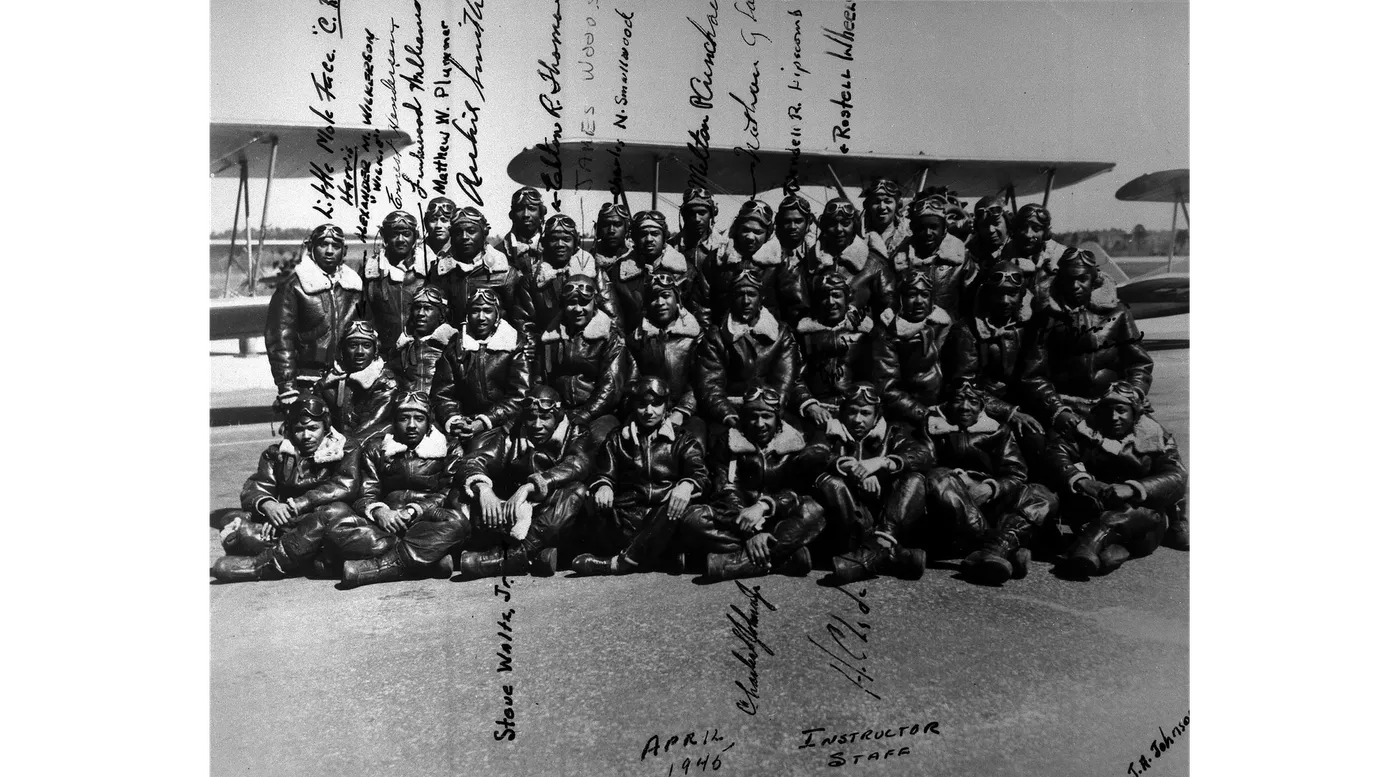
This photograph shows the instructors responsible for training the Tuskegee Airmen, the pilots who would go on to earn the "Red Tails" nickname through their service in Europe and North Africa. It reflects the full institutional structure behind the Tuskegee program, not just the pilots who flew in combat, but the instructors who built the training pipeline that made their historic service possible in the first place.