

4.15 - Economic Growth and Black Political Representation
Economic Growth and Persistent Disparities
Despite real growth in the Black middle class over the past several decades, substantial wealth disparities along racial lines remain deeply entrenched. Discrimination and racial inequality in housing and employment throughout the early twentieth century directly limited Black communities' ability to accumulate generational wealth in the decades that followed. The scale of this gap is stark: in 2016, the median wealth for Black families stood at just $17,150, compared to $171,000 for white families, a tenfold difference rooted in generations of accumulated disadvantage.
Education has been one of the clearer areas of progress. Desegregation throughout the 1950s and 1960s expanded educational opportunities and gradually increased the number of Black college graduates. By 2019, 23 percent of African American adults had earned a bachelor's degree or higher, a meaningful shift from the educational barriers of previous generations.
Urbanization also opened up new employment opportunities and fueled the growth of Black-owned businesses. Black entrepreneurs have long contributed to American society and its economy, and Black-owned businesses, including restaurants, banks, and publishing houses, were established specifically to serve Black communities, with some of these businesses remaining in operation today, genuine multi-generational institutions.
A few examples: Johnson Publishing Company in Chicago launched Ebony magazine in 1945 and Jet in 1951; Black-owned banks like Maggie L. Walker's St. Luke Penny Savings Bank in Richmond, Virginia (1903), lent to Black customers other banks turned away; and restaurants like Dooky Chase's in New Orleans became meeting places for civil rights organizers.
The Voting Rights Act and Political Representation
The Voting Rights Act of 1965 prohibits local and state governments from enacting laws or procedures that create racial discrimination in voting. Its passage had a direct, measurable effect: Black voting power and political representation expanded significantly in the late twentieth century, growing alongside the broader expansion of the Black middle class. Many African Americans went on to hold genuinely influential positions, serving as members of Congress, local legislators, judges, and high-ranking officials within presidential administrations.
The law has been weakened since then. In Shelby County v. Holder (2013), the Supreme Court struck down the formula that decided which states and counties needed federal approval before changing their voting rules. As of 2026, the Court has also narrowed when Section 2 of the act requires majority-Black election districts: in Louisiana v. Callais (April 2026), it struck down Louisiana's second majority-Black congressional district as a racial gerrymander.
The numbers reflect just how dramatic this shift was. Between 1970 and 2006, the number of Black elected officials in the United States grew from roughly 1,500 to about 9,000, a sixfold increase. The single largest annual jump occurred in 1971, a direct reflection of the Black Freedom movement's impact on political representation just a few years after the Voting Rights Act's passage.
Milestones in Black Political Leadership
Several individuals mark defining moments in this expansion of Black political power. Shirley Chisholm, a committed advocate for women's rights, became the first Black woman elected to Congress in 1968. In 1971, she helped found the Congressional Black Caucus, a group of Black members of Congress dedicated to growing Black political power by supporting Black candidates across national, state, and local elections, and by lobbying for reforms in healthcare, employment, and social service programs.
Chisholm represented a district in Brooklyn, New York, and in 1972 she became the first Black woman to run for a major party's presidential nomination, with the slogan "Unbought and Unbossed."
In 2001, Colin Powell became the first Black secretary of state, serving under President George W. Bush. He was succeeded in that role by Condoleezza Rice, who became the first Black woman to hold the position, marking two consecutive historic milestones in one of the country's most senior cabinet positions.
The early twenty-first century brought even more historic firsts at the highest levels of American government, with the elections of Barack Obama as president in 2008 and Kamala Harris as vice president in 2020, both the first Black Americans in United States history to hold these respective positions.
Required Sources
Commencement Address of General Colin Powell at Howard University, 1994
Colin Powell, the son of Jamaican immigrants, had recently retired as chairman of the Joint Chiefs of Staff (the first Black officer to hold the military's top job) when he gave this speech at Howard University, an HBCU in Washington, D.C., on May 14, 1994. The speech came after controversy over campus speakers who had spread antisemitic and racist messages. Powell defends free speech but tells graduates to separate wisdom from foolishness and to reject anyone who preaches hatred of any group, pointing to Nelson Mandela's new government in South Africa as proof that former enemies can reconcile. He honors the Buffalo Soldiers, Tuskegee Airmen, and other Black servicemen whose shoulders he says he stood on, and he urges graduates to work hard, serve their communities, and not let racism define them: "Let racism always be someone else's burden to carry." Seven years later he became the first Black secretary of state, so the speech shows the outlook of one of the most powerful Black leaders of the late twentieth century.

Gen. Colin L. Powell, commencement address at Howard University, Washington, D.C., May 14, 1994 (printed in the Congressional Record, May 19, 1994)
Let racism always be someone else's burden to carry.
Powell spoke at Howard after controversy over campus speakers who had spread antisemitic and racist messages. He defends free speech but tells graduates they have to sort wisdom from foolishness and reject anyone who preaches hatred, and he thanks the Buffalo Soldiers, Tuskegee Airmen, and other Black servicemen whose shoulders he says he stood on. The CED includes it as a voice of Black leadership at the highest level of national life in the decades after the civil rights movement.
Colin L. Powell, Commencement Address at Howard University (1994). Source: Congressional Record, May 19, 1994, govinfo.gov (full text)
Portrait of Former President Barack Obama by Kehinde Wiley, 2018
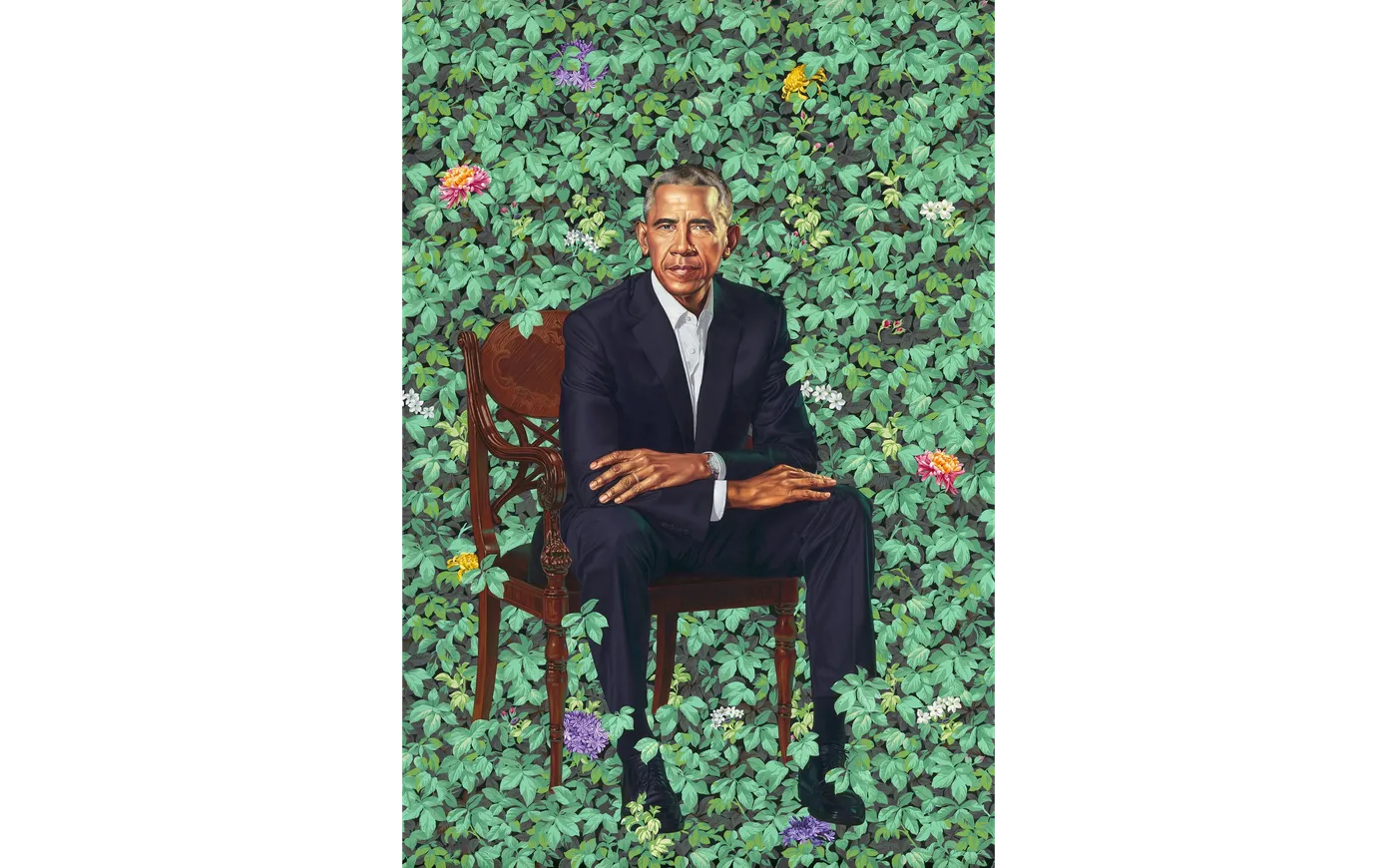
Kehinde Wiley painted this official portrait for the National Portrait Gallery, and it was unveiled in February 2018 along with Amy Sherald's portrait of Michelle Obama. Wiley and Sherald were the first Black artists chosen to paint official portraits of a president and first lady for the gallery. Wiley shows Obama seated in a chair in front of a wall of green leaves and flowers that point to his life story: chrysanthemums (Chicago's official flower), jasmine (Hawaii, where he was born), and African blue lilies (Kenya, his father's homeland). Wiley is known for painting Black people in the grand style once reserved for European kings and aristocrats, so the portrait celebrates the first Black president while placing him in a tradition that long excluded Black subjects.
Portrait of Former First Lady Michelle Obama by Amy Sherald, 2018
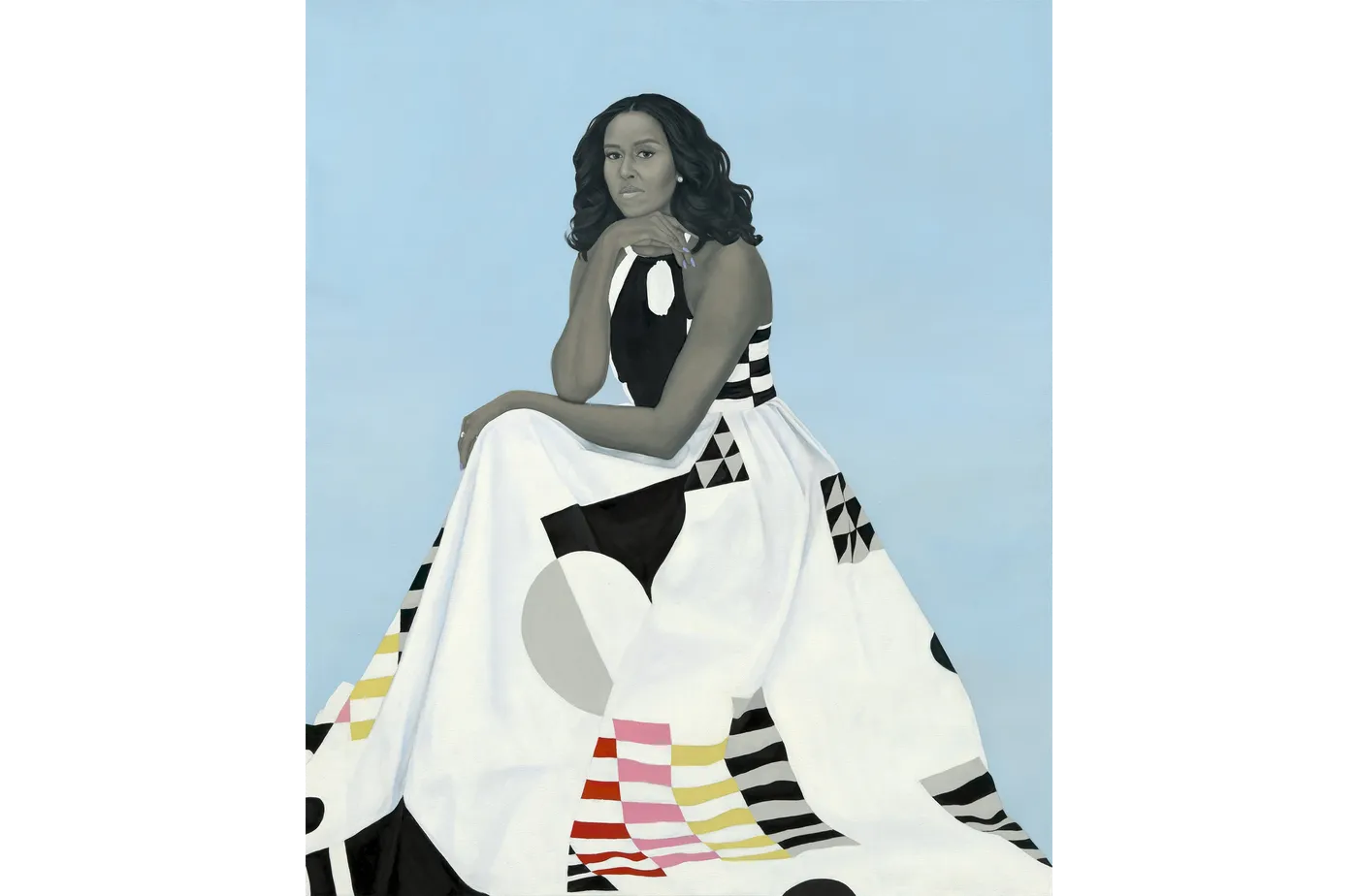
Painted alongside President Obama's official portrait, Amy Sherald's portrait shows Michelle Obama seated in a long, flowing gown with a bold geometric pattern, by designer Michelle Smith of the label Milly, against a light blue background. As in many of Sherald's portraits, the skin is painted in shades of gray, a choice Sherald uses to push viewers to see her subjects beyond assumptions about race. Michelle Obama was the first Black first lady, and the portrait marks how Black leadership reached the highest levels of American public life.
Charts from "The Black Middle Class Needs Political Attention, Too," Brookings Institution Report by Andre M. Perry and Carl Romer, 2020
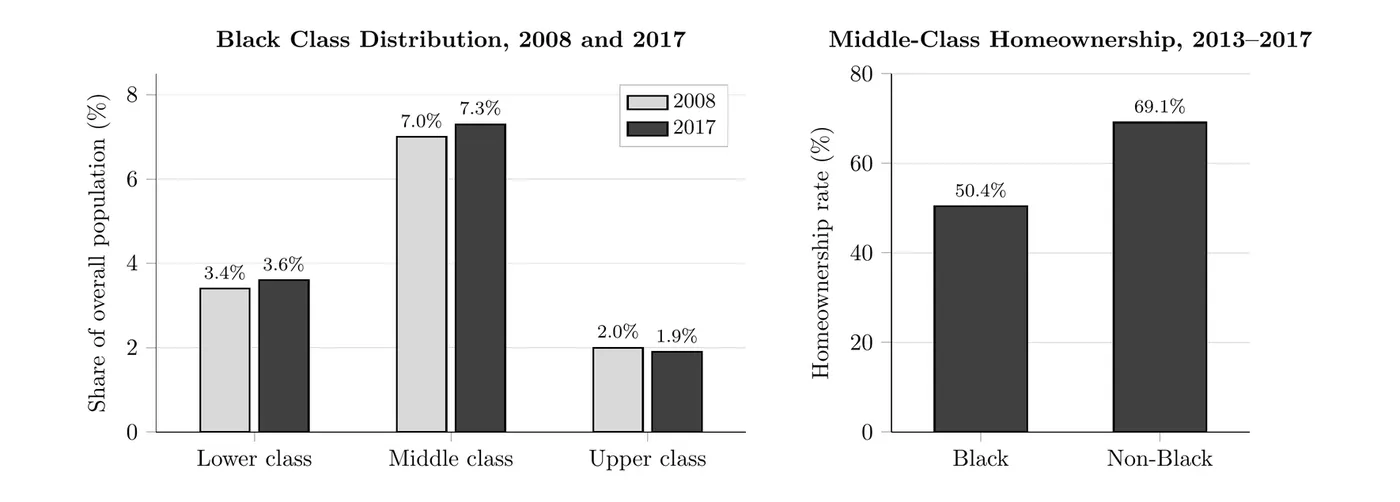
Andre M. Perry and Carl Romer of the Brookings Institution, a Washington think tank, published this report in February 2020. The redrawn charts above show two things. First, Black middle-class households grew only slightly as a share of the U.S. population between 2008 and 2017 (from 7.0 to 7.3 percent), while the Black lower class grew a little and the Black upper class shrank slightly. Second, even within the middle class, Black homeownership (about 50 percent) was far below non-Black homeownership (about 69 percent) from 2013 to 2017. Since a home is most families' biggest source of wealth, that gap helps explain why the racial wealth gap ($17,150 vs. $171,000 in median family wealth in 2016) stays so large even as the Black middle class grows. The authors argue the Black middle class needs its own policy attention. One limitation: the charts measure population shares and homeownership, not wealth itself, so they point to the wealth gap rather than measure it.