

4.17 - The Evolution of African American Music: From Spirituals to Hip-Hop
African Roots in African American Music
Since their ancestors first arrived in the Americas, African Americans have consistently drawn on African-based musical and performative traditions as the foundation for the sounds and expressions found throughout African American music. Core elements like improvisation, call and response, syncopation, storytelling, and the fusion of music with dance run continuously through this tradition, connecting music made today to techniques rooted in Africa centuries ago.
A Tradition That Reshaped Global Music
The African American musical tradition spans an enormous range of genres, spirituals, blues, jazz, gospel, rhythm and blues, and hip-hop, and together these genres have influenced and reshaped both American music, rock and roll being a prime example, and international genres like Latin jazz.
Rock and roll's foundation was laid directly by African American performers like Sister Rosetta Tharpe, Bo Diddley, and Little Richard, who modified gospel and blues traditions with new rhythms and the addition of electric instruments, essentially inventing the sound that would go on to define an entire genre credited largely to others in popular memory.
Sister Rosetta Tharpe, a gospel singer who played electric guitar, had hits in the 1940s and is often called the "godmother of rock and roll." Latin jazz, meanwhile, took off in the late 1940s when bebop trumpeter Dizzy Gillespie worked with Cuban percussionist Chano Pozo, blending jazz with Afro-Cuban rhythms in songs like "Manteca" (1947).
Across all of these genres, African American music has consistently reflected real lived experience, joy, hope, creativity, and pointed social critique, all carried forward even in the midst of ongoing racism and oppression. Music became a vehicle for processing and expressing exactly the kind of complex, layered experience that words alone often couldn't fully capture.
The Birth of Hip-Hop
Hip-hop refers to a culture born out of collaboration and artistic creativity among young Black and Latino community members in the 1970s. Rooted specifically in New York City's Bronx borough, it has since grown into a genuinely global phenomenon, reaching far beyond its neighborhood origins.
Music remains the most enduring component of hip-hop culture. African American artists like James Brown directly influenced the DJs who shaped the sound of community events throughout the 1970s. DJs like Grandmaster Flash built on this influence by adding improvised vocal rhymes and experimenting with new turntable techniques, including mixing and scratching, innovations that became the direct origins of modern rap music.
DJs also developed the technique of extending "the break," the instrumental portion of a song, giving dancers extended time to showcase new moves and routines. This gave rise to breakdancing, performed both independently by individual "b-boys" and "b-girls" and collectively in organized groups known as crews.
Hip-hop is often traced to a back-to-school party in the Bronx in August 1973, where DJ Kool Herc, who had moved to New York from Jamaica, used two copies of the same record on two turntables to stretch out the break. Hip-hop is usually described as having four elements: DJing, MCing (rapping), breaking (breakdancing), and graffiti writing. Rap first reached a national audience with the Sugarhill Gang's "Rapper's Delight" (1979).
Visual art played its own foundational role too. Graffiti art actually predates hip-hop's music and dance elements, but it became a vital form of artistic expression within the emerging youth culture nonetheless. The "writers," as graffiti artists were known, covered walls, bridges, and subway cars with their work, a practice that eventually brought real acclaim to artists like Jean-Michel Basquiat, whose career would go on to bridge graffiti and the fine art world.
Political Roots and Ongoing Impact
Hip-hop didn't emerge in a vacuum, it developed directly in the wake of the Black Freedom movements and the Black Arts Movement of the 1960s and 1970s. It blended elements like the fashion associated with the Black Panthers and Afrocentric style, Black nationalism, jazz, and poetry, weaving all of these influences together to articulate distinctly African American experiences and identities.
After the decline of the Black Power movement, hip-hop stepped into a related role: giving voice to African Americans' ongoing political struggles and reflecting on the state of Black America across past, present, and future. A wide range of hip-hop artists, from Queen Latifah to Kendrick Lamar, have used the genre to raise awareness of African American political issues, reaching audiences around the entire globe in the process.
Some examples: Grandmaster Flash and the Furious Five's "The Message" (1982) described poverty and stress in the inner city, Public Enemy's "Fight the Power" (1989) became an anthem against racism, Queen Latifah's "Ladies First" (1989) celebrated Black women's strength and leadership, and Kendrick Lamar's "Alright" (2015) was chanted at Black Lives Matter protests. In 2018, Lamar became the first rapper to win the Pulitzer Prize for Music.
Required Sources
Early R&B: "Ruth Brown - Hey Mama, He Treats Your Daughter Mean (Live)" (video, 2:01)

Ruth Brown was one of the biggest R&B stars of the early 1950s, with so many hits for Atlantic Records that the label was nicknamed "the house that Ruth built." "(Mama) He Treats Your Daughter Mean" was a No. 1 R&B hit in 1953, and this clip is a filmed performance from a 1950s rhythm and blues revue. Listen for the features R&B passed on to rock and roll: a strong backbeat, a band built around horns and rhythm, and Brown's powerful, church-trained voice. Brown later fought for R&B artists who had been cheated out of royalties, which helped lead to the founding of the Rhythm and Blues Foundation in 1988.
"The Evolution of African American Music" by Portia K. Maultsby, in Africanisms in African American Music, 1980
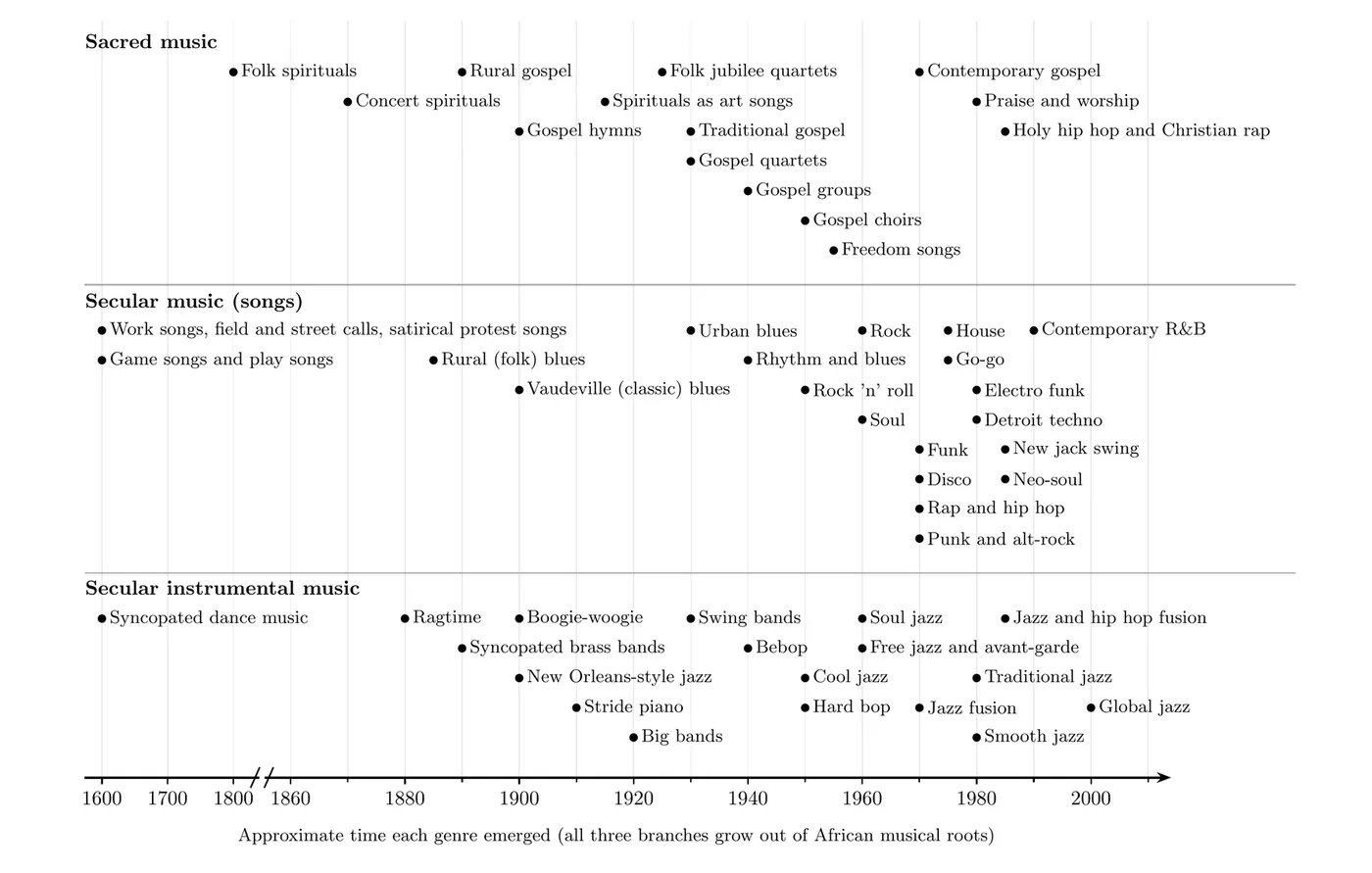
Portia K. Maultsby, an ethnomusicologist (a scholar who studies music in its cultural context) at Indiana University, created this chart, titled "Timeline of African American Music" (1992; the AP framework lists the source as 1980). At the top is a box for African musical roots, which splits into three branches: sacred genres (spirituals and gospel), secular genres (work songs, field calls, blues, and R&B), and secular instrumental genres (ragtime and the many styles of jazz). A timeline down the left side runs from the 1600s to the 2000s, and lines connect each genre to the ones it shaped, with one kind of line for direct influences and another for cross influences. Following the lines, you can trace how spirituals and work songs led to the blues and gospel, how those fed into R&B, rock 'n' roll, and soul, and how later styles like funk and rap/hip-hop grew out of them. The chart is evidence for this topic's main claims: African-based elements run through every genre, and African American music shaped American and global music. One limitation: a chart like this simplifies, since real musicians borrowed across many styles at once.
"Breakdancers in New York," 1984
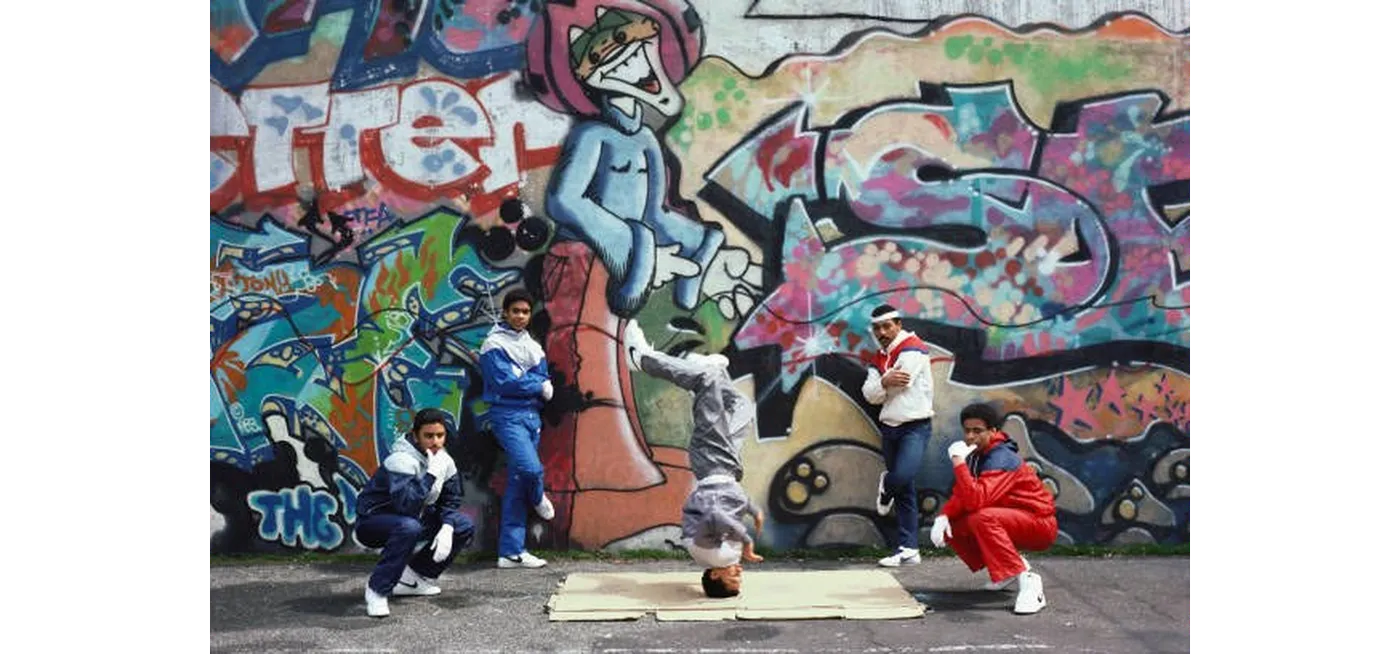
This photograph, from the Michael Ochs Archives, shows breakdancers performing in Brooklyn, New York, in April 1984, about a decade after hip-hop began in the Bronx. By then, breaking had spread across the city and was starting to appear in movies and on TV around the world. The dancers' spins, freezes, and footwork are the moves that DJs' extended "breaks" made room for, so the photo links the music on the turntables to the dance culture that grew up around it.