

4.11 - The Black Panther Party for Self-Defense
Origins and Political Goals
The Black Panther Party for Self-Defense was a revolutionary Black Power organization directly inspired by Malcolm X's arguments and ideas. It was founded by college students Bobby Seale and Huey P. Newton in Oakland, California, formed in the wake of Malcolm X's assassination, the brutality nonviolent protesters had endured, and ongoing police killings of unarmed African Americans. The party operated from 1966 through the 1980s.
The party's Ten-Point Program laid out its core political demands: freedom from oppression and imprisonment, and real access to housing, healthcare, education, and employment opportunities. This wasn't a vague call for equality, it was a specific, itemized platform addressing the concrete conditions Black communities faced daily.
Self-Defense and Federal Response
The Black Panthers' platform explicitly cited the Second Amendment to justify and promote the right to bear arms in self-defense, a direct extension of the philosophy Malcolm X had articulated years earlier. The party's calls for violent resistance to oppression, when necessary, led to real armed conflicts between Panthers and law enforcement. In response, the FBI waged a sustained campaign against the Black Panthers, treating the organization as a threat to national security and actively working to undermine and dismantle it.
The Panthers first became known for armed patrols in Oakland. Members legally carried loaded guns and law books, followed police cars, and watched arrests from a short distance to make sure officers respected Black residents' rights. When California lawmakers moved to ban carrying loaded guns in public, armed Panthers protested at the state capitol in Sacramento in May 1967, which made national news. The ban (the Mulford Act) passed anyway.
The FBI's secret counterintelligence program, COINTELPRO, used informants, wiretaps, and fake letters to spread distrust inside the party and turn it against other groups. In 1969, FBI director J. Edgar Hoover called the Panthers the greatest threat to the country's internal security. That December, Chicago police, using a floor plan from an FBI informant, raided an apartment and killed Fred Hampton, the 21-year-old leader of the Illinois chapter, in his bed.
Community Organizing and Women's Leadership
Local Black Panther offices were frequently led by women, who made up roughly half of the party's overall membership, a detail that complicates the common perception of the Panthers as a purely male-led, militant organization. The party expanded rapidly, establishing chapters in dozens of U.S. cities, and used that growing infrastructure to advocate for a broader range of social reforms beyond just self-defense.
Kathleen Cleaver, the party's communications secretary, was the first woman on its Central Committee, and Elaine Brown led the entire party as chair from 1974 to 1977. Women ran many of the community programs, even though they also faced sexism inside the organization.
Much of this work took shape through what the Panthers called "survival programs," practical initiatives designed to directly support low-income communities. These included the Free Breakfast for School Children Program, legal aid offices, and relief programs offering free medical care and clothing. These programs reveal a side of the Black Panther Party that often gets overshadowed by its more publicized confrontations with police, a genuine, sustained commitment to grassroots community welfare and mutual aid.
The Free Breakfast for School Children Program started in Oakland in 1969 and spread to dozens of cities, feeding thousands of children every morning before school.
Required Sources
The Black Panther Party's Ten-Point Program, 1966
Huey P. Newton and Bobby Seale wrote the Ten-Point Program, titled "What We Want, What We Believe," when they founded the party in October 1966. Each point states a demand and then the belief behind it. The demands include freedom and the power to decide the future of the Black community, full employment, decent housing, an education that teaches Black people's true history, an end to police brutality and the killing of Black people, freedom for Black men held in prisons, and trials by juries of their peers. The last point sums it up: land, bread, housing, education, clothing, justice, and peace. The point on police brutality cites the Second Amendment to justify armed self-defense, and a revised version in the early 1970s added a demand for free health care. The program shows that the party's goals were political, economic, and social, and went well beyond self-defense.
Huey P. Newton and Bobby Seale, "What We Want, What We Believe," the Black Panther Party's Ten-Point Platform and Program, October 15, 1966 (printed in The Black Panther, May 15, 1967)
We want freedom. We want power to determine the destiny of our Black Community.
Newton and Seale wrote the program when they founded the party in Oakland. Each of the ten points pairs a demand with the belief behind it, from full employment, decent housing, and an education that teaches Black people's true history to an end to police brutality and fair trials. The CED includes it because it shows that the party's goals were political, economic, and social, not only armed self-defense.
Black Panther Party, Ten-Point Program (1966). Source: HBCU History and Culture Access Consortium, Margaret Walker Center, Jackson State University (scan)
Black Panther Women in Oakland, CA, 1968
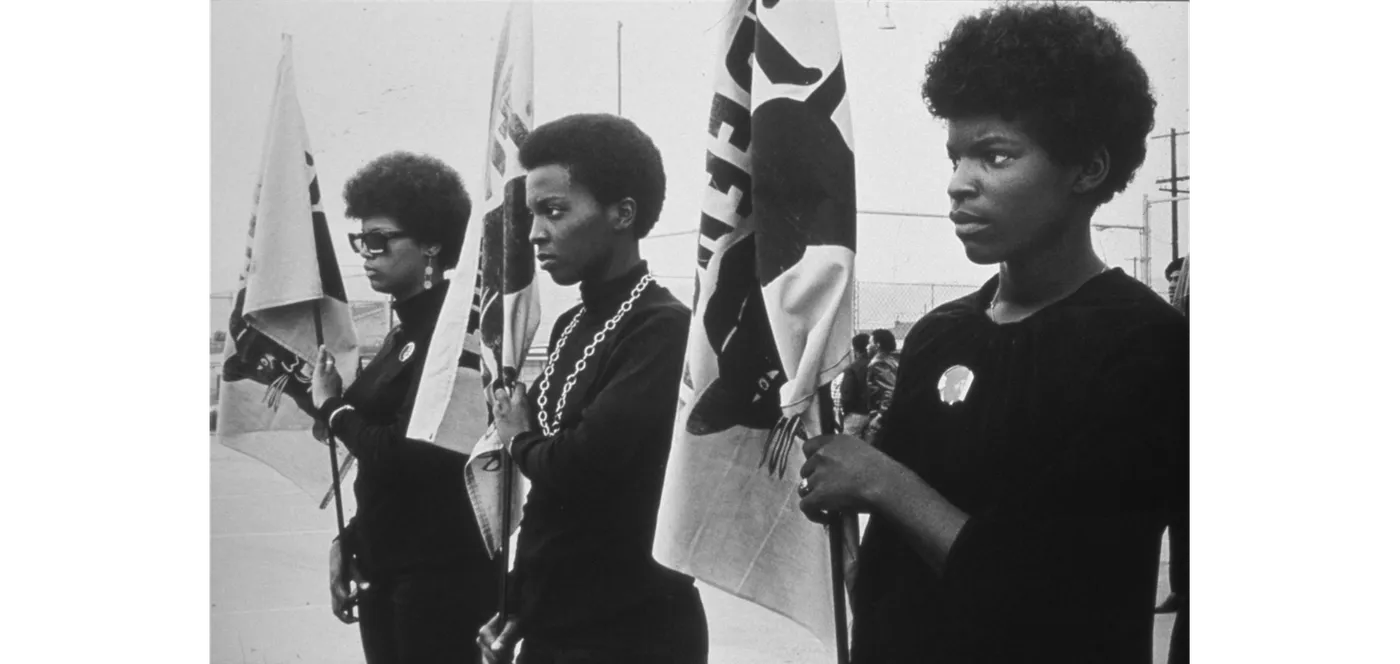
This photograph puts faces to the fact that women made up about half of the party's membership and frequently led local offices. Seeing Black Panther women directly represented pushes back against a narrower, male-centered popular image of the organization, highlighting their real leadership role within it.
Black Panther Free Food Program, 1972
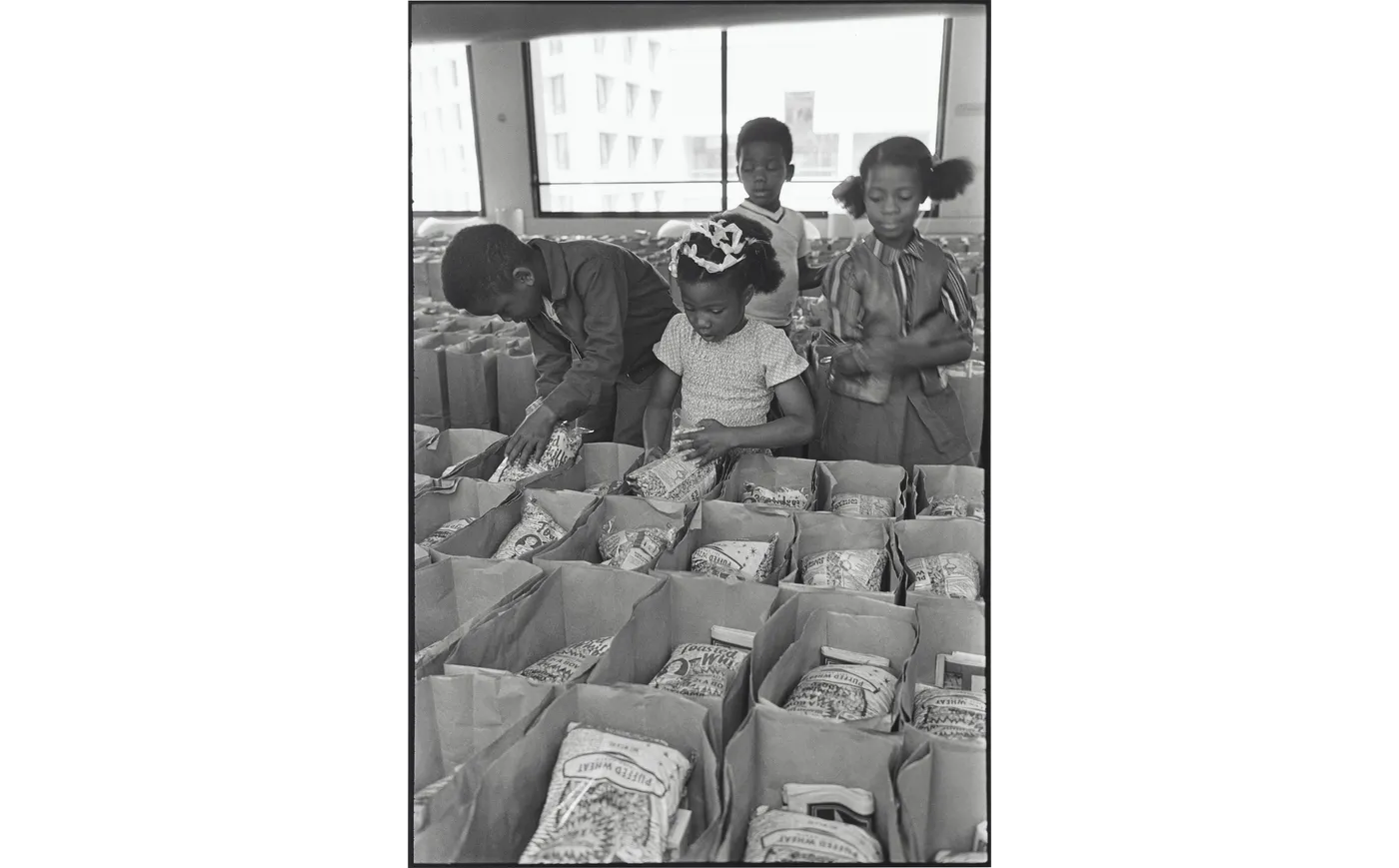
This photograph documents one of the party's survival programs directly in action, providing free food to community members in need. It offers a clear visual counterpoint to the more militant imagery often associated with the Panthers, showing the day-to-day community service work that made up a substantial part of the organization's actual activity.