

4.6 - Major Civil Rights Organizations
The "Big Four" and Their Shared Methods
Major civil rights organizations brought together African Americans with very different experiences and perspectives, united by a shared goal: ending racial discrimination and inequality. Four organizations in particular became so central to the movement that they're often referred to as the "Big Four."
The NAACP (National Association for the Advancement of Colored People) was founded in 1909 as an interracial organization, fighting discrimination and racial violence primarily through legal campaigns rather than direct protest. Its founders included W.E.B. Du Bois and Ida B. Wells-Barnett. Rosa Parks, before she became a household name, actually served as a local NAACP secretary, and it was in that role that she helped launch the Montgomery Bus Boycott in 1955.
CORE (the Congress of Racial Equality) was established in 1942 by Black and white students in Chicago. CORE worked alongside other organizations to organize sit-ins, voter registration drives, and the 1961 Freedom Rides, embodying the movement's interracial, direct-action approach from very early on.
The SCLC (Southern Christian Leadership Conference) was established in 1957, with Martin Luther King Jr. serving as its first president. The SCLC coordinated the actions of churches and local organizations to launch major, large-scale protests, including the 1965 Selma Voting Rights March.
SNCC (the Student Nonviolent Coordinating Committee) was founded in 1960, when Ella Baker helped students who were already involved with SCLC activism form their own independent organization, following their experience organizing the Greensboro sit-ins. SNCC primarily focused on nonviolent direct-action protest carried out through grassroots organizing.
Local branches of these organizations built a genuinely national movement grounded in shared methods, nonviolent, direct, and racially inclusive protest, combined with grassroots organizing at the community level. Tactics like marches, sit-ins, litigation, economic boycotts, and the strategic use of mass media were central to the movement's approach. These acts of nonviolent civil disobedience were frequently met with violence, which in some cases prompted a response of self-defense from activists and communities under attack.
Nonviolent Resistance in Action
Civil rights leaders organized the Birmingham Children's Crusade in Alabama in 1963, deliberately including children in the protest strategy because they weren't subject to the same penalties adults faced, like losing a job or a home, for participating. When local police responded to these children with shocking violence, and that violence was broadcast on television, it provoked outrage and shock among Americans and people around the world, turning children's vulnerability into a powerful tool for exposing the brutality of segregation.
In May 1963, Birmingham's commissioner of public safety, Eugene "Bull" Connor, ordered police dogs and high-pressure fire hoses turned on the young marchers and jailed hundreds of them. Within days, Birmingham's business leaders agreed to desegregate lunch counters and hire Black workers, and in June President John F. Kennedy proposed the civil rights bill that became the Civil Rights Act of 1964.
Later that same year, A. Philip Randolph and Bayard Rustin, working alongside an alliance of Black civil rights organizations and leaders from religious and labor groups, organized the March on Washington for Jobs and Freedom. The march highlighted economic inequality, unemployment, and racial discrimination all together, framing civil rights as inseparable from economic justice. It was at this march that Martin Luther King Jr. delivered his iconic "I Have a Dream" speech, calling for an end to discrimination and racism. Notably, SNCC leader John Lewis also spoke that day, using his platform to push for greater urgency around civil rights and the need to protect African Americans from ongoing racial violence. The march itself had faced controversy beforehand due to discrimination against Bayard Rustin, an openly gay advisor to civil rights leaders since the Montgomery Bus Boycott, yet despite this internal tension, the march succeeded as a peaceful protest that drew over 250,000 participants.
In 1964, the Mississippi Freedom Summer project exposed the intense racial violence African Americans faced simply for trying to exercise their constitutional right to vote. As part of this effort, the Big Four organizations established 41 Freedom Schools to prepare African Americans for civic activism through voter registration training and lessons in Black history, building directly on a tradition of community-developed schools for enslaved African Americans dating back to the eighteenth and nineteenth centuries. That same summer, the killing of three young activists, one African American and two Jewish, sent shockwaves through the movement, helping galvanize broader support and directly contributing to the formation of the Mississippi Freedom Democratic Party.
The three activists were James Chaney, a Black Mississippian, and Andrew Goodman and Michael Schwerner, two Jewish New Yorkers. They disappeared in June 1964 near Philadelphia, Mississippi, after looking into the burning of a Black church, and their bodies were found buried in an earthen dam weeks later. Members of the Ku Klux Klan, including a local deputy sheriff, took part in the murders. That August, the Mississippi Freedom Democratic Party challenged the state's all-white delegation at the Democratic National Convention.
Legislative Achievements
The coordinated, sustained pressure of the Civil Rights Movement ultimately produced major federal legislation. The Civil Rights Act of 1964 formally ended segregation and prohibited discrimination based on race, color, and religion. The Voting Rights Act of 1965 followed shortly after, outlawing the discriminatory barriers that had long been used to keep African Americans from voting.
The Civil Rights Act of 1964 also banned job discrimination based on sex and national origin, and it let the federal government cut off funding to segregated schools and programs. The Voting Rights Act passed months after the Selma to Montgomery marches, where state troopers beat peaceful marchers, including John Lewis, on the Edmund Pettus Bridge on "Bloody Sunday" (March 7, 1965). The law suspended literacy tests in the places it covered, sent federal examiners to register voters, and required states and counties with a history of discrimination to get federal approval before changing their voting rules. It worked fast: in Mississippi, Black voter registration rose from about 7 percent in 1964 to about 60 percent by 1967.
Required Sources
"Nonviolence and Racial Justice" by Martin Luther King Jr., 1957
King wrote this essay for the magazine The Christian Century, which published it in February 1957, soon after the Montgomery Bus Boycott ended and as the SCLC was forming. He rejects violence and hatred as a way to fight segregation and lays out what nonviolent resistance means. It is not passive or cowardly, since the resister actively opposes wrong. It aims to win over opponents and build a "beloved community," not to humiliate them. It attacks injustice, not the people caught up in it, so the struggle is between justice and injustice rather than Black and white people. It rejects hatred as well as physical violence, guided by love. And it rests on faith that the universe is on the side of justice, which lets resisters accept suffering without striking back. The essay explains the thinking behind the sit-ins, marches, and boycotts in this topic, drawing on Christian teaching and Gandhi's example.
Martin Luther King Jr., "Nonviolence and Racial Justice," The Christian Century 74, February 6, 1957, pp. 165 to 167
The aftermath of nonviolence is the creation of the beloved community
King wrote this essay for a national Christian magazine just after the Montgomery Bus Boycott. He makes five points about nonviolent resistance: it resists evil instead of giving in, it tries to win over opponents instead of humiliating them, it attacks injustice and not people, it rejects hatred as well as violence, and it trusts that the universe is on the side of justice. The CED includes it as the clearest statement of the thinking behind the sit-ins, marches, and boycotts in this topic.
Martin Luther King Jr., "Nonviolence and Racial Justice" (1957). Source: The King Papers, Martin Luther King, Jr. Research and Education Institute, Stanford University
John Lewis and Colleagues, Prayer Demonstration at a Segregated Swimming Pool, Cairo, Illinois by Danny Lyon, 1962
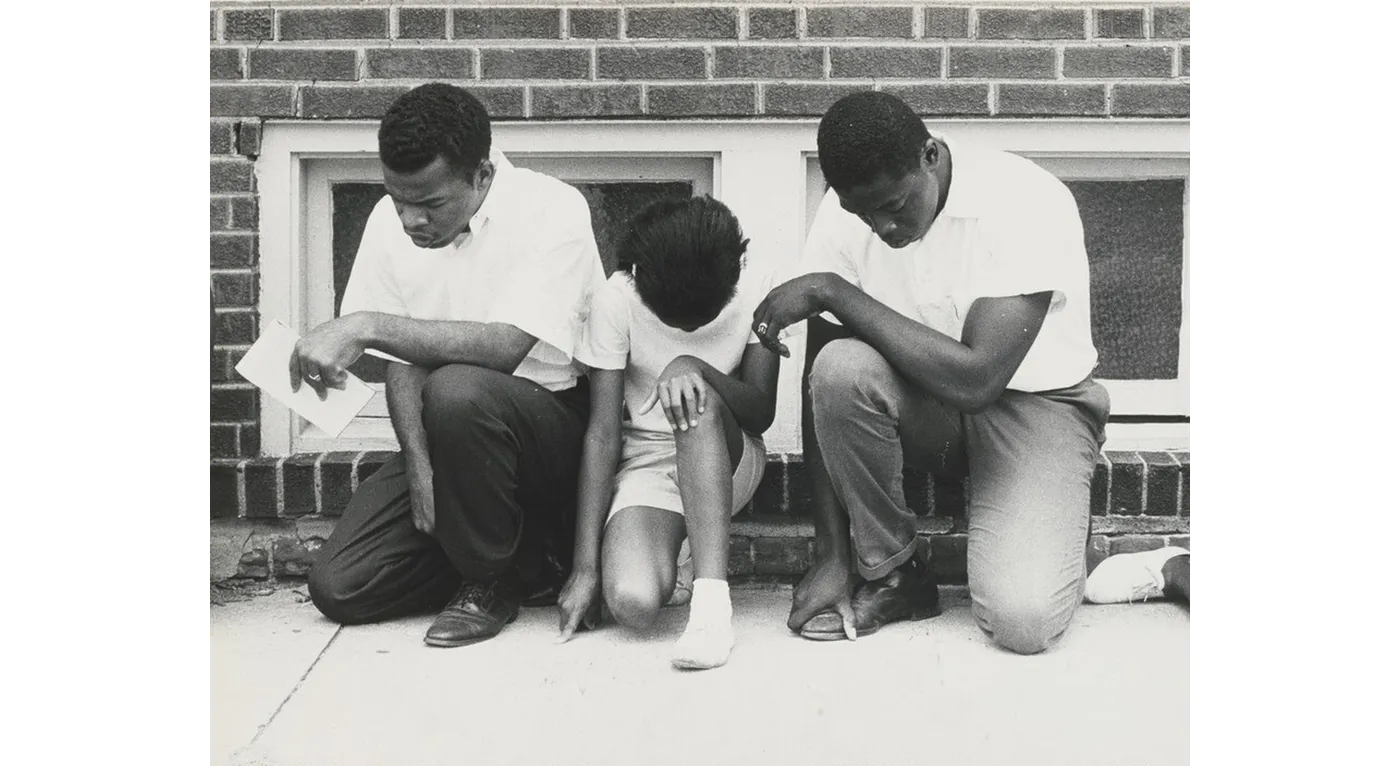
Danny Lyon, a young white photographer who became SNCC's first staff photographer, took this picture in 1962 in Cairo, a town at the southern tip of Illinois. It shows John Lewis and other young activists praying outside a segregated swimming pool. The scene is a clear example of nonviolent direct action: the protesters challenge segregation openly and peacefully, and photos like this were part of the mass media strategy SNCC used to show the country what segregation looked like. It's also a reminder that the movement's tactics played out in ordinary public spaces, and outside the Deep South, not just at famous marches.
"The Revolution Is at Hand" by John Lewis, 1963
John Lewis, the 23-year-old chairman of SNCC, was the youngest speaker at the March on Washington. His original draft, the version known as "The Revolution Is at Hand," was much angrier than most of the day's speeches. It said SNCC could not fully support President Kennedy's civil rights bill because it was "too little and too late" and would not protect Black Southerners from police violence, asked which side the federal government was on, and warned that activists might march through the South the way General Sherman's army had in the Civil War. Other march leaders, worried about losing allies, pushed Lewis to tone it down, and he cut those lines just before speaking. The draft shows the urgency of SNCC's young activists and the tension inside the movement over how hard to push.
John Lewis, "The Revolution Is at Hand," original draft of his speech for the March on Washington, August 28, 1963
I want to know, which side is the federal government on?
Lewis, the 23-year-old chairman of SNCC, wrote this draft for the March on Washington. It says SNCC can't fully back the Kennedy civil rights bill because it does too little, too late, accuses the federal government of failing to protect Black Southerners, and warns that activists may march through the South like Sherman's army. March leaders pushed him to cut the angriest lines before he spoke, and the CED includes the draft to show the urgency of young activists and the arguments inside the movement.
John Lewis, "The Revolution Is at Hand" (1963 draft). Source: SNCC Digital Gateway, SNCC Legacy Project and Duke University