

4.4 - Discrimination, Segregation, and the Origins of the Civil Rights Movement
Everyday Segregation Through the Mid-Twentieth Century
Well into the mid-twentieth century, African Americans in both the North and South continued to face persistent racial discrimination, violence, and segregation across nearly every part of daily life: education, housing, transportation, and voting all remained deeply unequal. The Civil Rights Movement grew directly out of the need to eliminate this segregation and to secure real federal protection for rights that had already been promised on paper, both by the Reconstruction Amendments and by the Civil Rights Act of 1875, which outlawed racial discrimination in public places. The Supreme Court struck down that ban in the Civil Rights Cases (1883), and Southern states found ways around the Reconstruction Amendments for decades.
The Brown v. Board of Education Decision
In 1954, the Supreme Court ruled that racial segregation in public schools was unconstitutional in its landmark Brown v. Board of Education decision. The Court determined that state-sanctioned school segregation violated the equal protection clause of the Fourteenth Amendment, directly overturning the "separate but equal" doctrine that had been established decades earlier in Plessy v. Ferguson.
Brown wasn't a single, isolated case. The Supreme Court combined school segregation cases from Kansas (Brown v. Board of Education), South Carolina (Briggs v. Elliott), Virginia (Davis v. County School Board), and Delaware (Belton v. Gebhart), and it decided a fifth case from Washington, D.C. (Bolling v. Sharpe) the same day. Because D.C. is federal territory, that ruling rested on the Fifth Amendment instead of the Fourteenth. NAACP lawyers led by Thurgood Marshall argued the cases, and together the five rulings ended "separate but equal" as a legal standard in public education.
One particularly influential piece of evidence in the Court's decision came from psychology rather than law. The Supreme Court specifically cited the "doll test," conducted by psychologists Mamie and Kenneth Clark in the 1940s, as a key factor in reaching its decision. This study demonstrated the real, measurable psychological harm that racial segregation caused to children's self-esteem, giving the Court concrete evidence that segregation caused genuine, documented harm, not just theoretical inequality.
Here's how the test worked. The Clarks showed Black children, most between about three and seven years old, two dolls that were identical except for skin color. They asked which doll the child wanted to play with, which one was "nice," which one looked "bad," and which one looked like them. Most of the children preferred the white doll and called it "nice," and many called the Black doll "bad." The Clarks argued this showed that segregation was teaching Black children to see themselves as inferior. Kenneth Clark testified about this research in the school cases, and the Court cited his work in a footnote to the Brown opinion.
Resistance to Integration
Despite the ruling, real integration didn't follow automatically, de facto segregation in public schools persisted for years afterward. Some states responded by cutting funding to newly integrated schools while continuing to financially support schools that remained predominantly white. Many white families responded by fleeing to the suburbs or enrolling their children in private schools instead, effectively shifting their investment into schools and neighborhoods that remained largely inaccessible to African American families. In some places, governors and local officials used police and state National Guard troops to block integration (federal troops and marshals were sometimes sent in to enforce it), and some schools chose to shut down entirely rather than integrate. Prince Edward County, Virginia, home of one of the five Brown cases, closed all of its public schools from 1959 to 1964.
There was also a quieter, less visible cost to this resistance: as a direct result of the Brown decision, many Black teachers in the South actually lost their jobs, with their positions routinely handed over to white teachers, often ones with considerably less experience, a bitter irony given that the ruling was meant to expand opportunity for Black students and educators alike.
Despite this widespread resistance, students at every age level pushed forward with integration efforts throughout the South. The "Little Rock Nine" are one of the best-known examples. In 1957, nine Black students enrolled at Little Rock Central High School in Arkansas. Governor Orval Faubus used the Arkansas National Guard to keep them out and white mobs gathered outside the school, until President Dwight Eisenhower sent the Army's 101st Airborne Division to escort the students inside. They faced harassment all year, but they stayed.
Required Sources
Clark Doll Test, Harlem by Gordon Parks, 1947
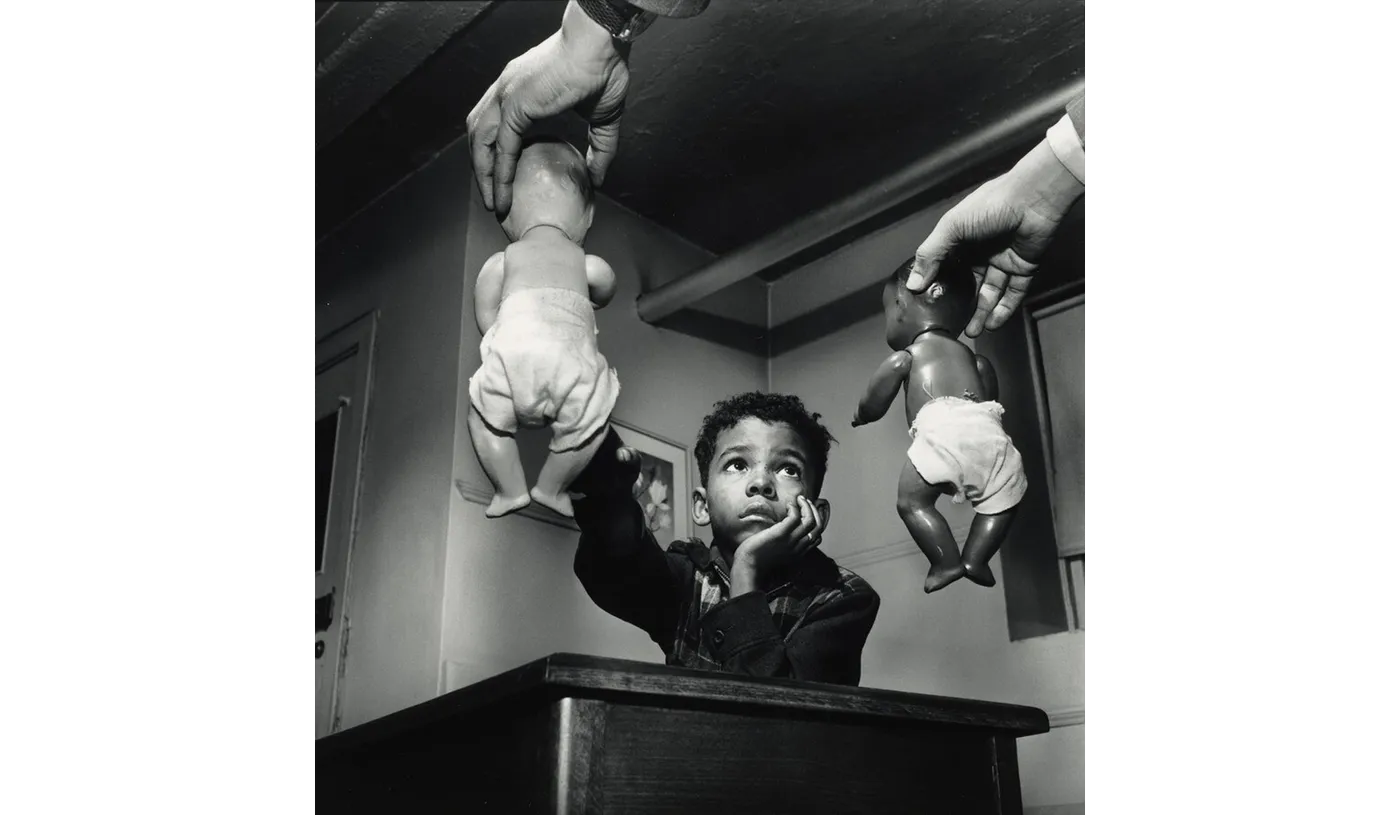
This photograph documents the actual doll test being conducted, the same study that would go on to directly influence the Supreme Court's reasoning in Brown v. Board of Education years later. Seeing the test in progress helps make the study's real-world methodology concrete, showing how researchers actually gathered the evidence that would later carry so much legal weight.
Kenneth Clark and Child During the Clark Doll Test, Harlem by Gordon Parks, 1947
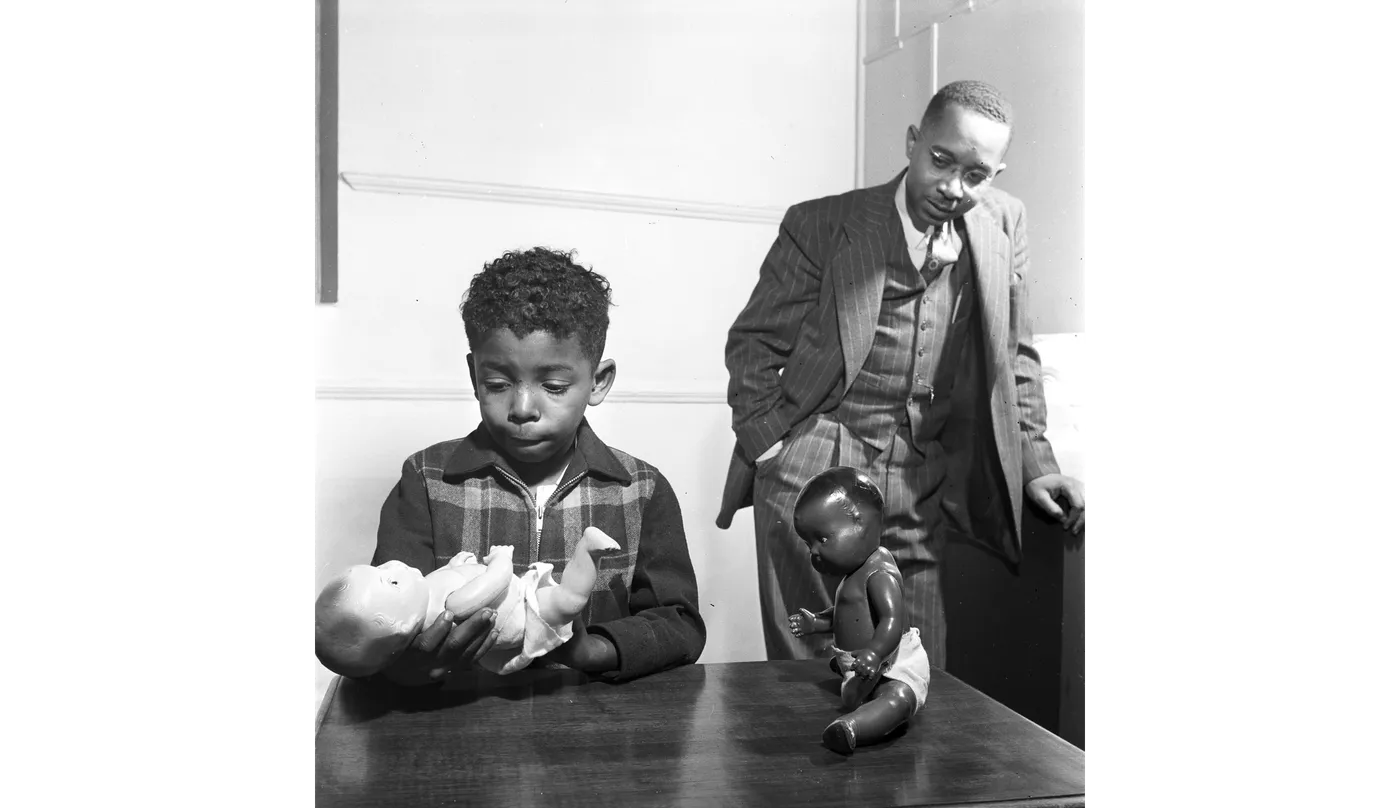
This photograph shows Kenneth Clark himself directly engaging with a child participant, putting a human face on both the researcher and the child whose responses would help shape one of the most consequential legal decisions in American history.
Brown v. Board of Education of Topeka, Opinion, May 17, 1954
Chief Justice Earl Warren wrote this opinion for a unanimous Court (9 to 0) on May 17, 1954. Warren asks whether segregating children in public schools by race, even when buildings, teachers, and other "tangible" factors are equal, deprives Black children of equal educational opportunity, and the Court answers yes. He writes that separating children by race "generates a feeling of inferiority" that may affect them for life, citing psychological research such as the Clarks' in a footnote, and concludes that "Separate educational facilities are inherently unequal." That violates the Fourteenth Amendment's equal protection clause. The opinion is the main evidence for this topic's question of why the Court rejected Plessy's "separate but equal" rule.
We come then to the question presented: Does segregation of children in public schools solely on the basis of race, even though the physical facilities and other "tangible" factors may be equal, deprive the children of the minority group of equal educational opportunities? We believe that it does.
In Sweatt v. Painter, supra, in finding that a segregated law school for Negroes could not provide them equal educational opportunities, this Court relied in large part on "those qualities which are incapable of objective measurement but which make for greatness in a law school." In McLaurin v. Oklahoma State Regents, supra, the Court, in requiring that a Negro admitted to a white graduate school be treated like all other students, again resorted to intangible considerations: ". . . his ability to study, to engage in discussions and exchange views with other students, and, in general, to learn his profession." Such considerations apply with added force to children in grade and high schools. To separate them from others of similar age and qualifications solely because of their race generates a feeling of inferiority as to their status in the community that may affect their hearts and minds in a way unlikely ever to be undone. The effect of this separation on their educational opportunities was well stated by a finding in the Kansas case by a court which nevertheless felt compelled to rule against the Negro plaintiffs:
"Segregation of white and colored children in public schools has a detrimental effect upon the colored children. The impact is greater when it has the sanction of the law; for the policy of separating the races is usually interpreted as denoting the inferiority of the negro group. A sense of inferiority affects the motivation of a child to learn. Segregation with the sanction of law, therefore, has a tendency to [retard] the educational and mental development of negro children and to deprive them of some of the benefits they would receive in a racial[ly] integrated school system."
Whatever may have been the extent of psychological knowledge at the time of Plessy v. Ferguson, this finding is amply supported by modern authority. Any language in Plessy v. Ferguson contrary to this finding is rejected.
We conclude that in the field of public education the doctrine of "separate but equal" has no place. Separate educational facilities are inherently unequal. Therefore, we hold that the plaintiffs and others similarly situated for whom the actions have been brought are, by reason of the segregation complained of, deprived of the equal protection of the laws guaranteed by the Fourteenth Amendment. This disposition makes unnecessary any discussion whether such segregation also violates the Due Process Clause of the Fourteenth Amendment.
Chief Justice Earl Warren for a unanimous Supreme Court, Brown v. Board of Education of Topeka, Opinion of the Court (1954). Source: United States Reports, vol. 347, pp. 493 to 495 (347 U.S. 483), Library of Congress (footnotes omitted; public domain).