4.16 - Demographic and Religious Diversity in Contemporary Black Communities
Growth and Diversity Since 2000
The African American population has grown significantly and become considerably more diverse since the turn of the century. One clear marker of progress: the number of Black college degree holders has more than doubled since 2000, reflecting expanded access to higher education in the decades following desegregation.
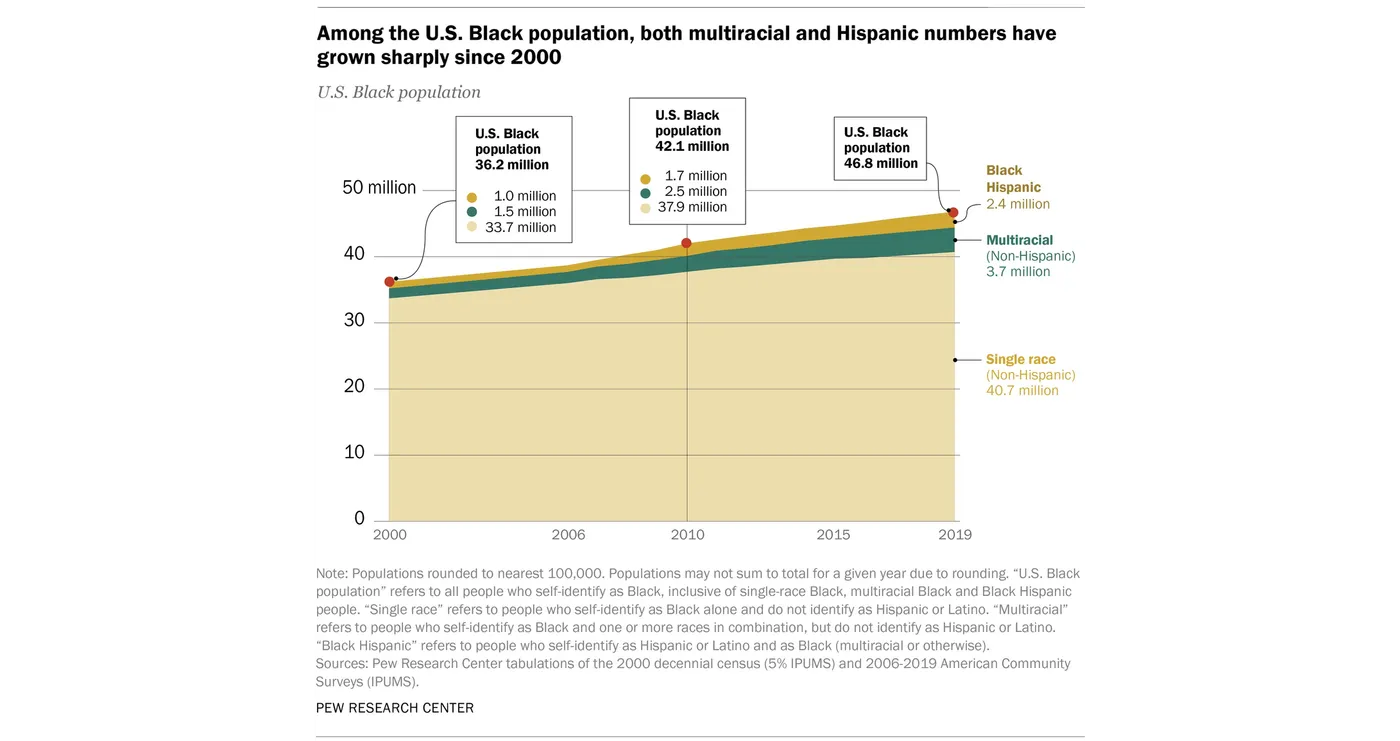
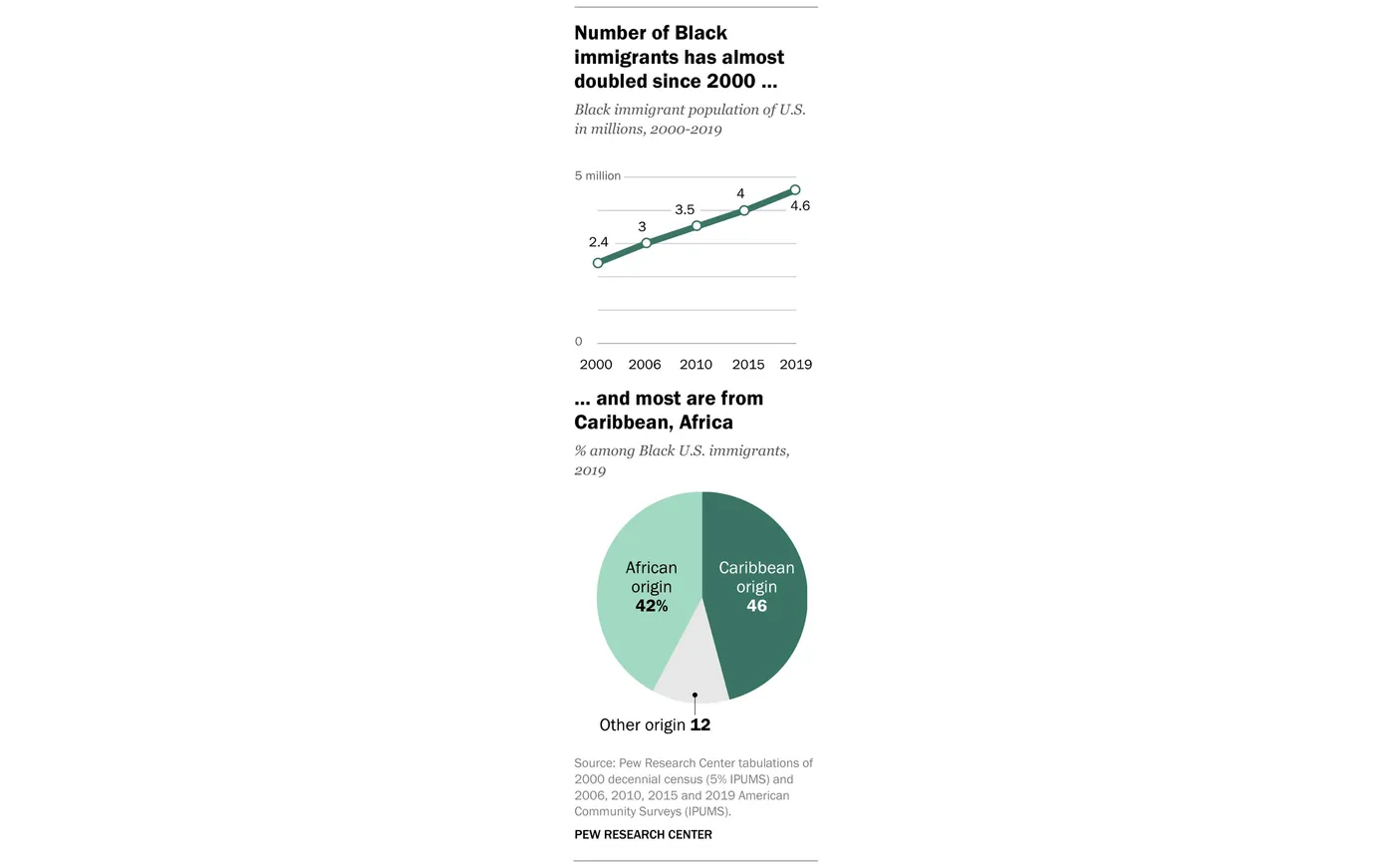
Immigration has also reshaped the composition of Black America. The number of Black immigrants in the United States has nearly doubled since 2000, driven primarily by immigrants coming from Africa and the Caribbean. As the overall Black population has grown, so has the number of people within it who identify as both Black and Hispanic, or as otherwise multiracial, reflecting a Black American population that's increasingly diverse not just in national origin, but in how people understand and describe their own identity.
The scale of this growth is substantial. Between 2000 and 2019, the Black-identifying population in the United States grew by 30 percent, reaching approximately 47 million people, nearly 14 percent of the entire U.S. population. This growth reflects both natural population increase and the rising number of Black immigrants arriving from around the world, making today's Black American population meaningfully different in composition from earlier generations.
Because Black America is so diverse, the word Black works as a unifying term: it points to a shared African heritage and shared experiences, while leaving room for many different identities. Descendants of people enslaved in the United States may call themselves African American. Recent immigrants may identify by race and nationality, such as Afro-Colombian or Haitian American. Multiracial people may identify with significant Black and white (or other) ancestry. All of them are part of Black communities in the United States.
Religion and Faith in Black Communities
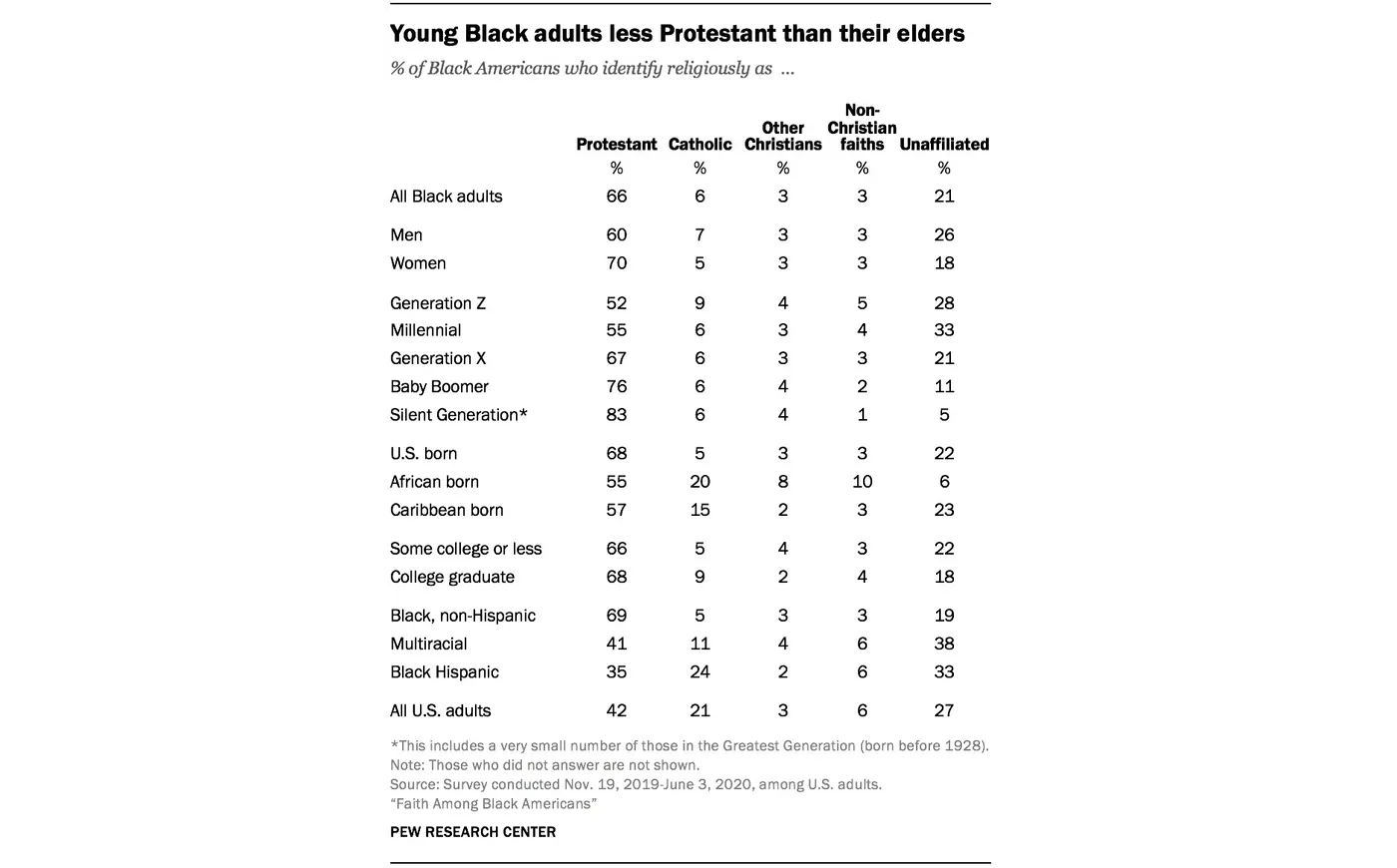
Religion has long been central to Black community life, and it is changing too. In the early twenty-first century, about two-thirds of African American adults identify as Protestant, while about 20 percent do not affiliate with any religion. Younger Black adults are less religious than their elders: according to the Pew Research Center (2021), only about half of Black Gen Z adults identify as Protestant, compared with about three-quarters of Black Baby Boomers, and younger adults are more likely to be unaffiliated.
Black religious leaders and faith communities have played major roles in civil rights and social justice advocacy by mobilizing their congregations. Churches hosted mass meetings, trained activists, and raised money during the Civil Rights Movement, and ministers like Martin Luther King Jr. led organizations such as the SCLC. Their activism has often reached beyond issues that directly affect Black communities. King spoke out against the Vietnam War in 1967 and planned the Poor People's Campaign for poor Americans of every race, and Philadelphia minister Leon Sullivan wrote the Sullivan Principles (1977), a code that pushed American companies doing business in apartheid South Africa to treat Black workers fairly.
The Black church has also been an institutional home where communities develop and debate their core values. Churches founded schools and colleges, ran Sunday schools and literacy classes, organized mutual aid and community improvement projects, and gave people a place to argue about race relations and strategy. They shaped Black cultural practices and vernacular (the language of sermons, gospel music, and call and response), and denominations like the African Methodist Episcopal (AME) Church, founded by Richard Allen in Philadelphia in 1816, built congregations in Africa, linking Black Americans to the broader diaspora.
Required Sources
"The Growing Diversity of Black America" by Christine Tamir, Pew Research Center, 2021
Christine Tamir, a researcher at the Pew Research Center, published this report in March 2021 using U.S. Census Bureau data. Its main findings: the Black population grew from about 36.2 million in 2000 to 46.8 million in 2019 (about 14 percent of the country); the number of Black immigrants rose from 2.4 million to 4.6 million, mostly from the Caribbean and Africa; by 2019 about 8 percent of Black Americans were multiracial and 5 percent were Black Hispanic; and the number of Black adults with at least a bachelor's degree more than doubled, from about 3 million (15 percent) to 6.7 million (23 percent). These numbers are the evidence behind the trends in this topic.
"Young Black Adults Less Protestant than Their Elders," Pew Research Center, 2021
This chart comes from the Pew Research Center's February 2021 report Faith Among Black Americans, based on a large survey of Black adults. The survey found that 66 percent of Black adults are Protestant, about 6 percent are Catholic, and 21 percent are religiously unaffiliated. The chart compares generations: about three-quarters of Black Baby Boomers identify as Protestant, but only about half of Black Gen Z adults do, and younger Black adults are more likely to have no religion. The report also found that about half of Black Protestants attend a Black church (one where most of the congregation and clergy are Black). Religion remains central in Black communities, but it is becoming more varied from one generation to the next.