

4.5 - Redlining and Housing Discrimination
Structural Barriers to Black Homeownership
Throughout the twentieth century, African Americans faced deliberate restrictions on their ability to own homes, restrictions that had lasting consequences for their ability to pass wealth down to future generations. Homeownership has always been one of the primary ways American families build and transfer generational wealth, so blocking access to it didn't just limit individuals, it limited entire family lines for decades to come.
This kind of housing segregation wasn't informal or incidental, it was actually written directly into federal policy. The Federal Housing Administration's Underwriting Manual of 1938 codified housing segregation, making it effectively illegal for African Americans to live in many communities across the country. It took decades of organized effort, including the NAACP's sustained fight against housing discrimination, to finally secure the passage of the Fair Housing Act in 1968.
In practice, the FHA (created in 1934) insured home loans, which made banks willing to lend. But its Underwriting Manual told appraisers that a neighborhood stayed stable only if it kept the same "racial classes," warned against "inharmonious racial groups," and recommended racially restrictive covenants (clauses in property deeds that banned selling or renting a home to Black families). So the federal government helped build the suburbs while keeping most Black families out of them. The Fair Housing Act of 1968, passed one week after Martin Luther King Jr.'s assassination, banned discrimination in the sale, rental, and financing of housing based on race, color, religion, or national origin.
At the center of this system was redlining, the discriminatory practice mortgage lenders used throughout the twentieth century, peaking around the mid-1900s, of withholding mortgages from African Americans and other people of color within specific geographic areas. This was done under the pretense that these communities posed a "hazardous" financial risk, a justification that had nothing to do with individual creditworthiness and everything to do with race.
The name comes from the color-coded maps the federal Home Owners' Loan Corporation (HOLC) drew for more than 200 cities in the late 1930s. Neighborhoods were graded from A (green, "best") to D (red, "hazardous"), and neighborhoods with Black residents were almost always shaded red. Grades like these shaped where banks and the FHA would lend, so Black neighborhoods were starved of mortgages and investment no matter how well residents kept up their homes.
Even when African Americans managed to move into well-resourced neighborhoods despite these barriers, integration itself often came at a real physical cost. Families who integrated into these communities sometimes became direct targets of mob violence, a stark reminder that housing discrimination wasn't limited to paperwork and lending policy, it was enforced through intimidation and violence as well.
One example: in 1951, when Harvey Clark, a Black bus driver and World War II veteran, tried to move his family into an apartment in Cicero, Illinois, an all-white suburb of Chicago, a mob of thousands attacked the building and burned the family's belongings, and the governor had to send in the National Guard.
The Long-Term Consequences
Housing discrimination didn't just limit where African Americans could live, it deepened and hardened existing disparities between Black and white Americans more broadly. Many African American communities ended up with limited access to public transportation, clean water and air, recreational spaces, healthy food, and healthcare services, a combination of deprivations that directly worsened health outcomes and widened racial health disparities that persist even today.
Transportation access was a particularly clear example of this inequality. Predominantly Black areas often lacked adequate public transportation infrastructure, and even where transportation existed, racial segregation kept it unequal. In response, African Americans found ways to build their own solutions, operating jitneys, small buses that functioned as informal taxi services, and in some cases starting their own bus companies entirely, creating transportation infrastructure that the broader system refused to provide.
Required Sources
Home Owners' Loan Corporation "Residential Security" Map of Philadelphia and Camden, 1937
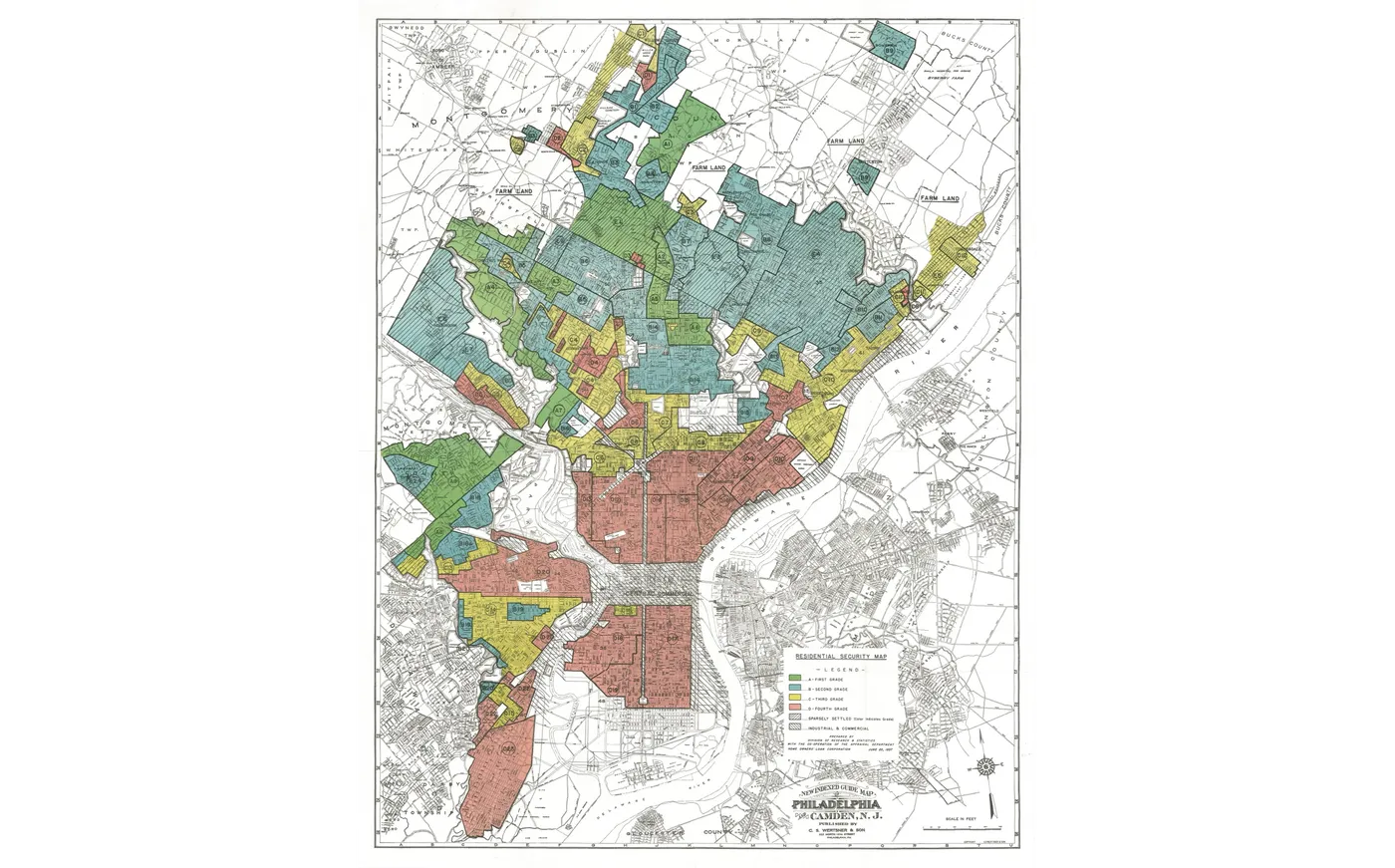
This HOLC map of Philadelphia and Camden, New Jersey, dates from 1937. Like every HOLC map, it colors each neighborhood by its grade, from green (A) to red (D). HOLC appraisers routinely marked neighborhoods red because Black families (or immigrant and working-class families) lived there, not because of the condition of the homes. The map makes redlining visible, showing exactly which communities were cut off from mortgages and, over time, from the chance to build wealth through owning a home.
Excerpt from A Raisin in the Sun by Lorraine Hansberry, 1959
Lorraine Hansberry's A Raisin in the Sun opened on Broadway in 1959, making her the first Black woman to have a play produced there. It follows the Younger family, who share a cramped apartment on Chicago's South Side. When the family receives a $10,000 life insurance check, the mother, Lena Younger, uses part of it to buy a house in Clybourne Park, an all-white neighborhood. Karl Lindner, from the neighborhood's "improvement association," then offers to buy the house back so the family won't move in, and the family has to decide whether to take the money. Hansberry drew on her own life: in 1937 her family bought a house in a white Chicago neighborhood, faced a violent mob, and took their fight against the area's restrictive covenant to the Supreme Court (Hansberry v. Lee, 1940). The play's title comes from Langston Hughes's poem "Harlem," which asks what happens to a dream deferred. The Youngers' dream of owning a home is exactly what redlining and restrictive covenants were designed to block.
Lorraine Hansberry, A Raisin in the Sun (play, first staged on Broadway in 1959; published by Random House, 1959)
The play follows the Younger family in their crowded apartment on Chicago's South Side. When Lena Younger uses part of a $10,000 insurance check to buy a house in Clybourne Park, an all-white neighborhood, a man from the neighborhood's improvement association offers to buy the house back so the family won't move in. The CED includes it because the family's choice shows how housing discrimination, the subject of this topic, stood between Black families and the dream of owning a home. The CED doesn't name a scene, so the most useful part to read is Karl Lindner's visit and the family's answer to his offer.
Lorraine Hansberry, A Raisin in the Sun (1959). Source: Penguin Random House (Vintage edition)