

2.7 - Forgetting and Other Memory Challenges
Forgetting: Why We Can't Remember
- Encoding Failure: The information never got into memory in the first place due to lack of attention or interference.
- Example: You've seen a penny thousands of times, but most people can't draw one correctly from memory, because they never paid attention to the details in the first place.
- Storage Decay: Memories fade over time if not used.
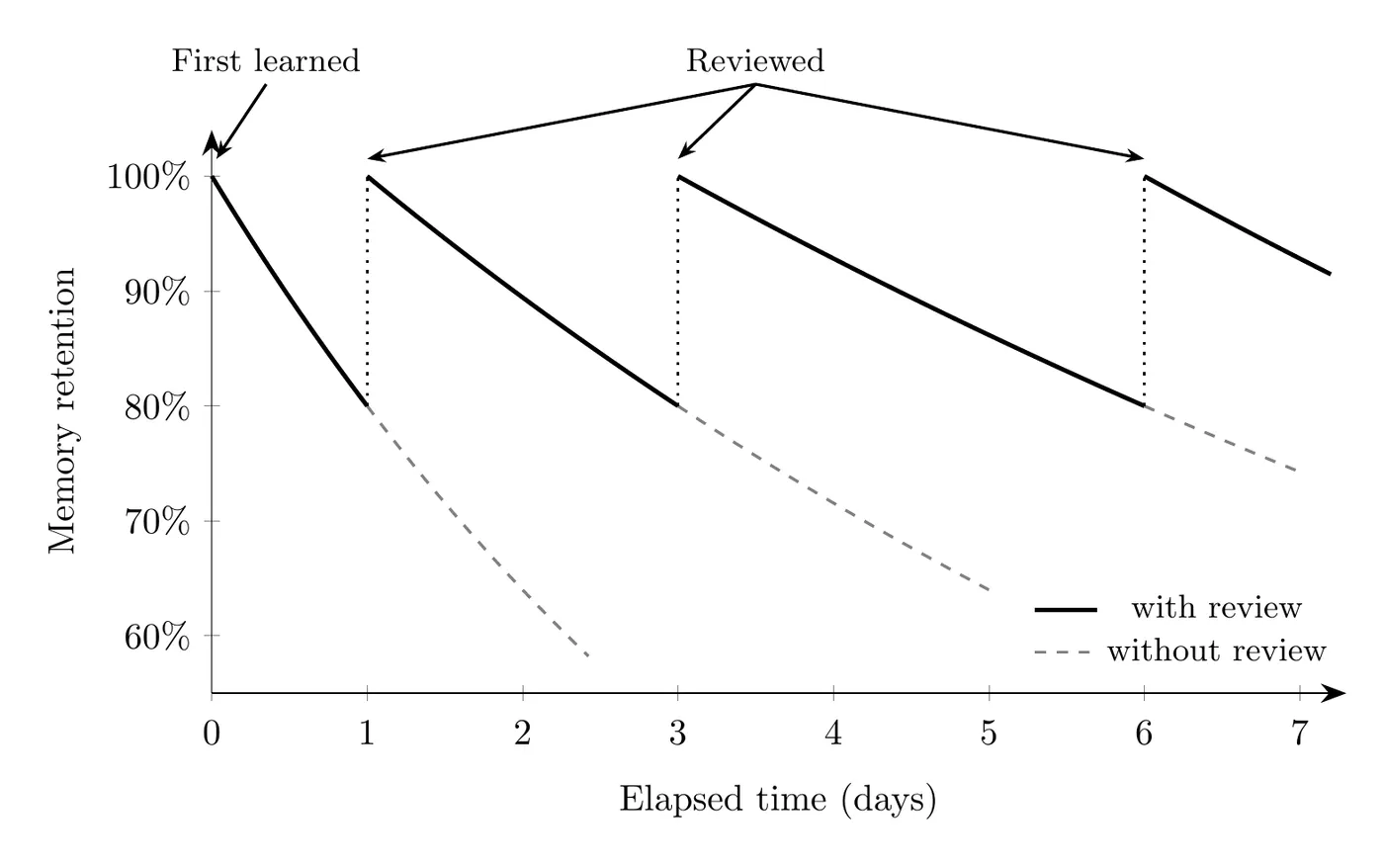
Ebbinghaus' Forgetting Curve
Shows a rapid initial decline in memory, followed by a slower rate of forgetting over time.
Hermann Ebbinghaus found this by memorizing lists of nonsense syllables (like JIH and BAZ) and testing himself after different delays. Much of the forgetting happened within the first hour, and after that it slowed down a lot. Reviewing the material brings retention back up and makes the next drop smaller (see the graph).
- Retrieval Failure: The information is stored in memory, but you can't access it.
- The tip-of-the-tongue phenomenon (2.6) is a classic retrieval failure. A cue like the word's first letter often brings it right back, which shows the memory was stored all along.
Interference: When Memories Collide
- Proactive Interference: Older memories interfere with remembering new information.
- Example: Your old locker combination keeps popping into your head when you try to remember your new one. Memory trick: proactive works forward (old blocks new).
- Retroactive Interference: New information interferes with remembering old information.
- Example: After learning Spanish this year, you have trouble remembering the French words you learned last year. Memory trick: retroactive works backward (new blocks old).
Forgetting and Memory Distortion
- Sleep and Memory: Sleep helps prevent retroactive interference, improving memory consolidation. Tip: Study before bed!
- Motivated Forgetting (Freud): We may unconsciously forget things we don't want to remember.
- Repression (Freud): Pushing anxiety-provoking thoughts and memories into the unconscious mind.
- Psychodynamic theorists see repression as a defense mechanism that protects the ego from distress (more in Unit 4). Many memory researchers doubt it happens often, since people usually remember traumatic events all too well.
- Suppression: Consciously trying to forget something.
- Mass Practice (Cramming): Studying for long periods without breaks. Less effective for long-term retention than spaced practice.
Other Important Concepts
- Source Monitoring: Remembering where you learned information.
Memory Construction and Errors
- Misinformation Effect: Incorporating misleading information into one's memory of an event. Example: Witnesses to a car accident might misremember details after hearing others' accounts.
- Loftus and Palmer (1974): People watched a film of a car crash and were asked how fast the cars were going when they "smashed into" or "hit" each other. The "smashed" group gave higher speed estimates, and a week later they were more likely to say they had seen broken glass, even though there was none.
- Source Amnesia (Misattribution): Remembering information but forgetting where it came from.
- False Memories (Elizabeth Loftus): Memories can be implanted or created through suggestion. Basically, memories of events that never actually happened, often created through suggestion or imagination.
- Constructive Memory: Memories aren't recordings. Each time we store or recall a memory, we rebuild it from pieces, and new information can get mixed in. Two ways this happens:
- Memory Consolidation: A memory is fragile while it's being consolidated (stabilized into long-term storage), and it becomes changeable again each time it's recalled and then stored back (reconsolidation). Information you take in during those windows can change the memory.
- Imagination Inflation: Repeatedly imagining an event that never happened makes it feel familiar, which makes people more confident it really happened. Example: After imagining breaking a window with their hand, people became more likely to say it really happened to them as a child.
Eyewitness Testimony: Why It's Not Always Reliable
- Memory is Reconstructive: We fill in gaps with our own assumptions and biases.
- Leading Questions: Can influence how witnesses remember an event.
- Memory Fades Over Time: Details become less accurate.
- Age: Children and older adults may be more susceptible to memory errors.
Practice exam
Test yourself on Unit 2: Cognition
Three exams for this unit in the real AP format, timed, with your score and what to study next.